







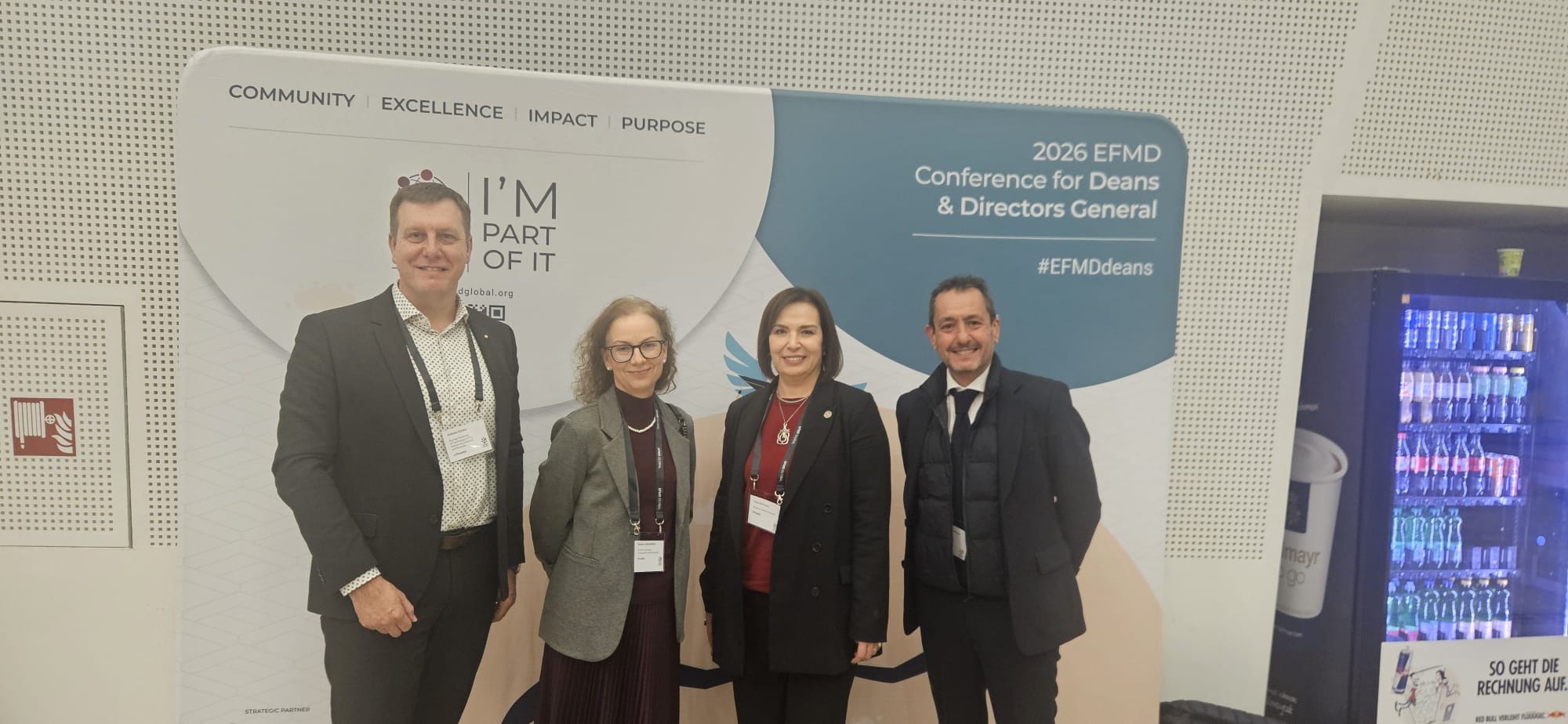
At the beginning of February, Yaryna Boychuk, CEO of the UCU Business School, took part in the EFMD Deans Conference 2026 — an international gathering of deans and leaders of business schools, and one of the key platforms for discussing the future of business education, partnerships, and the role of universities in responding to societal challenges.
This year’s conference program addressed a range of issues reflecting the outcomes of the international project EXIL (Sharing Experiences in Integrating Displaced Students). The institutional partners of the project include the European Foundation for Management Development (EFMD), University College Namur-Liège-Luxembourg (Belgium), Kaunas University of Technology (Lithuania), Kozminski University (Poland), New Bulgarian University (Bulgaria), Jean Moulin Lyon 3 University (France), and the Ukrainian Catholic University, represented in particular by the UCU Business School.
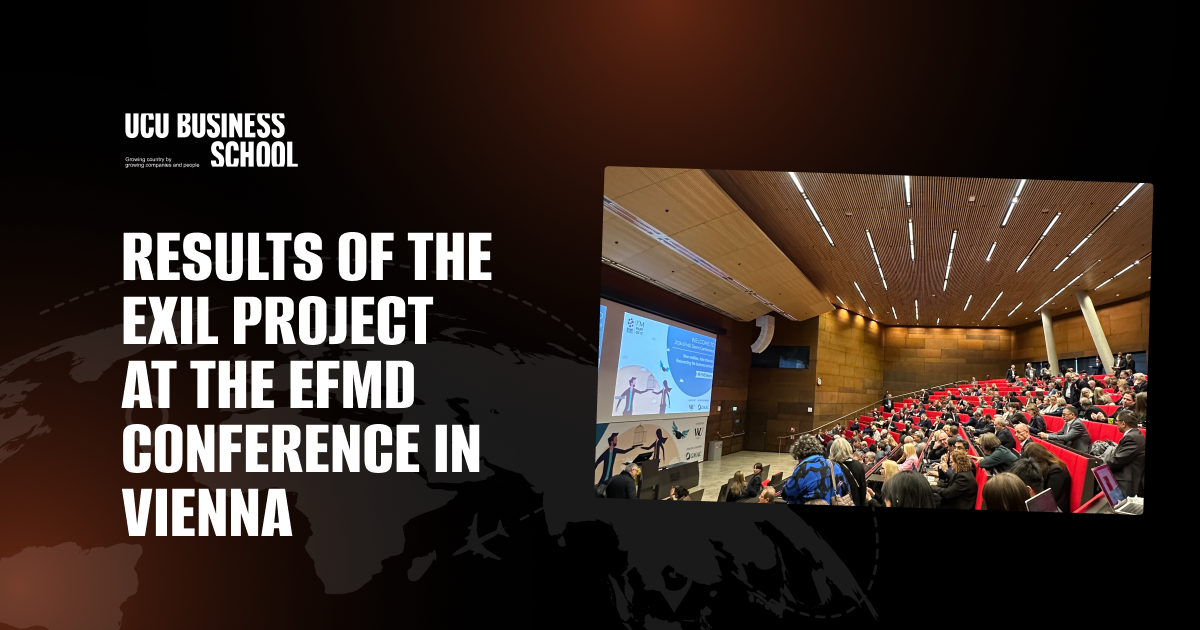 As part of the conference, a panel discussion titled “Integrating refugee students – The role of HEIs in times of crisis” took place. It was dedicated to summarizing the two-year international EXIL project, implemented with funding from the European Union under the Erasmus+ programme and aimed at fostering the development of inclusive educational policies in university environments.
From the Assessment of Needs to Strategic Dialogue
The EXIL project seeks to improve integration practices for displaced students in universities and business schools across the EU, as well as to strengthen understanding of the role of higher education institutions in times of humanitarian crises. It emerged as a response to the challenges faced by thousands of Ukrainian students following the outbreak of the full-scale war.
At the outset of the project, the UCU team played a leading role in developing the research methodology to assess the needs, expectations, and challenges of displaced students, as well as in collecting and analyzing data. The result of this work was an international analytical report that became the foundation for subsequent project activities and the formulation of recommendations for universities.
In addition, the UCU team contributed to the implementation of all key EXIL strands, including:
– studying best European practices in integrating displaced students;
– developing a guide for adapting pedagogical approaches to support academic achievement;
– creating recommendations for support and assistance systems aimed at fostering a safe and inclusive university environment;
– dissemination activities, including the EXIL podcast series.
 The Role of Business Schools in National Recovery
The above-mentioned panel discussion, in which Yaryna Boychuk also participated as a speaker, was moderated by Christophe Terras, Director of International Projects at EFMD Global. Other panelists included:
– Maciej Pietrzykowski, Associate Professor at Poznań University of Economics and Business (Poland);
– Kęstutis Duoba, Dean of the School of Economics and Business at Kaunas University of Technology (Lithuania).
In her remarks, Yaryna Boychuk focused on the role of business schools in national recovery during wartime, using the Ukrainian context as an example. She emphasized that working with displaced students is not merely a response to the crisis, but a long-term investment in human capital, leadership, and the future of recovery.
Yaryna Boychuk cited macroeconomic data underscoring the scale of the challenge:
“Since February 2022, Russian aggression has had a devastating impact on Ukraine’s economy and its population — from a sharp decline in GDP to the departure of nearly 6.2 million Ukrainians abroad. Estimates show that for GDP to grow by 2032, Ukraine will additionally need 8.6 million workers. Of these, 3.04 million will be high-skilled jobs.”
She stressed that it is precisely these young people — those who obtain high-quality education in European institutions — who should become the driving force behind recovery:
“We will need those young people who receive high-quality education at your institutions in particular, as well as gain professional experience in Europe or globally, and who will later return to become the leading academic and managerial force in projects aimed at rebuilding Ukraine’s economy, infrastructure, and society.”
The panel participants also discussed how higher education institutions can build resilience and prepare to receive displaced students in both the short and long term; which support practices are most effective; how to move from emergency responses to institutionalized support models at the level of universities, states, and regions; and why cooperation with networks, non-profit organizations, and initiatives such as EXIL is critically important.
“By educating Ukrainian students and preparing them for a complex yet highly impactful role in Ukraine’s recovery, universities generate measurable long-term impact. Having such individuals among your alumni will represent a significant strategic outcome for your institutions in the future.
Therefore, I anticipate that the findings of the EXIL research and the implementation of its recommendations will be supported by those institutions that embed long-term societal impact into their mission and strategy,” reflected Yaryna Boychuk, CEO of the UCU Business School.
EXIL as an Example of a Joint European Response
The EXIL project is coordinated by Poznań University of Economics and Business in partnership with EFMD Global and brings together universities from Ukraine, Poland, Belgium, Lithuania, Bulgaria, and France. Its outputs — analytical reports, practical guidelines, and multimedia formats — will be used to foster the development of more inclusive educational policies across the European Higher Education Area.
Yaryna Boychuk also emphasized the need to rethink the role of universities in a world of permanent crises:
“We are leading institutions at a time when crises overlap one another. Today’s wars have not only a military dimension, but also informational and cognitive ones. This means we must rethink universities and business schools and make our communities more resilient. It is precisely such research that creates the foundation for this rethinking for decades to come.”
The presentation of the EXIL results at the EFMD Deans Conference reaffirmed that the experience of Ukrainian universities and business schools is an important part of the broader European dialogue on the responsibility of higher education in times of crisis.