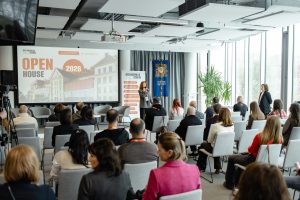







In February, the Ukrainian Catholic University Business School opened its doors for Open House 2026, which this year was combined with the celebration of the Business School’s 18th anniversary. Over ten days, from February 5 to 14, the university campus became a space for discussing key business challenges: artificial intelligence, labor shortages, customer experience, and veteran reintegration. In total, more than 300 people attended the Open House events.
All events were charitable. Nearly UAH 77,000 was raised for the Yaroslav Rushchyshyn Endowment Fund, which supports talented students from vulnerable groups in accessing education. The funds will provide scholarships for UCU students who cannot afford tuition.
Asymmetric Marketing: Why “Doing Things Right” No Longer Works
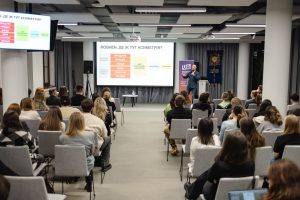
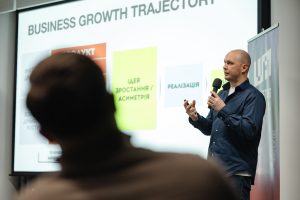
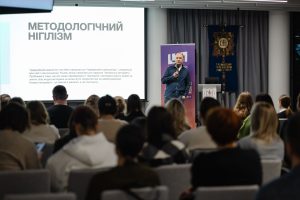
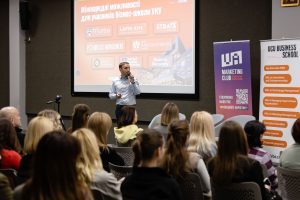
One of the key events kicking off Open House on February 5 was a charity meeting of the UA Marketing Club featuring Vladyslav Polonsky — founder and CEO of the creative agency Rockets. Growth R&D (ranked #2 in the 2025 “Agency of the Year” in Ukraine by VRK4).
Participants discussed the concept of asymmetric marketing — an approach that allows brands to break away from standard templates and frameworks, which often lose effectiveness in today’s world. Key points of his talk included:
- A world of identical solutions: Templates lead to brand uniformity, reducing practical value.
- Growth R&D: Research and experimentation should become not just part of processes, but a marketing philosophy.
- Points of asymmetric advantage: Finding non-standard paths for growth, where creativity is a tool for business effectiveness, not just decoration.
- Bold ideas: True creativity is measured not by the “strangeness” of an ad, but by its ability to create real competitive advantage.
The meeting brought together marketers and founders eager to replace “doing things right” with doing things effectively.


HR Challenges: Labor Shortages and New Expectations
During HR Friday, experts discussed the labor market situation. Key trends for 2026 include:
- Over 5 million Ukrainians are abroad, and about 700,000 are mobilized.
- Artificial intelligence is becoming a basic skill; by year-end, up to 70% of large companies plan to use it in recruiting.
- More than half of employers already recognize the importance of systemic mental health support for teams.
A key focus of Open House was veteran reintegration. The event presented the study “Challenges in Employing and Collaborating with Veterans”, conducted jointly with the Ukraine-Moldova American Enterprise Fund.
Participants emphasized that reintegration is not just an HR process, but a strategic value for companies. Major Ukrainian businesses, including Kyivstar, SoftServe, and OKKO, already implement adaptation programs, psychological support, and retraining for veterans.



Customer Experience as a Business Resilience Factor
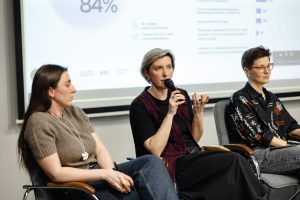
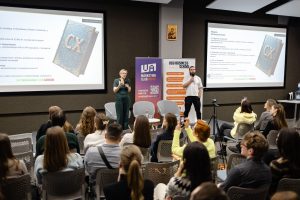
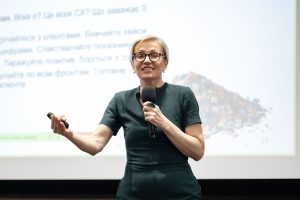
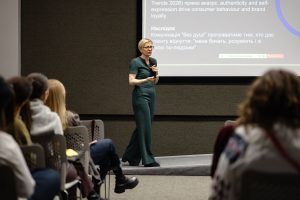
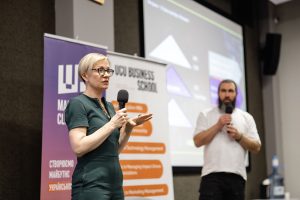
A separate discussion was dedicated to Customer Experience (CX) in today’s conditions. Experts — Olena Tsysar, Kyrylo Yezhov, and Ihor Blystiv — stressed that in the Ukrainian context, CX has ceased to be just an emotional positioning element of the brand and has become a practical mechanism for business survival.
Participants considered CX as a system influencing customer behavior — shaping habits, expectations, and trust. It spans the entire customer journey, from initial contact to the end of the relationship, and works effectively only when aligned with real customer needs and values.
Experts also emphasized that effective CX combines processes, data, and organizational culture, while relying on trust, humanity, and responsible use of technology.

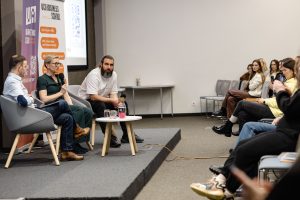
Human Judgment vs. Algorithms: Key Insights from Dave Snowden
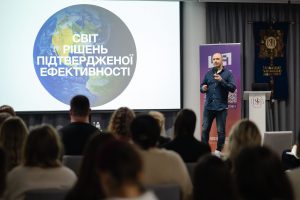
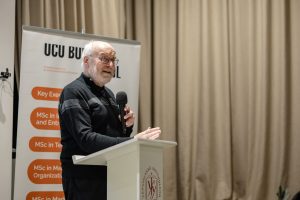
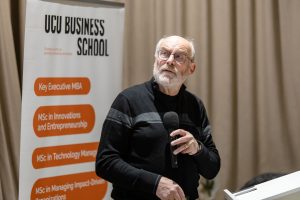
One of the central events of Open House was a lecture by Dave Snowden — founder of The Cynefin Company and creator of the Cynefin Framework — focused on understanding the role of AI in complex systems.
His main message: artificial intelligence should not be treated as equivalent to human thinking. AI is effective at pattern recognition and optimization but cannot achieve true understanding, judgment, or ethics.
Snowden emphasized that human intelligence is largely based on what cannot be formalized: sensory experience, context, and intuition — “compressed knowledge” that cannot be encoded in an algorithm. Humans know more than they can say and say more than they can write, whereas AI works only with text and tokens.
He proposed viewing intelligence as a combination of three components:
- Salience – the ability to see what matters amidst information noise;
- Sapience – the ability to model and predict;
- Sentience – sensitivity, morality, and empathy.
The last component, he noted, remains exclusively human. Snowden also warned against over-reliance on technology, which can erode judgment skills if humans delegate thinking to AI for prolonged periods. At the same time, he sees potential in combining artificial and collective human intelligence, where technology helps manage large information flows, but the final decisions are made by people.


Highlight Event: Leaders’ Perspectives on Decision-Making in Times of Uncertainty
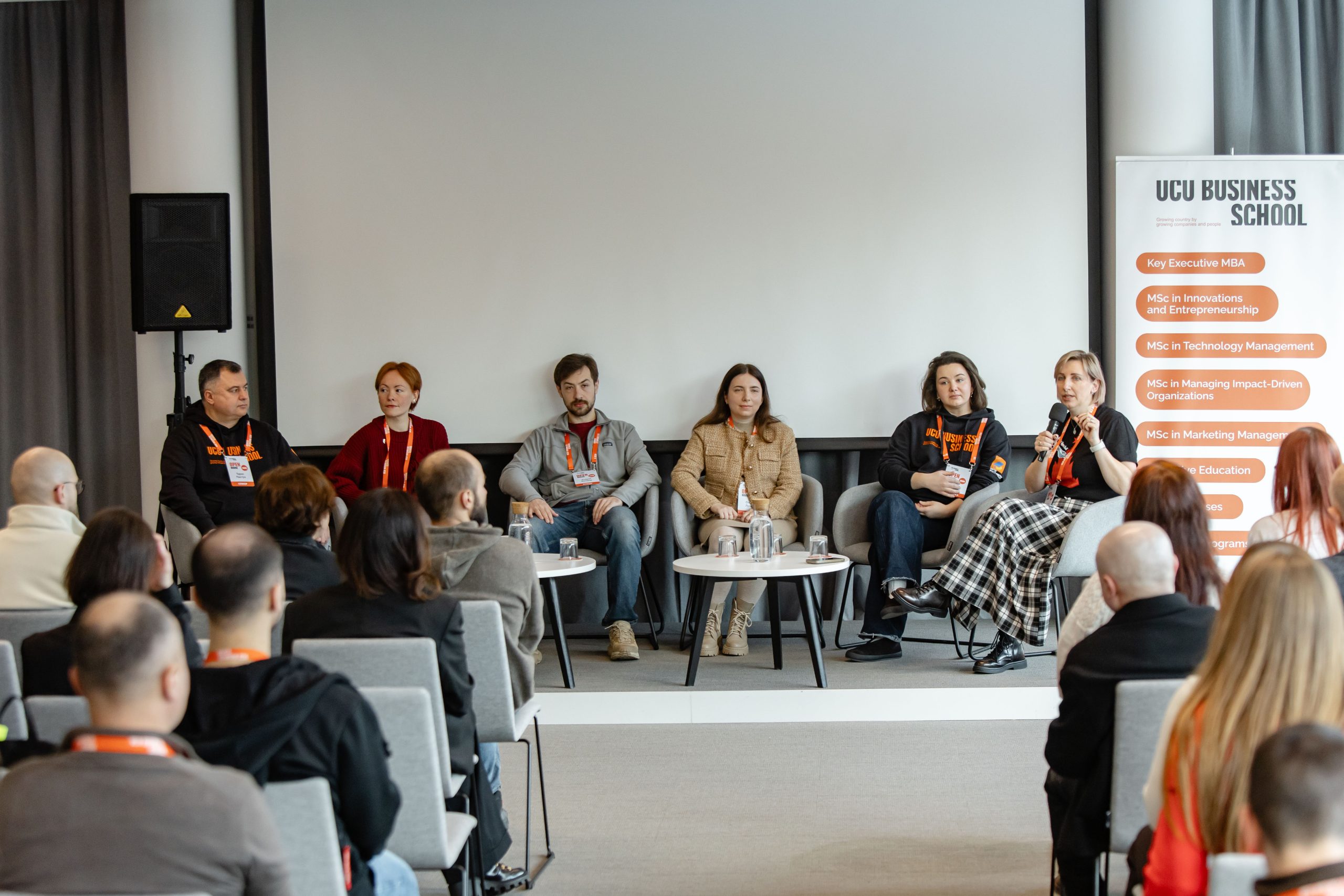
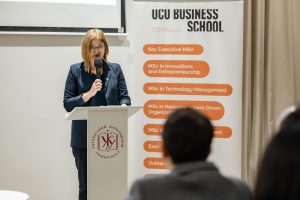
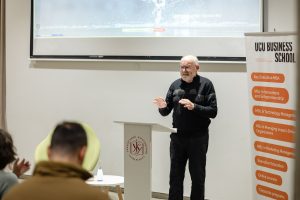
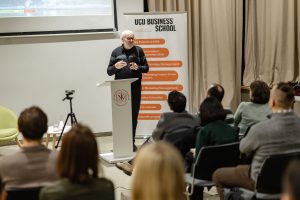
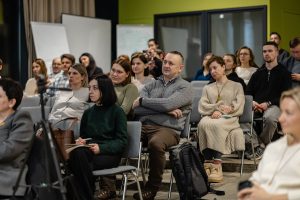
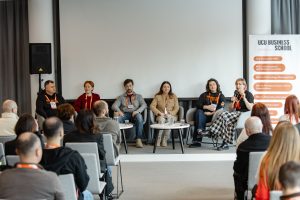
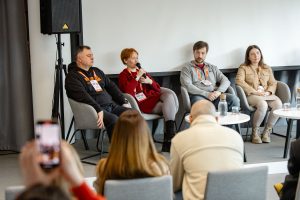
The main event of Open House 2026 took place on February 14 at UCU Business School and focused on the theme “Complex Decisions in an Era of Upheaval.” Dedicated to the School’s 18th anniversary, the event became a space for open dialogue among alumni, entrepreneurs, and executives on how to make strategic decisions in times of war and instability.
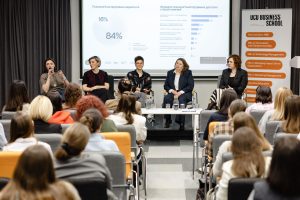
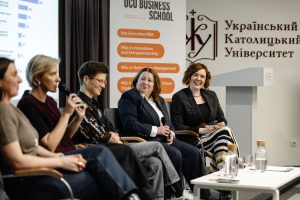
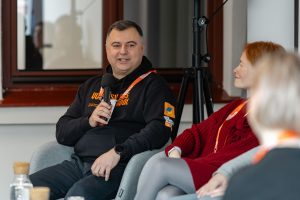
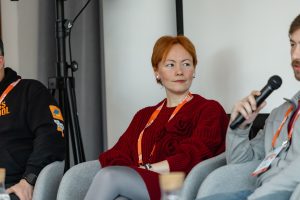
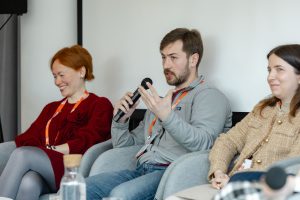
The central part of the day was a panel discussion moderated by the Founding Dean of UCU Business School, Sofiia Opatska. The discussion featured the School’s alumni who are now working in public administration, technology business, and entrepreneurship. Among the speakers were Taras Pastukh, Head of the Ternopil Regional Military Administration; Viktoriia Yaremchuk, Co-founder of the defence-tech company Farsight Vision; Andrii Bondar, CEO of R.flo; Olha Luchka, Development Director at Krona LLC; and Nataliia Kotliar, Founder of Co. Marketing Bureau and the DobroBuro Charitable Foundation.
Taras Pastukh, Head of the Ternopil Regional Military Administration and a war veteran, spoke about the complexity of transitioning from a successful business career to public service during wartime. He compared management education to “emerging from Plato’s cave” — an experience that enables one to see the broader context of a country’s development and to take responsibility not only for one’s own business, but also for societal decisions.
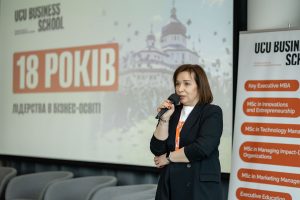
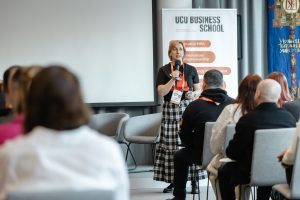

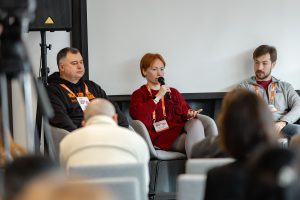
Viktoriia Yaremchuk, Co-founder of the defence-tech company Farsight Vision, shared her experience of building a technology business amid the near absence of a defense technology market in Ukraine. She emphasized the importance of overcoming an “inferiority complex” when engaging with international partners and of confidently positioning Ukrainian innovations on the global stage.
Andrii Bondar, CEO of R.flo, spoke about the company’s strategic decision to focus on industrial energy storage systems rather than short-term demand for household solutions. According to him, in times of crisis, the ability to think long-term becomes crucial — even when it runs counter to immediate market signals.
Olha Luchka, Development Director at Krona LLC, stressed the importance of focusing on core products and highlighted the manager’s role as a “translator” of the Ukrainian context for international partners. Nataliia Kotliar, Founder of Co. Marketing Bureau, shared her personal story of deciding to begin her studies during the war, emphasizing that education can become an inner pillar of support in times of loss and uncertainty.
Among the shared conclusions of the discussion was the idea that in an era of upheaval, true leadership means being ready to take responsibility for decisions with long-term consequences. Education and professional communities, the speakers noted, become critically important in supporting executives who often operate in conditions of informational isolation.
Open House 2026 once again reaffirmed the role of UCU Business School as a platform for dialogue between business, government, and society — and as an environment where leaders capable of acting systemically and responsibly amid constant change are shaped.
We thank all our guests and participants who shared their knowledge and experience and joined us in seeking new meaning in an era of transformation.
In February 2026, UCU Business School at the Ukrainian Catholic University marked its 18th anniversary. Over this time, it has become one of the leading business education institutions in Ukraine, working with executives, entrepreneurs, and change leaders both during periods of economic growth and amid the challenges of a full-scale war.