






At a time when traditional management models no longer work, Ukrainian entrepreneurs are searching for new reference points — balancing responsibility to the country, the pressure of global uncertainty, and the need to build markets “from scratch.” These very issues were at the heart of the event “Complex Decisions in an Era of Shifts” held at the UCU Business School, which brought together entrepreneurs, executives, and alumni to discuss how to make decisions that shape the future of business and society.
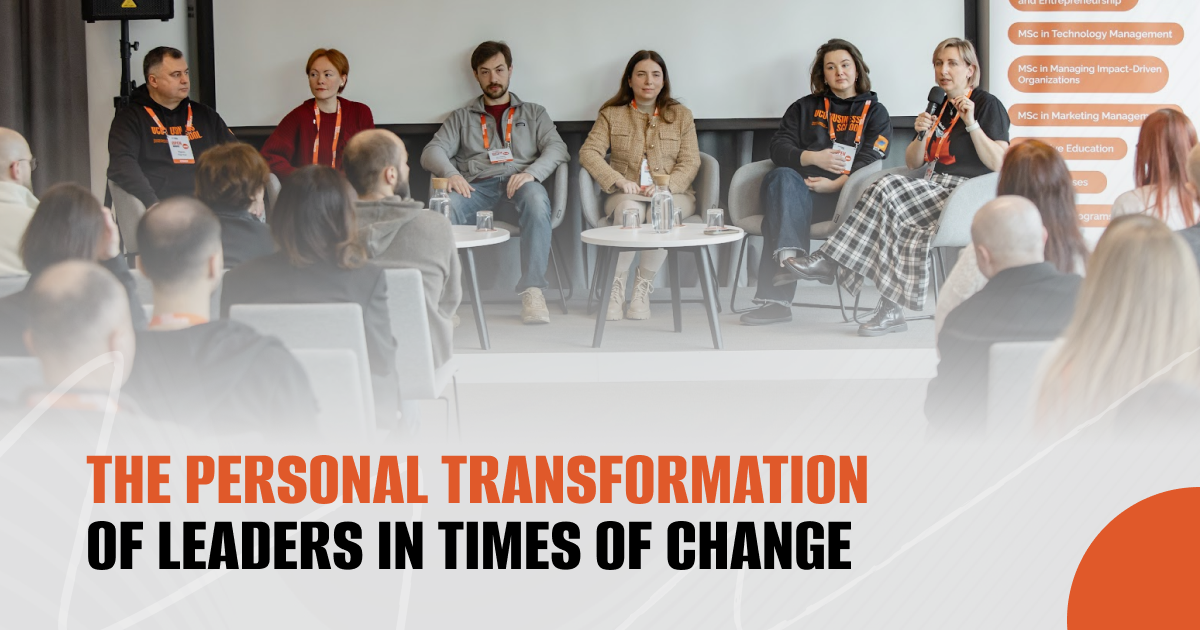
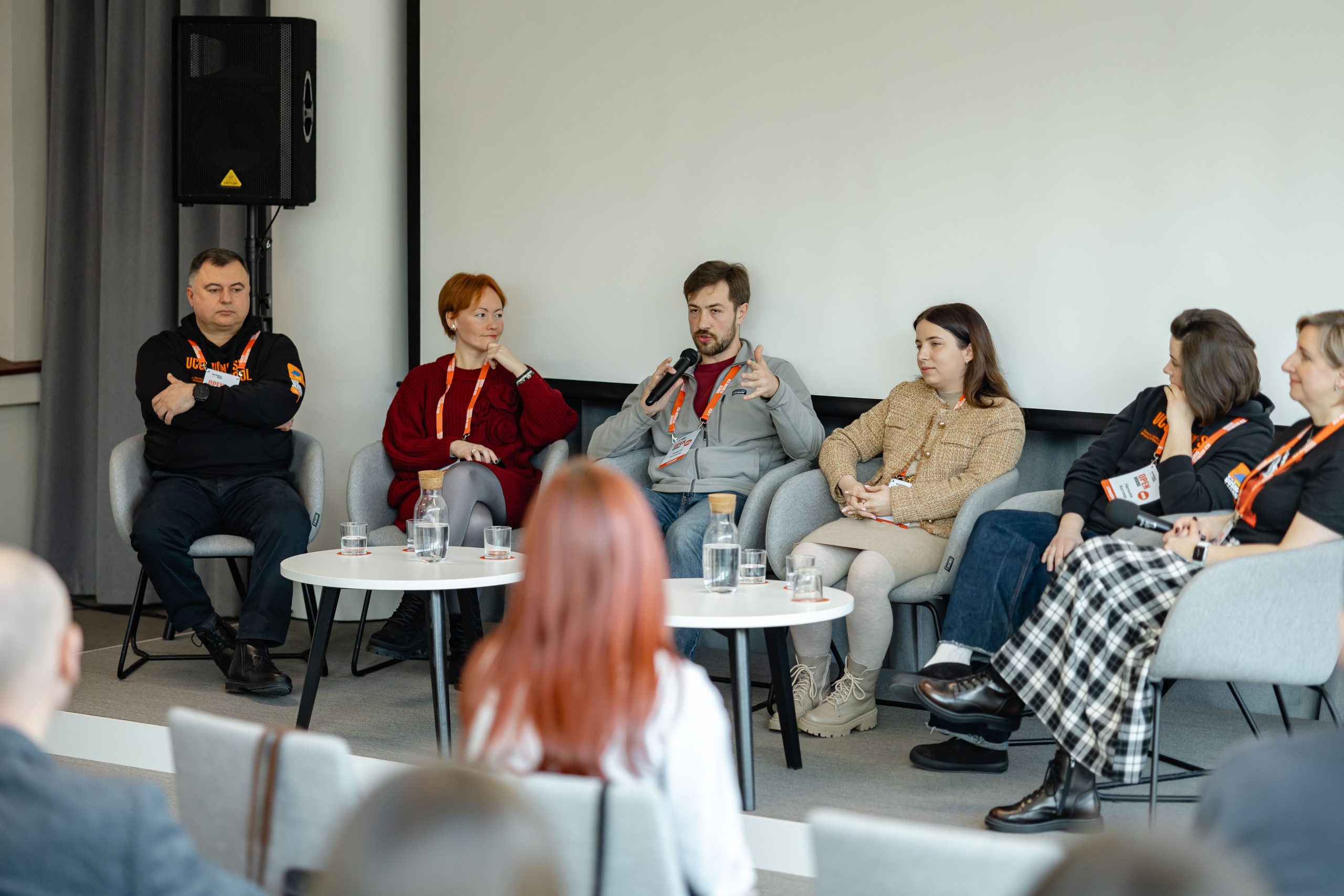
On Saturday, February 14, the UCU Business School hosted the culminating event of Open House 2026 – “Complex Decisions in an Era of Shifts.” The program featured a public discussion with distinguished speakers, including Head of the Ternopil Regional Military Administration and Key Executive MBA alumnus Taras Pastukh; Co-founder of the defence-tech company Farsight Vision Viktoriia Yaremchuk; CEO of R.flo Andrii Bondar; Development Director at Krona LLC Olha Luchka; and Founder of Co. Marketing Bureau and the charity foundation “DobroBuro” Nataliia Kotliar. The event marked the 18th anniversary of UCU Business School and was moderated by its Founding Dean, Sofiia Opatska.
Global Mission and Personal Responsibility
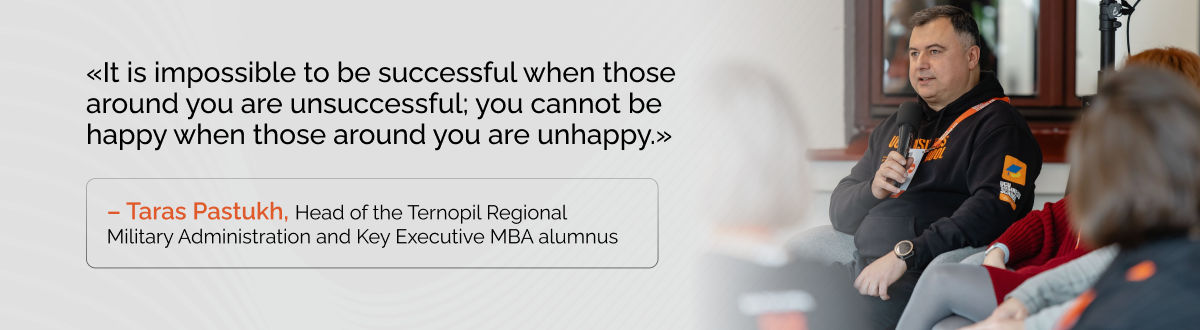
Taras Pastukh shared his experience of transitioning from pursuing business interests to serving the country. In his view, individual success is impossible without the well-being of the community:
“It is impossible to be successful when those around you are unsuccessful; you cannot be happy when those around you are unhappy. To achieve something great, you will have to give up what you strongly desire right now and set it aside for something greater — for your city, your region, your country.”
He drew a parallel with the transformation of Ukraine’s Armed Forces, noting that the country’s survival required abandoning outdated doctrines: “If our army had continued fighting like a small Soviet army against a large one, we would have lost. The Armed Forces transformed themselves and began writing new rules of the game on the battlefield.”
To illustrate the complexity of strategic choice, Pastukh recalled the academic simulation Markstrat, where his group risked successful products of the moment for the sake of a future breakthrough: “Sometimes what helps and drives us today is not enough to break through. We abandoned everything and invested in one story we believed was promising — and that allowed us to break into leadership that no one could catch up with.”
Building Markets in a “Grey Zone”
Viktoriia Yaremchuk, Co-founder of Farsight Vision, which recently raised $7.2 million in investment, captured particular attention. A graduate of the MSc in Technology Management program, she described building a technology business during wartime as “a shift within shifts.”
“We faced the problem that it’s not just that we don’t know how to build within an existing environment — the environment itself does not exist, and you have to build the market yourself. During a full-scale war, innovators find themselves in a specific grey zone where they must create the entire infrastructure and ecosystem around them.”
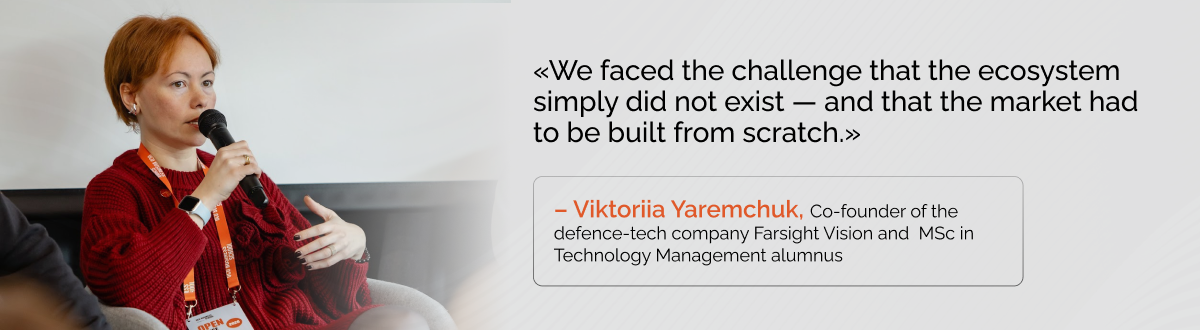
She also addressed the lingering “inferiority complex” that hinders Ukrainian companies internationally. Even with unique battlefield experience, businesses often perceive Western partners as inherently “superior.” “We primarily position ourselves as those who receive and listen, rather than those who share experience gained through immense losses. We have incredibly valuable experience, but we do not know how to ‘package’ and communicate it. It is time for us to learn how to build long-term commercial relationships with NATO countries as equals—not simply be happy that we were invited to a meeting.”
She emphasized the importance of business hygiene: timely email responses and honoring contracts often build trust more effectively than the product itself. Among the key virtues she gained during her studies at UCU Business School, Viktoriia highlighted humility—the ability to accept great uncertainty without losing purpose and motivation.
The Leader’s Ego and Team Effectiveness
Andrii Bondar, CEO of R.flo and graduate of the MSc in Innovations and Entrepreneurship program, shared his transformation from technician to executive and underscored the importance of team unity. His journey reflects the difficult choice between a personal passion for science and the demands of business.
“I am someone who truly loves chemistry. But in 2021–2022, I had to forget about it and deal with all this ‘underdeveloped business’: raising funds, searching for markets and clients, building a team. It’s a daily decision—to give someone else the authority to do what you loved most, and not interfere, not think every day that someone is doing it wrong.”
R.flo’s strategic resilience became evident after 2022, when the energy crisis created enormous demand for household batteries. Despite the temptation of the “hot” market, Bondar chose to remain in the niche of complex industrial solutions:
“At that time, there was huge enthusiasm to buy in containers and resell, because we understand this market. But we rejected that idea. We hold on to the fact that we must build industrial-scale systems that will stand in fields near cities and villages, balancing the local power grid and ensuring high-quality electricity.”
Focus and “Different Optics”
Olha Luchka, currently completing the MSc in Managing Impact-Driven Organizations (MIDO), brought a systemic management perspective shaped by working in two very different environments: a family-owned food business in the Ternopil region and the large international engineering group Ginger Group, headquartered in Paris.
Speaking about the family business, she emphasized the importance of curbing managerial ambition for the sake of team stability:
“In our case, managerial ego pushed us to add new types of processing and expand production. But we realized that under current conditions, it is better to focus on key product positions. This decision allowed us to improve the processes we perform best, considering the real capacity of our team in this challenging time.”
Working with French partners on infrastructure projects in Ukraine, Olha encountered the challenge of adapting foreign business models to Ukrainian realities. She articulated an important management formula about the “optics” of perception.
“Our partners abroad and beneficiaries here in Ukraine have very different optics and perceive the same things completely differently. One of the key roles of a manager is to explain the situation through each party’s own optics and bring it to a shared solution.”
She also reflected on her learning experience at UCU Business School, noting that genuine growth occurs through discomfort and openness to others’ experiences:
“It is important to fully trust the experience happening to you during your studies and to remain open to the experiences of your peers, because the group is also a powerful source of learning. Through asking the right questions—to yourself, to classmates, and to professors—you personally discover a path that is dynamic and adaptive in this era of shifts.”
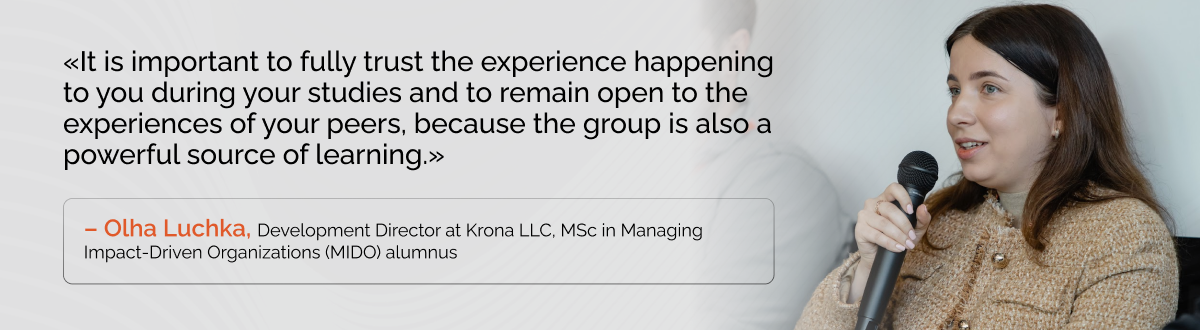
Regarding European integration, Olha stressed that EU standards are not merely bureaucratic requirements, but instruments of development:
“Issues related to quality and product safety management systematically develop our business — not just the product itself. The sooner each business recognizes these opportunities and begins working on regulatory and marketing requirements, the greater our chances of competing successfully in the future.”
Inner Grounding as a Criterion of Truth
Nataliia Kotliar, a graduate of the MSc in Marketing Management program, shifted the focus to a deeply personal understanding of leadership. She suggested that a complex decision is no longer about certainty in the outcome, but about responsibility when “the ground beneath your feet is moving.”
She shared two defining challenges from her time in the program:
- The decision to begin her studies. Despite the war, having a small child in her arms, and managing multiple projects, she chose honesty with herself. Her inner insight was:
“We do not choose the time we live in, but we can clearly choose who to be in that time.” - The decision to stay in the program after losing her mother. When exhaustion and grief made her want to give up, she asked herself:
“Is this building me? Will I be proud of myself when I complete this path?”
She emphasized:
“It is important not to make decisions from a place of fatigue or heaviness, because fatigue always leads to escape.”
Nataliia articulated a universal criterion for a “right” decision:
“Any decision, if it does not internally create a greater sense of grounding, may have been made incorrectly. And if it strengthens your inner sense of stability, then it is undoubtedly the right one.”
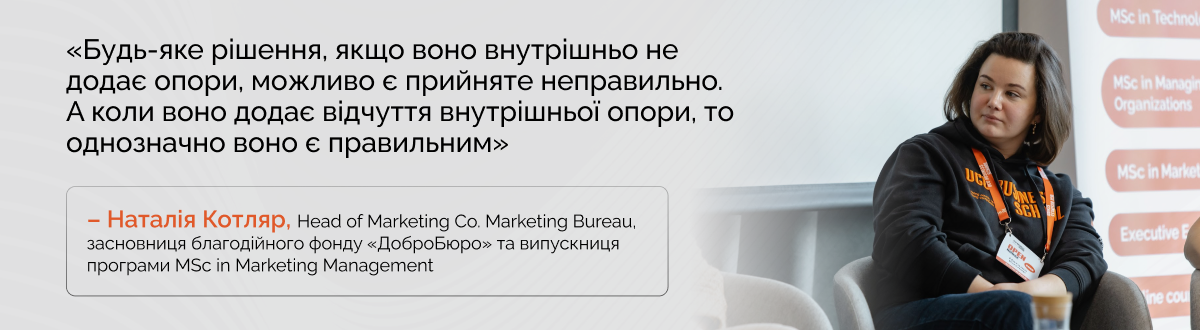
Concluding the official part of the event, Sofiia Opatska reminded participants that UCU Business School is an environment where people do not construct an “ideal image,” but begin to build trust. Throughout the day, participants also explored the School’s master’s programs and contributed to the Yaroslav Rushchyshyn Scholarship Fund, investing in the education of those who will make complex decisions tomorrow.
Learn more about the master’s programs at UCU Business School and other opportunities for learning and professional development.