






In today’s managerial context, ethics is no longer an abstract, detached theory. It has become the foundation of organizational culture, embedded in everyday practices where decisions are made in the space between legal requirements and personal convictions.
This article explores the course “Organizational Ethics,” part of the Master’s program “Managing Impact-Driven Organizations” at UCU Business School. Through the lens of instructor Nataliia Yakymets’ expertise and students’ reflections on the power of conscious managerial choice, it presents ethics as a form of “navigation” for modern leaders.
 Ethical Leadership: The Perspective of Nataliia Yakymets
The course is taught by PhD Nataliia Yakymets, a lecturer in business ethics and ethical leadership. She approaches organizational ethics as a leader’s “internal compass” — one that guides decision-making in situations where no ready-made instructions exist.
Yakymets emphasizes that a leader’s responsibility extends beyond numbers and strategy. It includes an awareness of how seemingly minor or non-obvious actions can shape a company’s reputation. Ethical responsibility, she notes, emerges precisely in ambiguous contexts where values come into conflict.
Explaining the nature of the discipline, she says:
“By ethics, we mean the beliefs and practices that an organization embodies — those according to which it operates, and which lie in the realm between legislation and personal convictions. In an organizational context, individual beliefs alone are insufficient, and legislation does not fully cover all aspects of activity. That is why ethical responsibility arises in complex situations where values compete, and decisions are not simply between good and bad, but between growth, profit, and preserving the well-being of the team.”
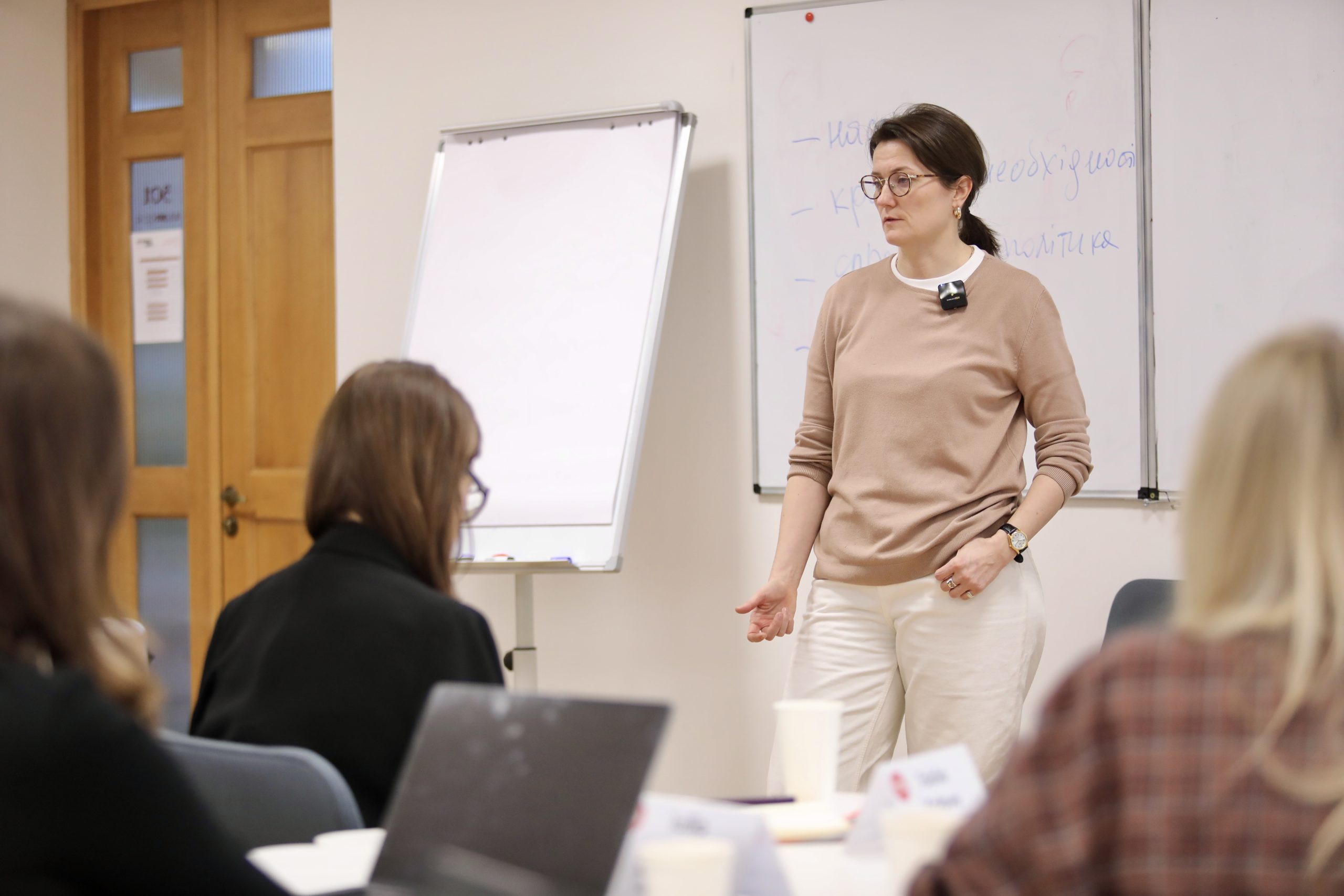 Alongside introducing participants to approaches and tools for ethical decision-making, Nataliia Yakymets highlights the importance of analyzing Ukrainian wartime experience as a unique contribution to global management science:
“It is crucial for us to collect the data and experiences our managers are going through — and these are not always stories of great success, but often stories of dramatic struggle. We must document them, develop new case studies, and generate insights that will be needed in the future within the global system of ethics and security. This is a long journey from practice to theory, where we teach students, and students teach us by bringing in data ‘from the field.”
Moral Choice in Management: Insights from Guest Speaker Iryna Podoliak
A key insight for managers facing difficult choices is that true responsibility begins beyond formal protocols — where a leader is left alone with their own conscience.
To explore the practical dimension of ethics, the course welcomed Iryna Podoliak, former Deputy Minister of Culture and Development Director at NGL Media. Her leadership journey in both government and media provided students with a powerful example of how inner moral principles shape professional resilience.
Podoliak shared real-life situations in which she faced complex dilemmas. Her experience shows that ethical choices rarely arise in clear-cut scenarios; rather, they emerge where decisions carry a high cost — emotional, professional, or material. In such contexts, it is essential not to reduce management to formal procedures, but to preserve humanity and respect for those affected by decisions — even when this requires additional effort and inner resources.

 Ethics is also reflected in the ability to decline attractive opportunities if they contradict core values. The key reference point in such decisions is not only short-term benefit, but also a question of inner integrity: does this choice allow me to remain aligned with my principles? Not only the outcome matters, but also the way it is achieved and the human dimension of its consequences.
Summarizing her experience of decision-making in uncertainty, Podoliak notes:
“Every situation has its own criteria, and ultimately, all of them reside within us.”
Student Insights on the Role of Ethics in Business
Students of the Master’s program “Managing Impact-Driven Organizations” shared key takeaways from the course that reshape how they view ethics in leadership:
Ethics as a tool of agency
Integration advisor Olha Honcharova highlights that understanding one’s responsibility for choice gives a manager real power over their life:
“When you realize it is your choice, it gives you power. It becomes easier to understand the situation you are in and act accordingly, instead of feeling like a victim of circumstances or simply going with the flow.”
 Ethics as a navigation system
For HR professional Olha Piliuta, the central insight was the role of ethics in everyday decision-making:
“Ethics is like navigation. It is important to constantly reflect on yourself as a leader: what principles guide me, and what ethical dilemmas I face, so that I can manage them and make the right decisions within the company.”
 The value of synergy in complex issues
Mariia Savchenko, Development Director at YouControl, emphasizes the importance of collective reflection on topics without clear answers:
“I truly value the synergy within a group, especially when discussing topics like ethics or culture, where there are no unequivocally correct answers. It is challenging to work with questions where the mind seeks quick labels, but this kind of collaboration helps reveal multiple perspectives.”
Ethics in Ukraine: A System in Transformation
Organizational ethics in Ukraine is a system continuously reshaped by the challenges of war. As Iryna Podoliak concludes, “The highest task for a leader is the aspiration to ensure that ‘our moral compass aligns with the ethical system we seek to build in this country — one that will be ours and that, we hope, will emerge after the victory.’”

This course, developed and taught by Nataliia Yakymets within the Master’s program “Managing Impact-Driven Organizations” at UCU Business School, is designed to support managers on their path toward conscious leadership. It helps them harness the potential of ethical dilemmas for responsible development and for strengthening the resilience of their organizations.