






In today’s management world, the line between stability and chaos is blurring, requiring leaders to rethink the very nature of leadership. Today, this concept extends far beyond formal positions, encompassing organizational ethics, strategic vision, and the ability to make decisions in conditions of complete uncertainty.
As part of the Master’s program in Managing Impact-Driven Organizations at the UCU Business School, a leadership course was held that focused on interactive engagement, teamwork, and collective reflection on real-world case studies. Course instructor Andriy Rozhdestvenskyy and invited guests — Sofiya Opatska, Founding Dean of UCU Business School and Vice-Rector for Strategic Development at Ukrainian Catholic University, and attorney and veteran Masi Nayem — shared their perspectives on leadership competencies and ethical guidelines with the students.
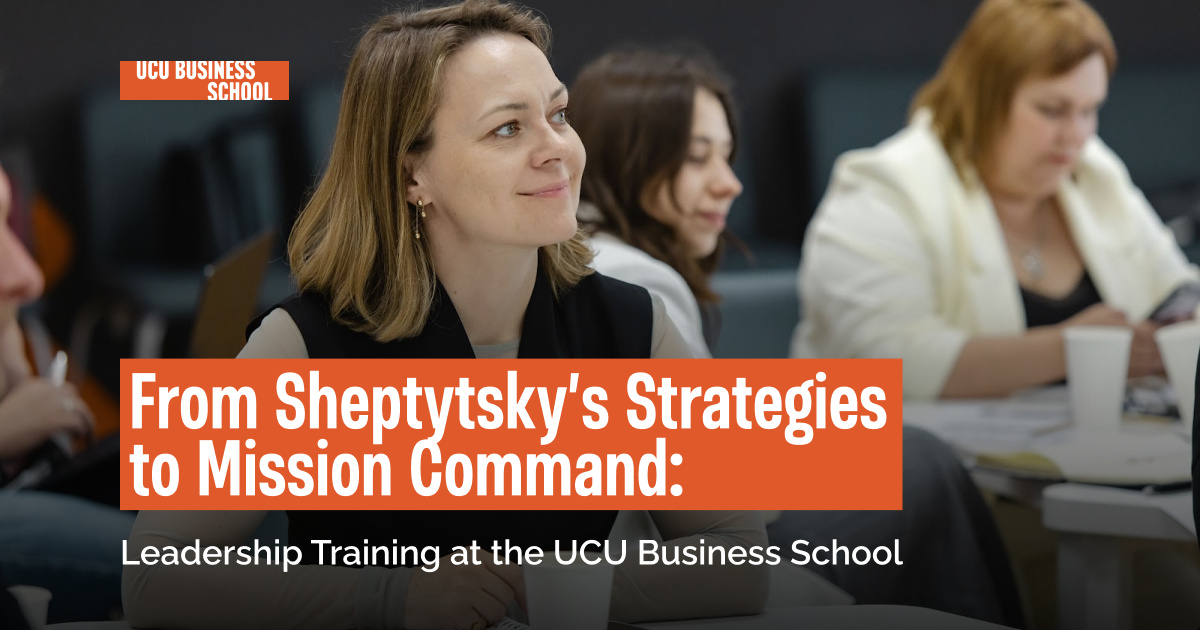 Andriy Rozhdestvenskyy: “A leader is a steward of the energy of change.”
The training module with Andriy Rozhdestvenskyy began as an open discussion, where each student could share their own perspective on the environment in which Ukrainian businesses operate today. The instructor himself acted as a moderator, helping the audience distinguish between different types of management challenges. Together with the group, they analyzed case studies — from the 2022 fuel crisis to the challenges of implementing artificial intelligence — to demonstrate how a leader’s role changes depending on the circumstances.
For Andriy Rozhdestvenskyy, a leader’s primary task is to correctly identify the environment, since complex challenges cannot be solved using old technical methods. He emphasizes that leadership style should depend on the type of challenge: moderate, critical, or complex (adaptive):
“Moderate situations make up 90% of our daily lives and require only rational calculation. Adaptive challenges, however, arise where no ready expertise yet exists, so the leader’s task is to correctly diagnose the context so as not to attempt to solve a complex problem using outdated methods.”
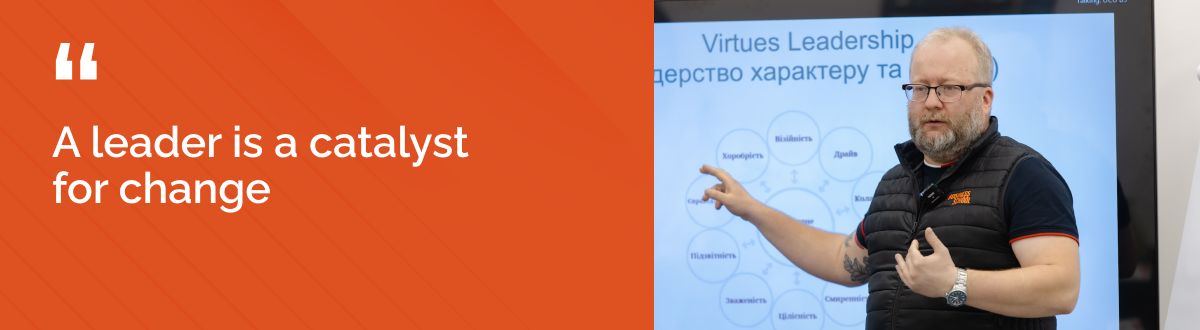 When discussing management methods, Andriy Rozhdestvenskyy noted that in chaotic conditions, control must give way to trust and competence. He introduced students to the principle of Mission Command, which allows for flexibility through the decentralization of authority.
“This is intentional management, where you decentralize authority as much as possible and empower local teams to make decisions on their own. The leader establishes a shared understanding of why and what needs to be done, while allowing freedom in choosing how to execute it.”
An important prerequisite for such autonomy is a highly professional team capable of acting independently. Andriy Rozhdestvenskyy views competence as the foundation for creative problem-solving. Only the combination of high qualifications with an atmosphere of trust allows a team to act autonomously, without fear of making mistakes and taking responsibility for finding new solutions
“Only highly competent people are allowed to improvise, because only professionals are capable of successful group improvisation. If mistakes are not tolerated in your team, initiative is completely stifled, leading to systemic burnout.”
Ultimately, the role of a leader is not to have all the answers, but to channel the team’s energy in the right direction. This requires honesty with oneself and others:
“True leadership is the ability to present reality without illusions, no matter how difficult it may be. A leader is a steward of the energy of change who may not have all the answers, but knows how to ask the right questions.”
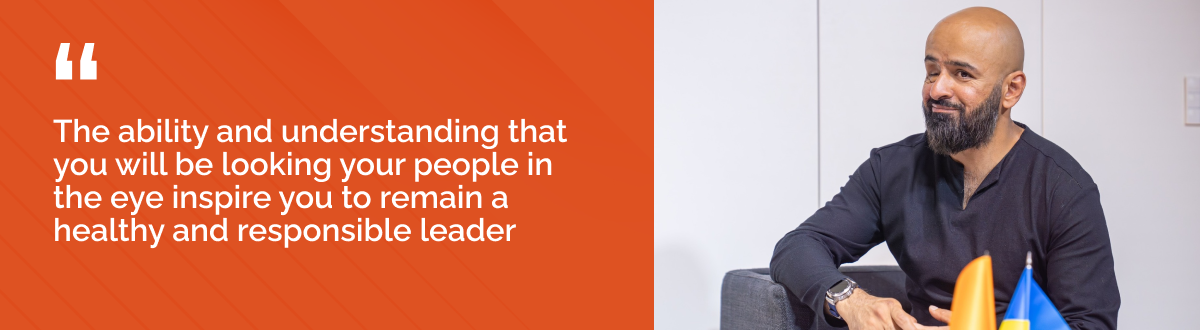 Masi Nayyem on Ethics, Responsibility, and Humility
The discussion with Masi Nayem turned into a profound conversation about a leader’s inner strength, during which students actively engaged with questions of justice and personal resilience. Masi shared his experiences while answering questions from the audience, ranging from the reintegration of veterans to the balance between trust and control in leadership. He emphasized that in civilian life, leadership is first and foremost a conscious choice, which automatically places the burden of responsibility for the consequences on the individual. He notes that in civilian life, this role is voluntary but uncompromising:
“I made the choice to go to war, and this is my responsibility, which I must carry forward without blaming circumstances or other people. True leadership resilience is manifested in the ability to remain composed in critical situations and to act out of an incredible love for people. The ability and understanding that you will look your people in the eye provides the inspiration to remain a healthy and responsible leader.”
Masi’s story about organizational ethics resonated particularly strongly with the audience. He cited an example from his own company, where the foundation of values proved more important than operational processes.
“We demonstrated our zero-tolerance policy toward corruption in practice by firing a partner three hours after he attempted to offer a bribe. A leader must convey their values to colleagues, and if ethical violations occur within the company, it means the leader has not fully fulfilled their role. It’s not enough to write a policy on paper — it’s important to stay in touch with yourself and be guided by inner harmony.”
Organizational ethics serve as a guiding principle that enables a company to maintain integrity during the toughest times. To maintain inner balance, a leader must learn to manage their own ego, thereby becoming less vulnerable to external attacks. Masi compares this to a “balloon” that needs to be deflated in time:
“The more inflated the balloon of our ego is, the more pricks from external reality it takes upon itself. If, however, you deflate the balloon through the practice of humility, you remove yourself from the line of fire, becoming less vulnerable to criticism.”
A leader’s inner resilience, according to Nayem, is based on a deep understanding of human nature and the ability to find peace within oneself. This allows one to lead a team even in a state of extreme fatigue:
“I really hope you find peace within yourselves, because that is our main task right now. If we find this peace, everything else will be a little easier, even among tired and uncooperative people.”
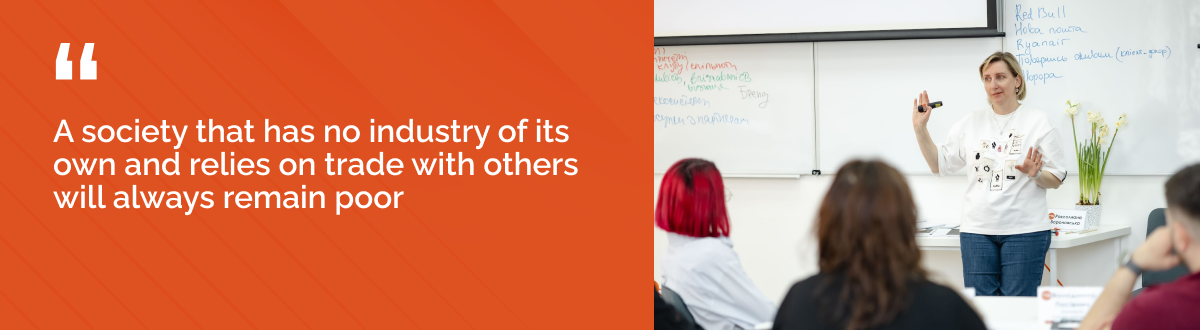 Sofiya Opatska on the Andrey Sheptytskyy Case Study and Ecosystem Leadership
The session with Sofiya Opatska was structured as a group case study analysis. Under her guidance, students explored how Metropolitan Andrey Sheptytskyy served as a champion for the creation of a middle class and Ukrainian identity. Participants discussed how, in the face of complete chaos, a system emerged that endured for decades.
Sofiya Opatska explored the idea of “how to build one’s own home” through the development of an economic agency.
“One of Metropolitan Sheptytskyy’s messages was that a society without its own industry, one that trades in others’ goods, will always remain poor. He encouraged Ukrainians to cooperate as partners, a partnership that benefits all participants. In modern business terms, we would explain that the closer you are to the consumer in the value chain, the more autonomous you are.”
The discussion centered on the rescue of the Land Mortgage Bank in 1927–1928. The main conclusion students reach when analyzing this situation is that, in the face of a critical challenge, a leader must act not merely as a manager putting out fires, but as a builder of an ecosystem. Sheptytskyy demonstrated how reputation and social capital enable the realization of seemingly impossible plans: by saving the bank, he simultaneously created a source of sustainable development for education and culture.
This approach underscores the importance of a long-term perspective, in which business does not exist in isolation but rather strengthens broader social institutions. It was precisely this strategy that enabled Ukrainian organizations to survive even under the pressure of repression. As Sofiya Opatska notes:
“Sheptytskyy thought in terms of decades, creating a structure that provided long-term mortgage loans. He understood that for a person to be able to influence their own destiny, they must, as the quote states: ‘Help the poor not just from day to day, but help them as much as you can so that they may rise from their misfortune and stand on their own two feet. Give the poor the ability to earn — teach them, show them how they can improve their own lives.”
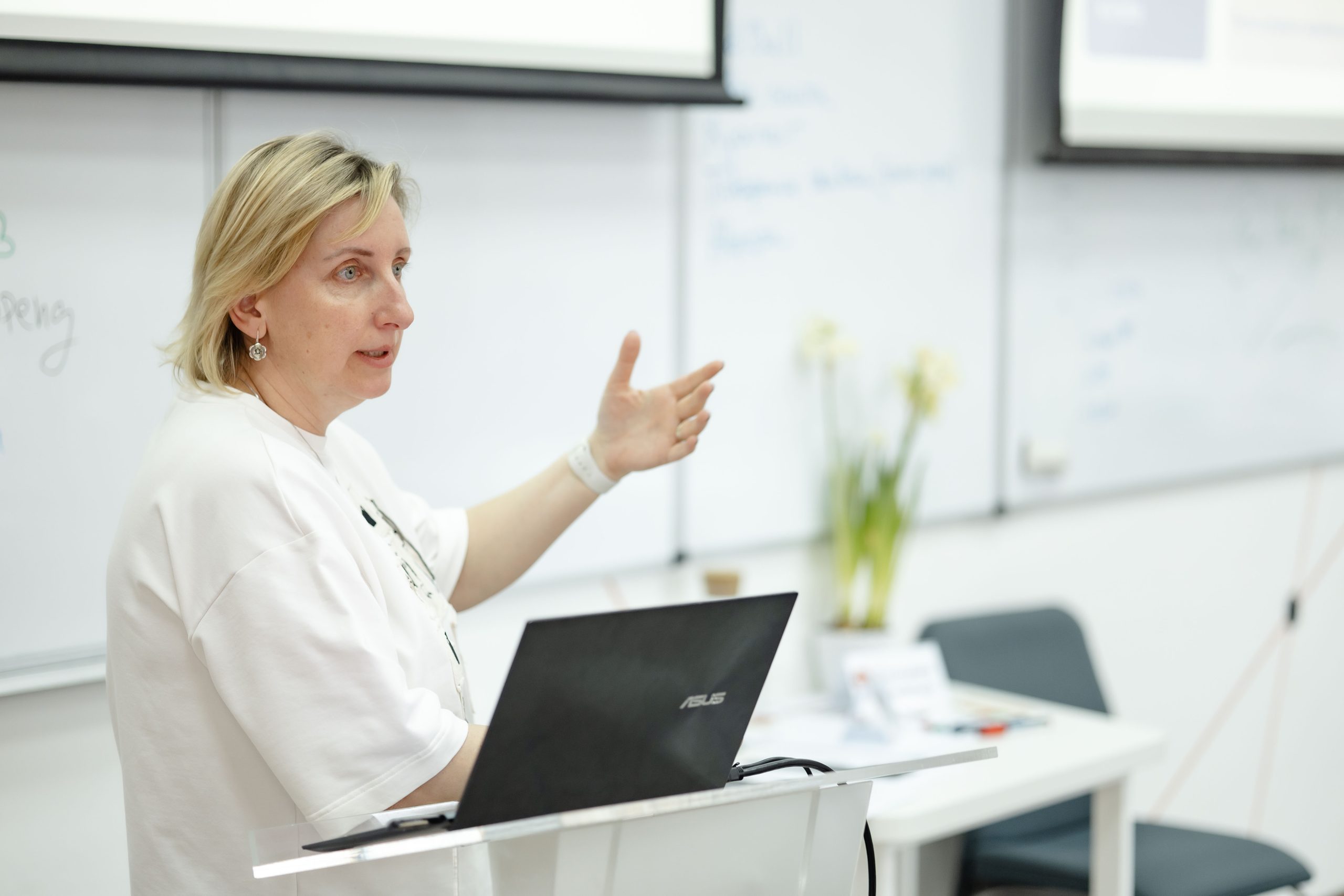 Behind this “architecture” lies the Metropolitan’s deeply principled leadership. It is precisely this integrated approach — where a leader drives progress for the entire system, not just a single unit — that defines Sheptytskyy’s legacy as an ecosystem leader.
Become a leader who drives change
Today’s challenges require managers to demonstrate maturity and a readiness for transformation. The Master’s program in Managing Impact-Driven Organizations at the UCU Business School is designed for those who seek to lead systematically, grounded in values and committed to amplifying positive impact on society.