







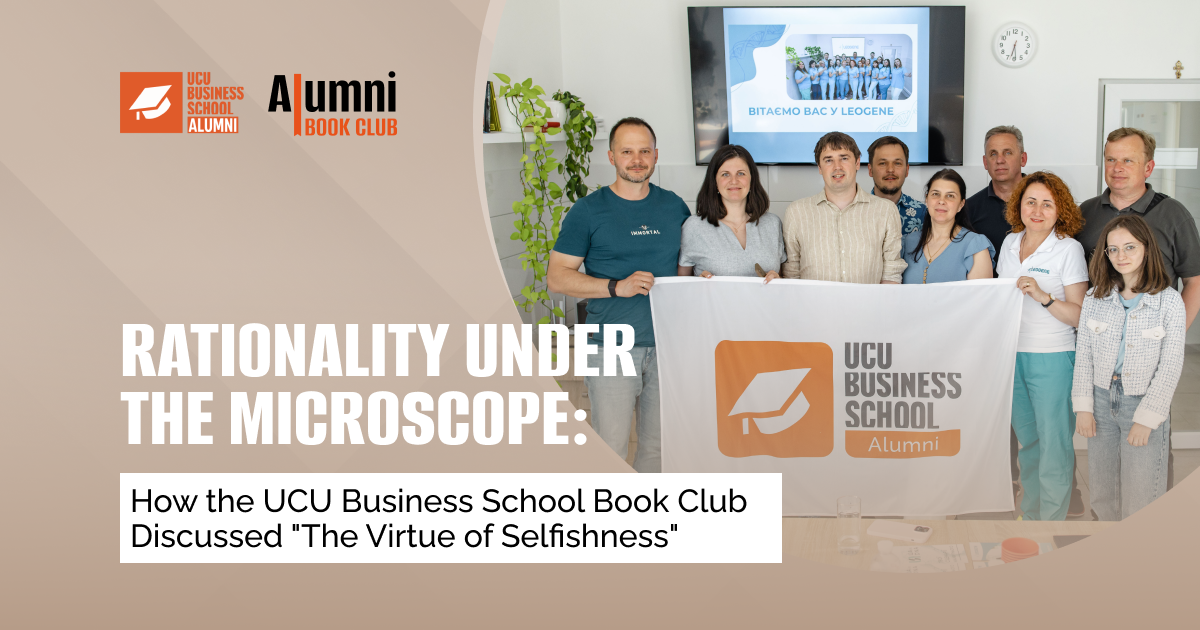
Following a long-standing tradition, the UCU Business School Book Club meets at alumni-run companies or organizations. This allows the community not only to exchange views on what they’ve read but also to gain a deeper understanding of the Ukrainian business ecosystem through their peers’ experiences.
The Book Club for alumni and participants in the UCU Business School’s master’s programs gathered for its regular meeting to discuss one of the most provocative works of the 20th century—Ayn Rand’s collection of essays, “The Virtue of Selfishness”. This time, the discussion took place at the “LeoGen” Medical and Genetic Research Center, co-founded by Halyna Makukh, an alumna of the Key Executive MBA 2025.
 The Genetics of Business and the Philosophy of Choice
Halyna Makukh, co-founder of the center, spoke about “LeoGen’s” national B2B model, which brings together doctors and laboratories across Ukraine to advance preventive medicine. However, the real discussion centered on whether Rand’s concept of “rational egoism” can be applied to real life and business.
Geneticist Halyna Makukh shared her experience of shifting her perspective, noting that the strict “rationality” Rand advocates doesn’t always work in a profession that involves people’s lives.
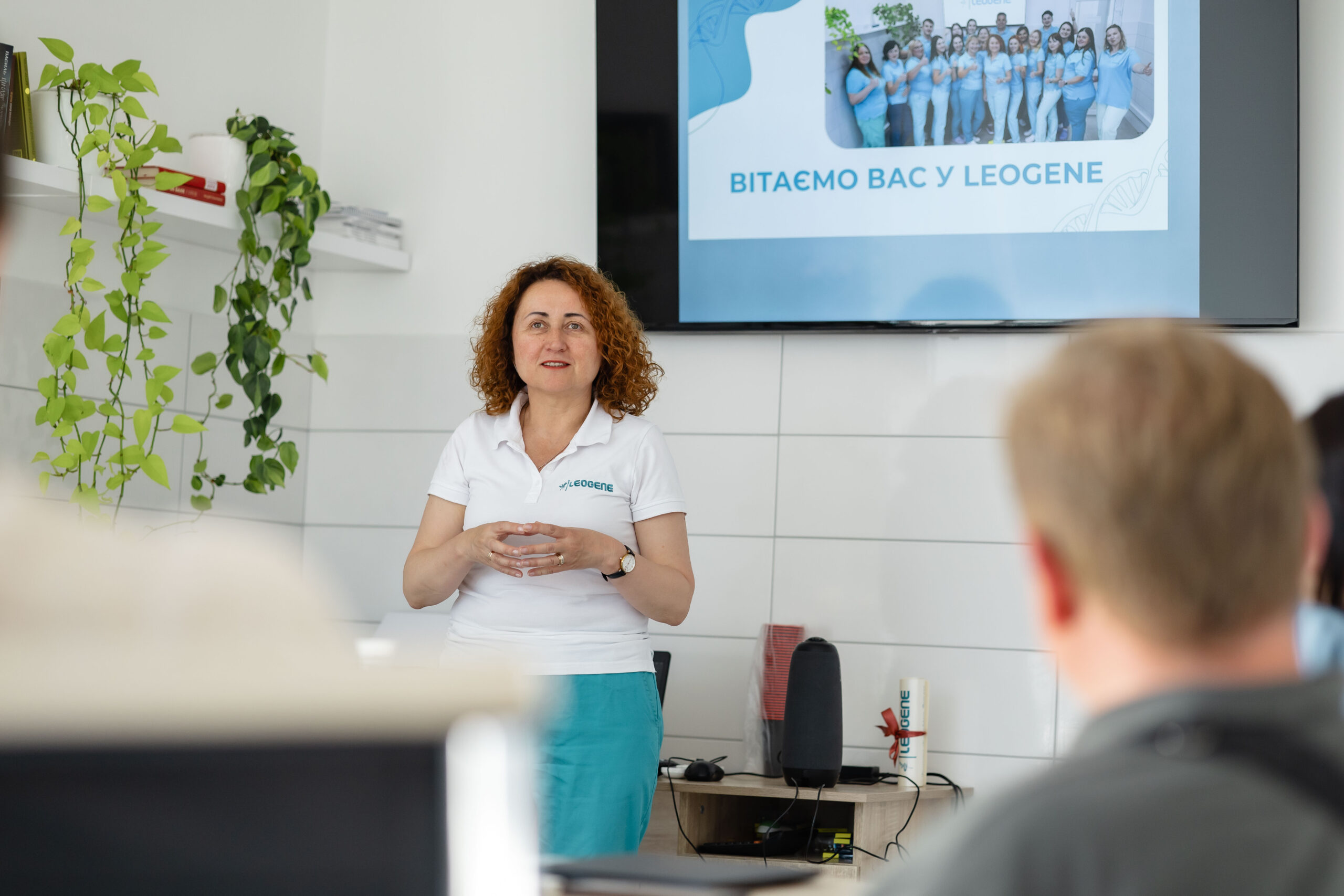
“I entered the field of genetics as a ‘proper’ geneticist with honors, where everything was supposed to be rational. But working with families raising children with medical conditions, I moved away from that. My path to faith and ethics came through my work, because not everything in life can be explained purely rationally,” noted Halyna.
War as a Test of Objectivism
The most heated moment of the discussion came when participants attempted to apply Rand’s philosophy to the context of contemporary Ukraine and the events of February 2022. They debated whether there was room for self-sacrifice and volunteerism within the author’s framework.
Graduate Andriy Syvak called the book “the bible of a fictional world,” where everything makes sense only within the utopia created by the author. Dmytro Vasylchenko, on the other hand, suggested viewing the text as a specific lens:
“This book is descriptive, not prescriptive. It’s like a fisheye lens: it shows the same object, but distorted. When a person chooses the ideals of self-sacrifice, they are also acting in their own best interests, because they cannot imagine the meaning of life without these principles. Rand is simply too radical in her rationalization.”
Participant Olena Ivankiv-Sozanska added that in the early days of the full-scale invasion, the actions of people heading east to defend the country lacked “logic” as Rand understood it, but represented a profound value-based choice.
 Criticism and Conclusions for Leaders
The Alumni Book Club community concluded that, despite the popularity of Rand’s ideas among entrepreneurs, her concept of a “black-and-white world” often ignores the complexity of real-world processes. Taras Vasylyshyn, analyzing the evolution of Rand’s views, noted that her aversion to altruism is understandable given her experience living under the Soviet system; however, modern behavioral economics easily debunks the notion of absolute human rationality.
Summing up the meeting, the participants concluded that “The Virtue of Selfishness” is an important intellectual exercise that forces one to rethink one’s own motivations, but it cannot serve as a ready-made guide to life.
For the UCU Business School community, such meetings are not merely an exchange of thoughts on what has been read, but a search for answers to the question of how to remain humane and effective in a world where the old rules no longer apply. The Club plans to hold its next meeting off-site, continuing the tradition of deep intellectual reflection among “like-minded people.”