





How can management expertise be translated into practical benefits for Ukrainian communities today? This was the question explored by participants in the Key Executive MBA programme at UCU Business School. At the final presentations of the practical course Business Solutions for Community Development (Business on the Frontlines), participant teams presented community leaders, investors and experts with ready-to-implement tools for local development — ranging from legal frameworks for public-private partnerships to a unified museum pass concept and a strategy for preserving mountain landscapes.
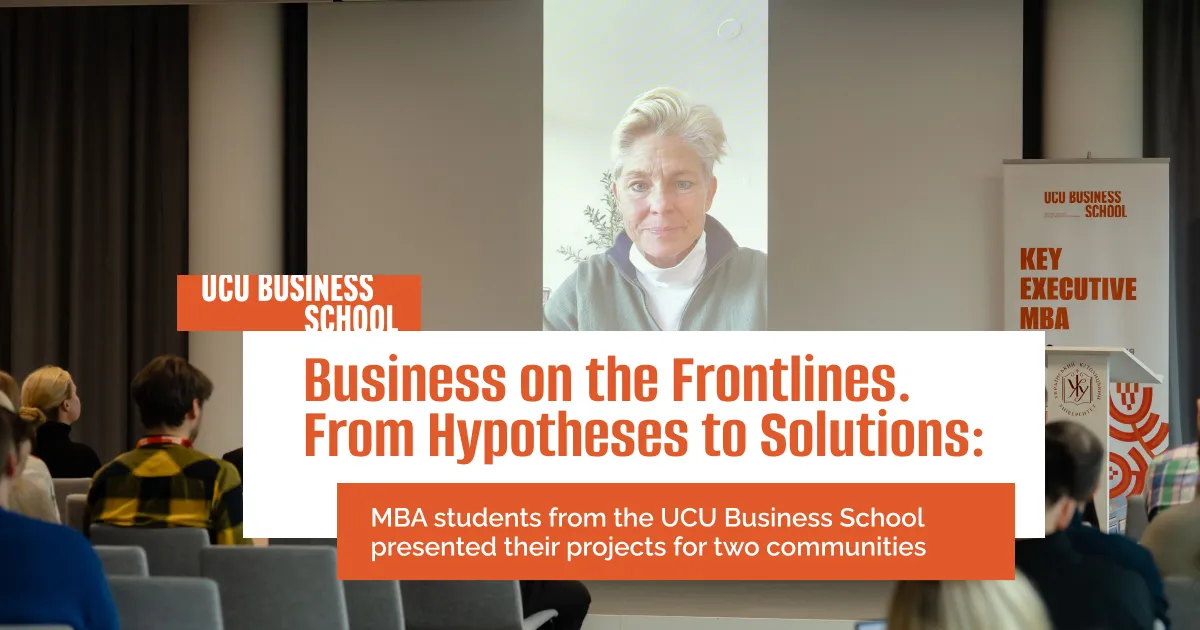
The course followed a Service-Learning approach, combining business education with hands-on work addressing real social and economic challenges at the local level. It was based on an adapted methodology developed by the Frontlines Institute, which aims to build a bridge between the university, local government and the private sector, bringing them together to develop solutions that contribute to the sustainable development of communities.
For participants in the Key Executive MBA programme — business owners and executives — the five-month course, which took them from identifying a challenge to developing a solution, was a genuine test of their leadership capabilities in conditions of uncertainty. In July and August this year, the teams travelled to Verkhovyna and Novyi Rozdil for field visits. From desk research and initial hypotheses to meetings and interviews with stakeholders, participants undertook a process of testing business logic against people’s actual needs every step of the way. They concluded the course by developing practical solutions and handing them over to their community partners.

The Course Philosophy: Service, Partnership and Long-Term Cooperation
Yaryna Boychuk, CEO of UCU Business School, emphasises that learning through service to communities changes the very perspective from which managers approach their work:
“Economic resilience is part of our security system, an essential component of the security agenda for the entire country, and business has an enormous role to play here. Through hands-on experience, students see how productive it can be when businesses understand the needs of a community, achieve even greater impact in their own development, and take responsibility for the resilience of the territory in which they operate. We need to prepare for the country’s actual reconstruction, where businesses understand that their role in a community is also a form of service.”
Artem Kornetsky highlights the importance of a three-year cycle of cooperation with each community:
“The whole of Ukraine is a frontier today, which is why the Business on the Frontlines course is designed to support communities through local organisations, businesses and government. This approach creates a sustainable model for project development and generates long-term impact, helping to offset the cyclical nature of education. If we keep a project on our radar for three years, we can maintain our focus and achieve meaningful results even when everything is changing at an extraordinary pace.”
Verkhovyna Community: Sustainable Tourism, Heritage Preservation and Landscape Protection
In the Hutsul region, participants worked on developing a brand and tourism positioning for Kryvorivnia as a cultural hub, securing the legal status and safeguarding the Paraska Plytka-Horytsvit Museum, and devising a strategy to protect the Verkhovyna landscape from haphazard construction through dialogue among local government, businesses and the community.
 Preserving Mountain Landscapes and Spatial Planning
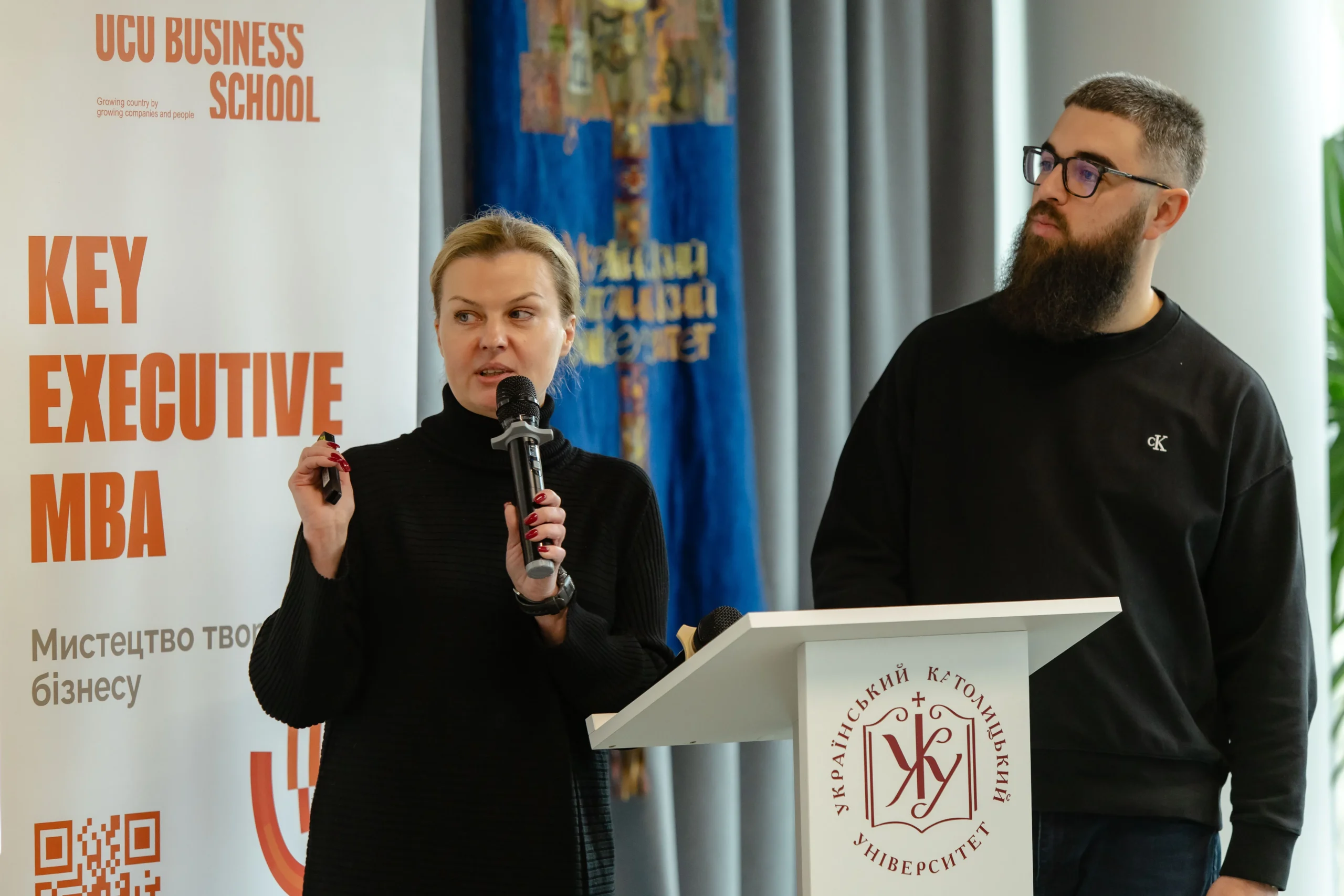
The first team, working alongside Home Group and the local council, examined the risks posed by unregulated construction of hotels and glamping facilities on mountain peaks. Participants proposed establishing a local Advisory Board involving independent experts, as well as bringing greater order to detailed territorial development plans and zoning regulations.
According to the team’s estimates, better management of land resources would not only help preserve the natural environment but also increase the capital value of land several times over, directly benefiting local residents.
“Our work was about helping the local community and everyone who cares about the area preserve the magnificent mountains they are fortunate to have. We wanted to help people move towards an entirely different, sustainable development trajectory,” said Ihor Kachmarskyi, a participant in the Key Executive MBA programme.
A Unified Museum Pass and Gastronomic Routes
The second team studied tourist flows and challenged the assumption that the region suffers from a lack of visitors. The main problem, they found, was the dominance of low-budget package tourism, which leaves very little money in the local economy.
Participants developed a digital prototype of a unified museum pass, valid for 48 or 72 hours, with automatic revenue distribution among participating institutions. They also proposed a concept for gastronomic tours during the off-season. The team’s mentor was architect and urban planner Yulian Chaplinskyi.
“Because of the war, tourist visits to our museums have become unpredictable and irregular. The students’ work was of a very high standard. The idea of a unified ticket will help us organise these flows and generate revenue for the community’s economy,” said Oksana Kolomiychuk, Head of the Culture Department at the Verkhovyna Town Council.
The Paraska Plytka-Horytsvit Museum
The third team’s work resulted in a strategic roadmap for preserving and promoting the legacy of Paraska Plytka-Horytsvit, a unique artist from Kryvorivnia.
The proposals covered legal protection of intellectual property rights; the urgent digitisation of more than 4,000 artworks and 46 handwritten books; a business model for the museum; ways to carry on the artistic tradition by engaging younger generations; and plans to commemorate the 100th anniversary of the artist’s birth.
Novyi Rozdil Community: Public-Private Partnerships and Veteran Support Facilities
In the Lviv region’s Novyi Rozdil community, cooperation with UCU Business School is now in its second consecutive year. Following the first year of collaboration, the community had already achieved tangible institutional and economic changes thanks to the research and solutions developed by MBA participants.
A Legal Framework for the Zhevusky-Liantskoronsky Palace
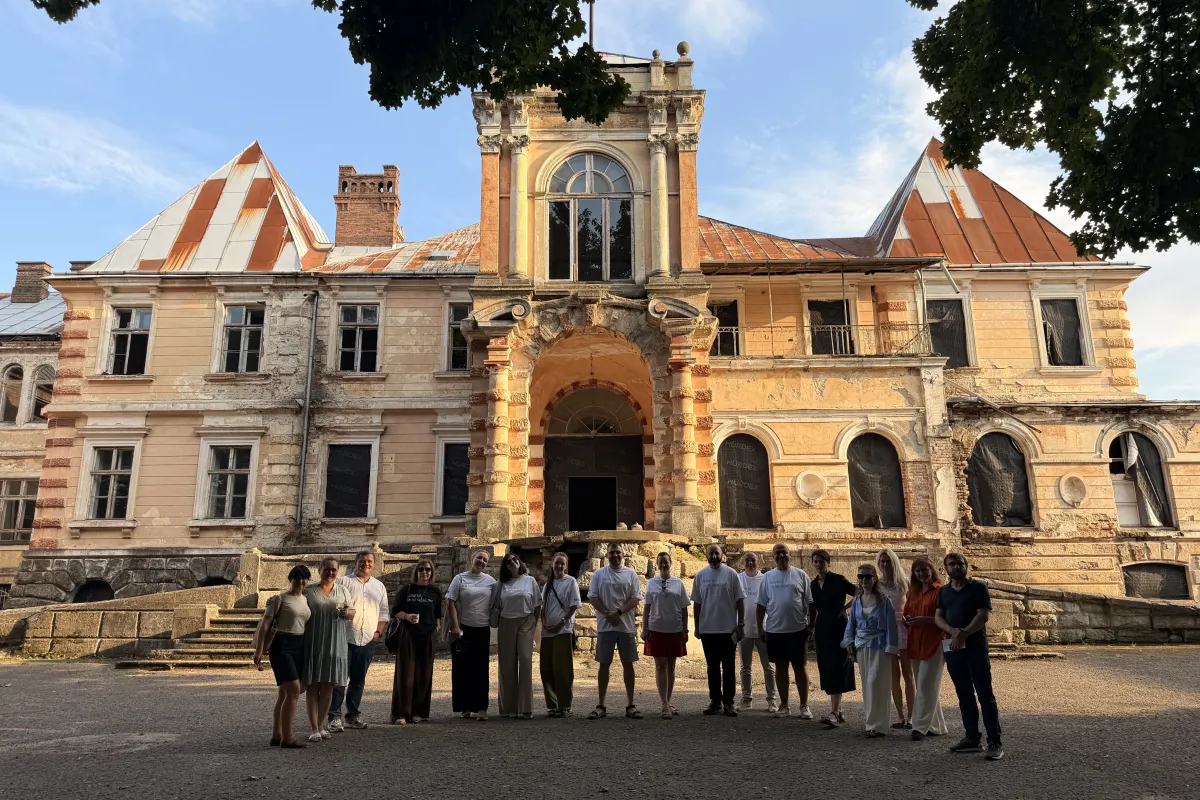
The revitalisation project for Rozdil Palace — a nationally significant architectural landmark in the town of Rozdil — has progressed from developing a financial model to signing a public-private partnership agreement.
Since the palace is privately owned by an investor, while the park is a municipally owned monument of landscape gardening, the team developed regulations for a Coordination Council and a legal framework for cooperation. Both were approved by a decision of the Executive Committee.
“This is the first example in Ukraine of a legally formalised long-term cooperation programme being developed to facilitate a partnership between a community and an investor. It will serve as a reliable institutional compass for protecting and developing our shared cultural heritage,” emphasised Hanna Havryliv, founder of the Heritage.UA initiative.
A Veteran Rehabilitation Centre and the Revival of Sports Infrastructure
The team addressed an ambitious challenge put forward by PRANA: how to establish a large-scale medical and rehabilitation centre on the site of the derelict “Dnister” swimming pool. Participants explored ways to tackle this complex challenge while taking into account the realities of the present day and the needs of the community.
Having analysed the market and capital expenditure requirements, the team recommended that its partners revise the business model and adopt a phased approach. Rather than making substantial upfront investments, participants developed a concept for the rapid launch of a sports and recovery hub for community residents, featuring fitness facilities, a hostel and subsidised training programmes for veterans.
This approach would make it possible to generate revenue from the very first year of operation and gradually reinvest the proceeds in the full-scale reconstruction of the swimming pool.
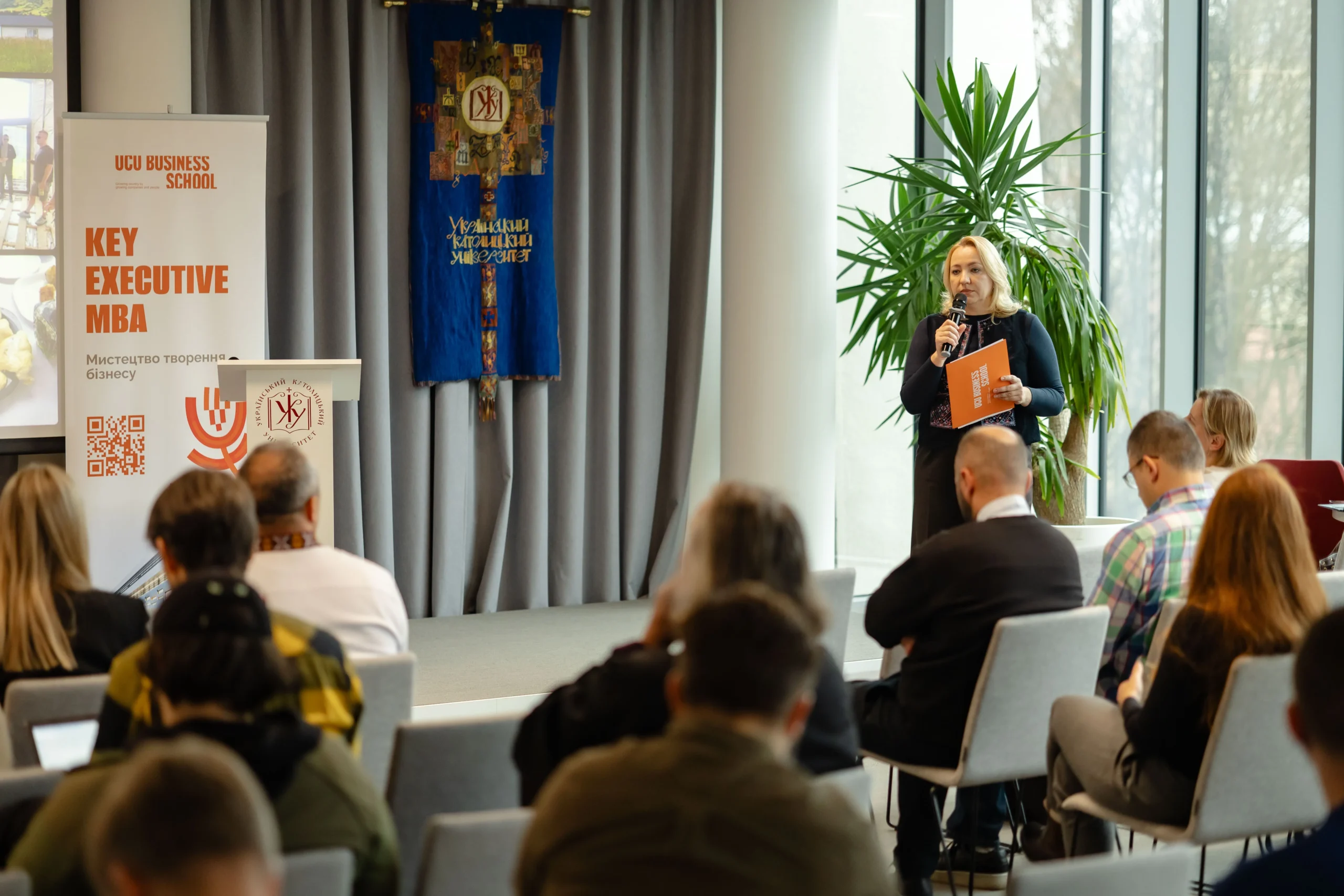
Reflecting on the course, Olena Trevoho, Academic Director of the Key Executive MBA programme, reiterates its central principle: partnership in which the communities themselves take the lead.
“We did not come in with ready-made answers: our partners led the way, while we listened, contributed our expertise and helped identify connections that are not always visible from within. Solutions emerged at the intersection of the interests of the community, business and the state. These are not reports that simply document our findings, but practical tools that our partners can continue to use in their work.”
Service-Learning turns education into a tool for community development — provided that the communities themselves remain at the forefront of the process. Through systematic cooperation with investors, the Novyi Rozdil community has already increased its budget revenues, while the Verkhovyna community now has practical proposals ready to support the introduction of a unified museum pass and the preservation of its mountain landscape.
Read also: Business on the Frontlines: How Business Can Transform Communities
Take on real-world community challenges and turn your management expertise into solutions that make a difference in people’s lives through the Business Administration programme.