





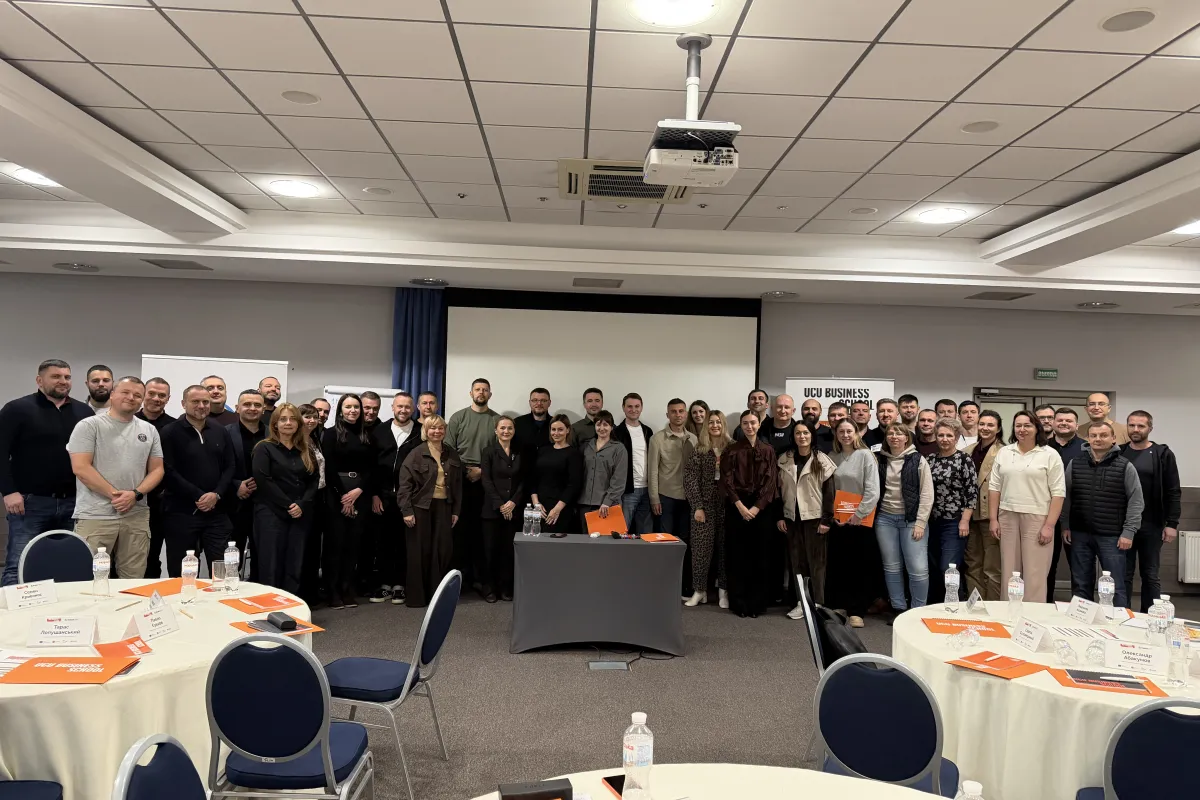
The training program “The Architecture of Management: From Communication to Results,” developed by the UCU Business School, brought together 49 senior and mid-level managers from the National Anti-Corruption Bureau of Ukraine (NABU) in Kyiv to strengthen their leadership skills. The training was supported by the EU Anti-Corruption Initiative (EUACI).
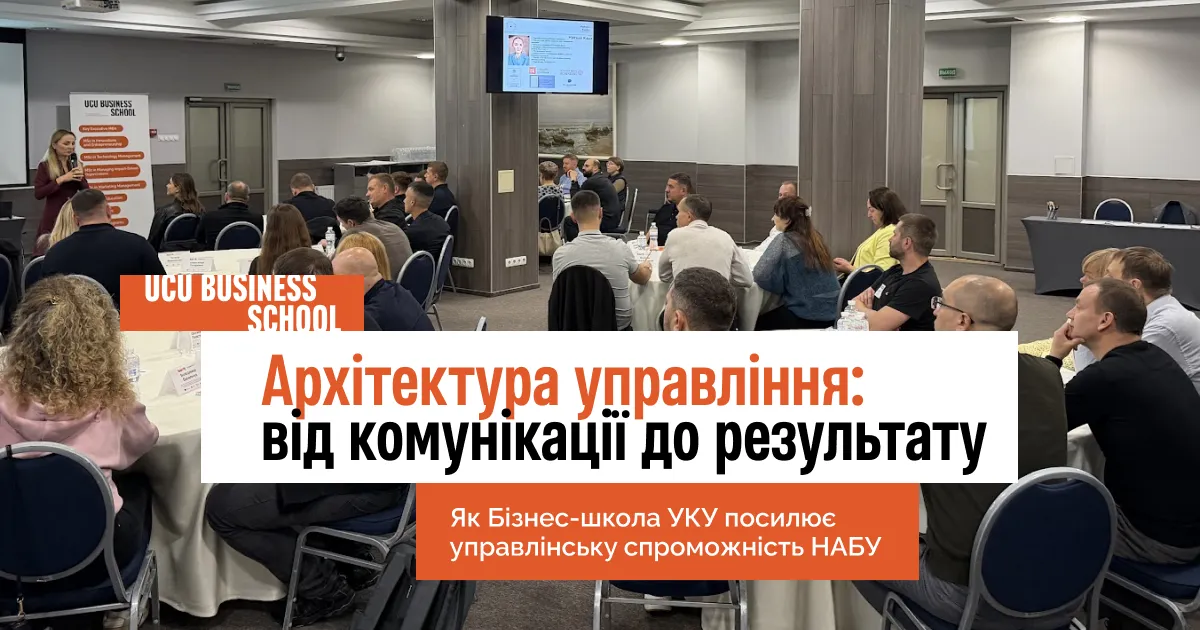
During the two-day intensive workshop, managers from the anti-corruption agency, together with instructor Natalia Kadia, learned how leadership neurobiology tools work, how to build effective communication and trust within teams, and how to provide feedback.
Systemic Partnership: From “Leadership in Times of Change” to “Management Architecture”
This program marks the second joint initiative between the UCU Business School and the National Anti-Corruption Bureau of Ukraine, building on our previous training experience. In July 2025, in collaboration with the UCU Leadership Center, we implemented the “Leadership in Times of Change” program for the Bureau’s top leadership team. At that time, under the guidance of Andriy Rozhdestvenskyi, Executive Director of the UCU Leadership Center, NABU Director Semen Kryvonos, his deputy Denys Gyulmagomedov, and the heads of key departments strengthened their leadership skills, explored mechanisms to overcome resistance to change, and worked to build the institution’s internal resilience.
As Yaryna Boychuk, head of the UCU Business School, noted, supporting institutions that ensure the country’s legal and anti-corruption resilience is an important part of UCU’s mission.
The new training module — “Management Architecture: From Communication to Results” — served as a continuation of the previous program. Whereas participants had previously focused on leadership in conditions of uncertainty, this time the emphasis was on practical management tools—effective and clear communication, cognitive biases, and feedback.
What the program covers: how we make decisions, the SCARF model, and open communication
The training module was developed based on a detailed preliminary survey of participants, enabling the case studies to be adapted to the real management challenges faced by NABU. The training was structured according to the principle of “from awareness to action.”
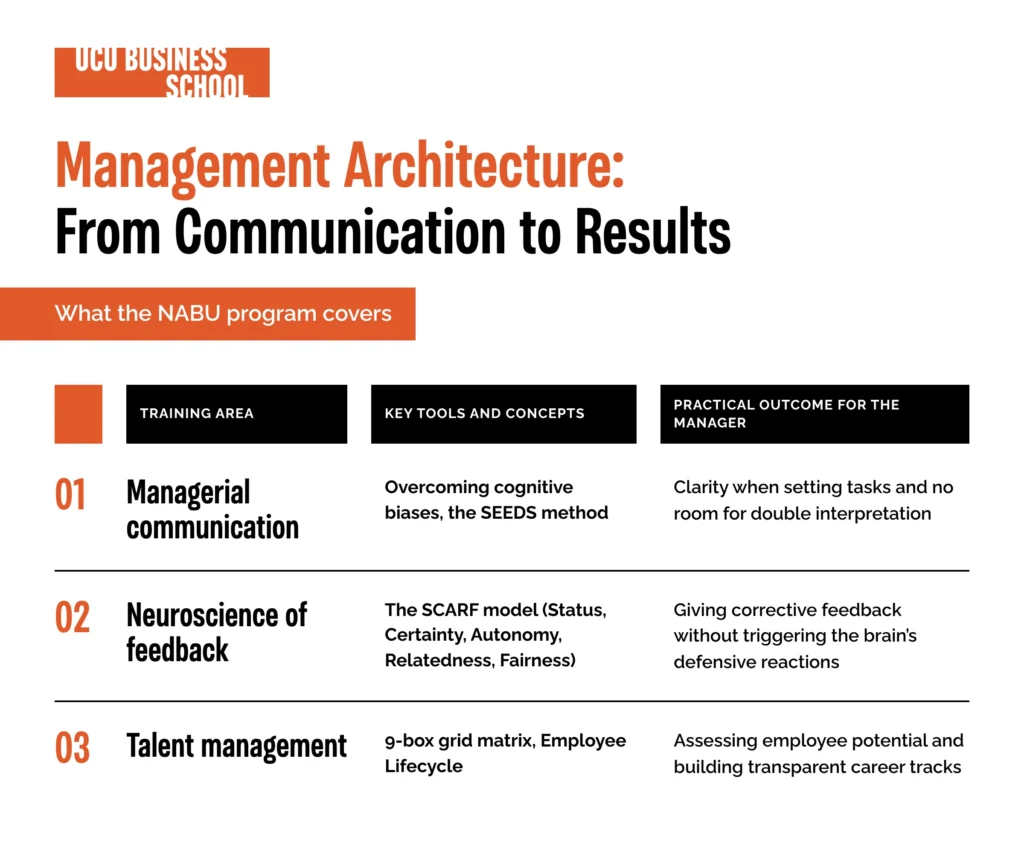
During the sessions, instructor Natalia Kadia explained how the brain’s unique functioning affects the perception of management decisions. Participants also learned about tools that will help them overcome cognitive biases and make more responsible decisions in the future.
Feedback from NABU Leaders: Reflections on Trust and Well-Communicated Decisions
The main outcome of the two-day intensive was the practical insights gained by the Bureau’s leaders and their readiness to implement new approaches in their daily work.
“Involve people in discussions before making decisions and always explain them. A well-communicated decision is an accepted decision. The team you lead is, in part, a result of your communication,” shares NABU Director Semen Kryvonos.
In addition to purely managerial tools, a key achievement of the two-day intensive was the opportunity to speak openly about internal challenges while maintaining a focus on the institution’s shared mission. Denis Gyulmagomedov, First Deputy Director of NABU, highlighted the importance of an atmosphere of trust during the training:
“The National Anti-Corruption Bureau is making our society more mature through its activities. It’s important to remember the lofty goals we’re working toward. The training was marked by genuine sincerity, trust, and the courage to speak frankly with one another.”
Training participants also noted the value of informal communication among the investigative, legal, and administrative departments.
The Experience of NABU and the National Police of Ukraine
Strengthening leadership competencies and implementing international management standards are common trends across Ukraine’s entire law enforcement system. In parallel with projects for NABU, the UCU Business School, in partnership with the international organization Project Expedite Justice (PEJ), is involved in training other security institutions.
In particular, specialists from the National Police of Ukraine are enhancing training for heads of investigative units responsible for investigating war crimes, integrating international criminal law with modern management tools.
This approach to training managers at the NABU and the National Police underscores that the successful investigation of corruption and international crimes depends not only on leaders’ professionalism but also on effective communication and coordinated teamwork.
Partnership for Ukraine’s Institutional Resilience
The implementation of such large-scale educational programs is the result of a joint effort by Ukrainian educational institutions and international partners.
The educational program, developed by the UCU Business School, is being implemented with the support of the EU Anti-Corruption Initiative (EUACI), which is funded by the EU, the German Federal Ministry for Economic Cooperation and Development, and the UK Department for International Development, and is co-funded and implemented by the Danish Ministry of Foreign Affairs. The opinions and views expressed do not necessarily reflect the position of EUACI, the EU, or the governments of Denmark, Germany, or the United Kingdom.
The UCU Business School continues to support Ukraine’s teams by providing them with knowledge and management tools to build a strong, transparent, and sustainable state.