






How should business schools prepare students for a world in which business education is becoming increasingly empirical? What were the key educational trends in 2025, and how are they being integrated into the learning process at UCU Business School? We discussed these and other questions with Sofiia Opatska, Founding Dean of UCU Business School, and Yaryna Boichuk, CEO of UCU Business School. Read more in the full article.
1. Business education in Ukraine is highly sensitive to the economic context
Sofiia Opatska noted that today Ukrainian business largely operates in a state of constant tension, often focused simply on survival, given that the broader backdrop of life in Ukraine is the fourth year of full-scale war. At the same time, many companies realize that tough competition lies ahead, especially following Ukraine’s potential accession to the EU.
Yaryna Boichuk added that, based on this year’s admission campaign at UCU Business School, applicants came primarily with the following key needs:
- how to enter export markets;
- how to structure and scale business projects, initiatives, and their own companies.
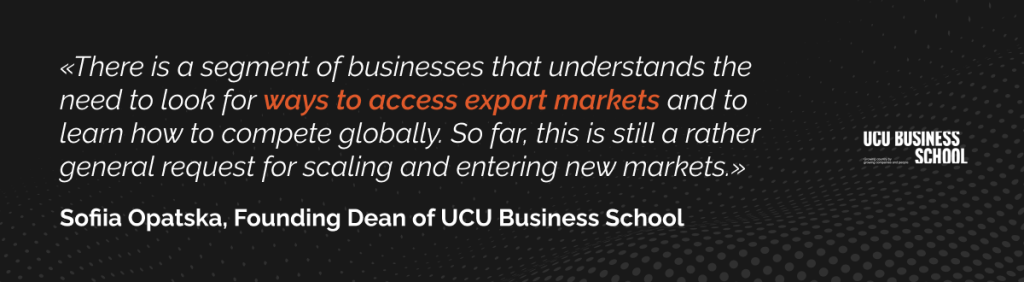
“There is a segment of businesses that understands the need to look for ways to access export markets and to learn how to compete globally. So far, this is still a rather general request for scaling and entering new markets. Naturally, at UCU Business School we try to respond to all of this: it affects content, courses, and programs. It also influences decisions about whom we additionally invite to teach and how to make programs more flexible and adaptive to these specific needs,” added Founding Dean Sofiia Opatska.
2. “This is one of the best times in the world to earn an MBA”

In an article, Lee Newman, Dean of a Spanish business school, remarked that 2025 was one of the best times to pursue an MBA degree. What do the leaders of UCU Business School think about this trend?
“At all times—and especially during crises or periods of challenge—people start to look inward more closely and to realize their personal responsibility. Despite the frequent desire of leaders to ‘free up their hands and minds’ so that the business can operate autonomously, no one really wants companies to be run, say, by artificial intelligence. That is why fe,” said Yaryna Boichuk, CEO of UCU Business School.
She also emphasized the importance of MBA programs today: students engage not only in the learning process but also in a community where knowledge is exchanged not only from lecturer to classroom, but also among participants themselves.
“The exchange of experience and real-life cases creates a unique learning opportunity that continues even beyond the program,” Yaryna concluded.
Sofiia Opatska added that it is important to understand that trends in business education globally and in Ukraine sometimes diverge, for many reasons and preconditions. Much depends on the country’s internal economic situation, as well as on the type of MBA programs in question—full-time or Executive (for managers):
“One of the strongest growth periods for MBA enrollments globally was 2009–2010. Why? Because there was a financial crisis, many people were laid off, they took out loans and went to study. They could devote those two years to education and obtain an MBA degree, and once the recession ended, they entered the job market with higher expectations regarding salary and employment. That is logical. But what does a business owner do during a crisis? The answer is just as obvious—focus on the business first. That is why, in our time of global challenges and acute crises in Ukraine, we may well see the opposite trend.”
In summary, demand for business education—particularly for MBA degrees—may be shaped by crises, but it manifests differently in different countries.
3. Online or offline learning?
When examining trends in business education, one more key trend stands out—the flexibility of programs and formats, specifically the shift toward hybrid learning (online and offline).
“Unfortunately, there is no strong culture of hybrid learning in Ukraine. There are certain rules and attitudes. When people study online abroad, they genuinely allocate time to learning instead of just appearing as black squares on online platforms. In my opinion, in our current Ukrainian realities we are playing a supportive role for students, which is why we insist on offline learning. Today, the business school has become something of a space for mental reflection, which Ukrainians urgently need in addition to acquiring knowledge,” Sofiia reflected.
She also noted that UCU Business School has no online master’s programs, and this is a conscious position: participants in master’s programs are expected to study physically in the classroom, because this is the format the school believes in and sees results from.
At the same time, Yaryna and Sofiia emphasize that the key strength of a business school lies in its ability to adapt programs to current needs and challenges.
4. Forecasts for trends in business and business education
Yaryna Boichuk, CEO of UCU Business School, shared her prognosis and reflections on the role of AI:
“It seems to me that rapid self-learning is becoming extremely relevant right now. Some companies talk about this openly, others remain silent, but expectations are the same: every employee, at their own level, should be able to work with artificial intelligence or at least basic analytics—and do so proactively. I have even seen quotes where leaders say that if their employees fail to master AI within a certain timeframe, they are simply dismissed and replaced by those who already have these skills.
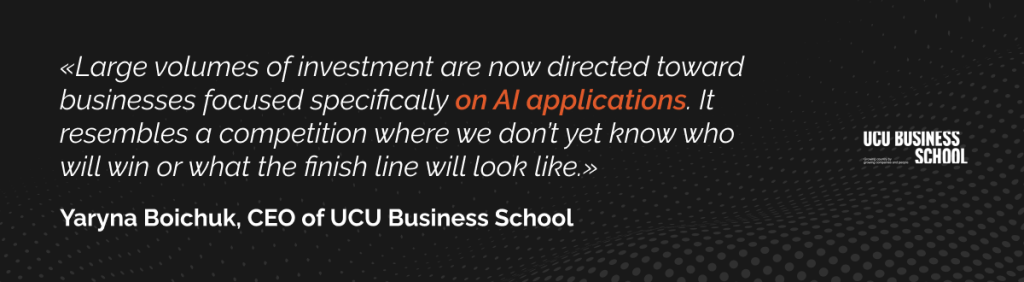
What does ‘mastering AI’ mean? Sometimes it seems that companies themselves do not fully understand this. Still, it is a massive trend, and in some cases even a bubble. Huge amounts of capital are flowing from traditional startups into those connected with artificial intelligence. Large volumes of investment are now directed toward businesses focused specifically on AI applications. It resembles a competition where we don’t yet know who will win or what the finish line will look like.
I am not saying that learning is unnecessary, but skills must be practical. In the longer term, we see that the pace of technological development is so fast that people do not have time to stop and reflect on the consequences of its application. There are also security risks that are easily forgotten when everyone is running forward without looking back. These are enormous challenges that have not yet been fully realized.
The world is under tremendous threat—and often it is unclear where that threat may come from. What seems safe now can be used by another side in the long run. This can pose risks to business, the state, or the economy. So we must be ready for anything.”
Founding Dean Sofiia Opatska focused on another enduring trend—leadership:
“Every time—whether it is 2025 or 2005—people talk about leadership; only the context changes. Leaders and owners face the task of moving toward the future with their teams when that future is highly uncertain.
Today, almost every program—even those not directly related to leadership—tries to include a separate leadership course and place emphasis on relationships and character, as we do.
In Ukraine, the current context is even more complex. Very often, organizational leaders are viewed as if they should know everything—from ‘when will the war end, please finally tell us,’ to how a leader can help people cope with trauma or loss. These are new, non-trivial tasks that no one has prepared leaders for.
Psychologists know how to work with trauma. But three to five years ago, this was definitely not part of a leader’s job description. Now they have to do it—and to do it consciously, while also serving as an example.”
Sofiia Opatska also reflected on the fact that the world continues moving forward, adding that no one is waiting until Ukrainians recover from the war:
“No one says, ‘let’s wait for Ukrainians, and then continue competing.’ I am not very comfortable with placing Ukraine in a separate category. It worries me because then we become ‘special,’ overly focused on our own challenges, and we lose the sense of global competition.
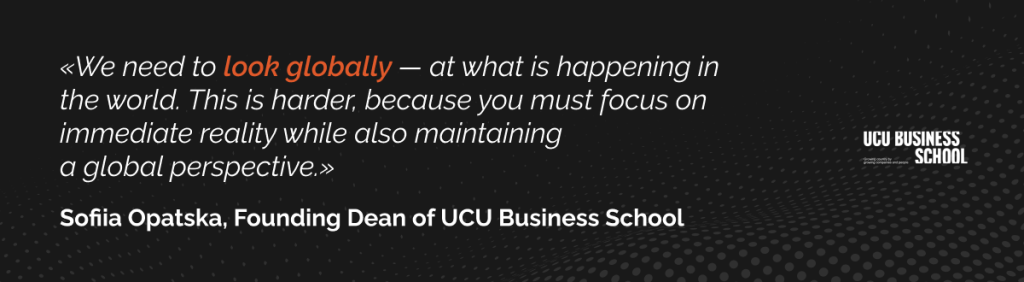
All of this has to be processed mentally, reflected on (preferably not alone, but together with colleagues), translated into meaning for your people, and communicated. That is difficult.
This is why I think leadership is so much in demand today—and will be even more so in the future.