








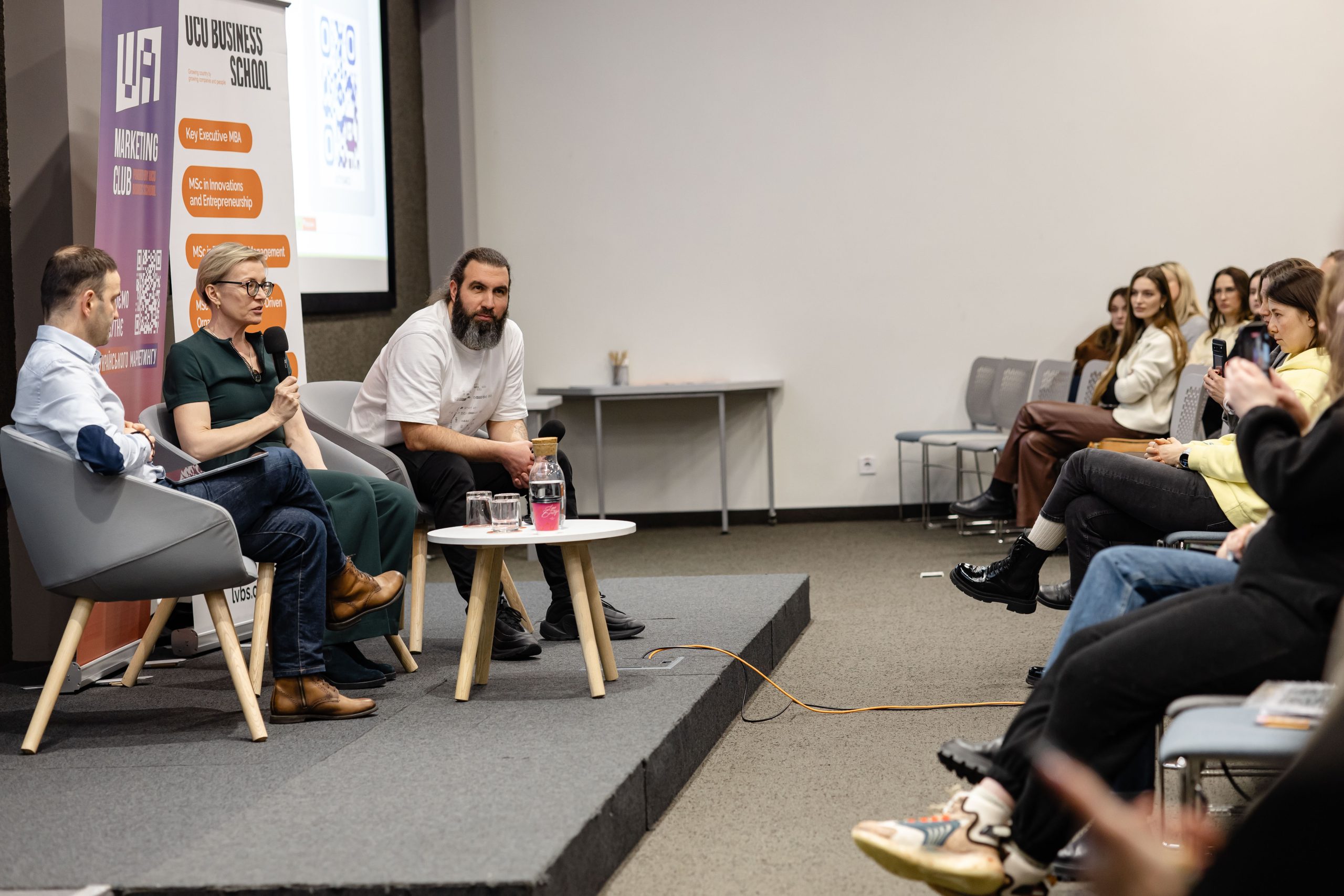
How customer experience is no longer a distinctive advantage of the brand but is becoming a mechanism for business survival was discussed during an event at the UCU Business School featuring Olena Tsisar, Kyrylo Yezhov, and Ihor Blystiv.
The meeting, titled “Customer Experience: Theory, Trends, and Practice,” took place at the Ukrainian Catholic University Business School and focused on customer experience (СХ) in business within Ukrainian realities, supported by practical examples. The speakers identified CX trends for small and medium-sized businesses, discussed the impact of these trends on customer return and company growth, and outlined how to start improving customer experience right away.

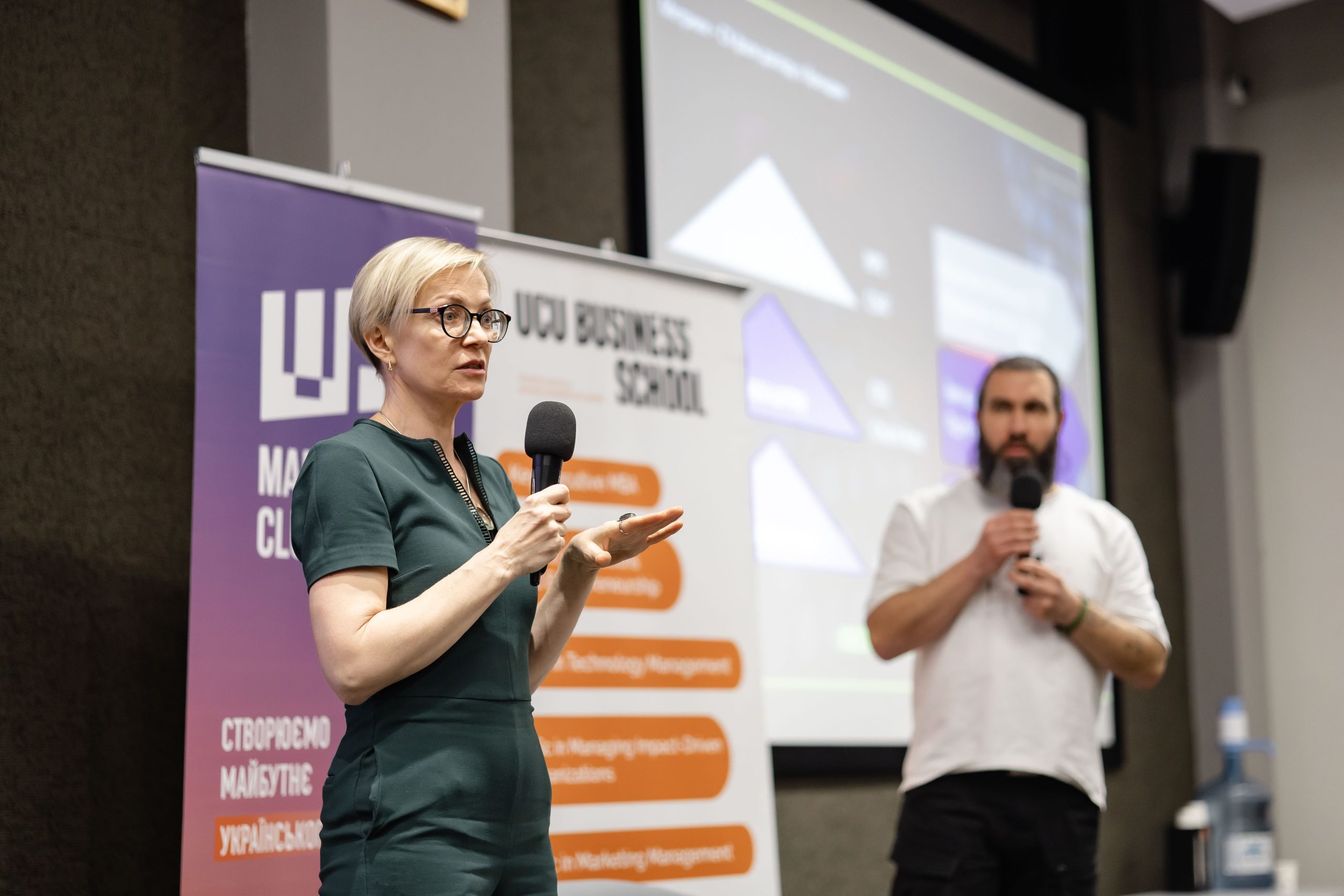
The discussion featured Olena Tsysar, a customer experience expert, researcher, and mentor with more than 20 years of experience; Kyrylo Yezhov, Business Development Director at Kantar Ukraine and a CX domain leader; and Ihor Blystiv, Director of the MSc in Marketing Management program, Marketing and Innovation Director at Kormotech, and founder of the UA Marketing Club.
What Is Customer Experience and How Does It Change Customer Behavior?
During the event, customer experience was considered not as a service function or an emotional add-on to a brand, but as a tool for influencing consumer behavior. This approach was illustrated both through conceptual models and applied cases.
The central idea of the discussion was that customer experience works when it changes customer behavior — specifically, when it shapes habits, expectations, and the way customers interact with a brand.
“In CX, it is important not simply to do familiar things differently, but to transform the experience in line with customers’ needs and values. These are constantly changing, and if a business can recognize and actualize them, it can manage the experience without radically reinventing everything,” says Kyrylo Yezhov.
Customer experience was defined as the sum of customer interactions throughout their entire lifetime with a company. In this context, Olena Tsysar referred to Forrester’s “join–use–leave” approach. Thus, CX encompasses the entire cycle of interaction with a brand, from entry to the completion of cooperation.
Kyrylo Yezhov also described customer experience as an anti-stress mechanism for the client, where the focus shifts from emotional peaks to basic reliability. Customers need services that function without surprises and unnecessary steps.
“Both globally and in Ukraine, crises have become so frequent that we are entering a time of increasing instability. Therefore, we must take care of our customers in moments of crisis,” Tsysar emphasized.
The speakers also analyzed the concept of resilience-by-design — service resilience under conditions of risk and crisis that must be embedded in strategic planning. Olena Tsisar stressed that crisis scenarios must be incorporated into customer experience design. As an example of a systemic experience, they mentioned the case of the Bründl store, as well as the importance of defining responsibility and the leader’s role in crisis management.
In this context, it is also important to appoint a single “owner” of customer experience.
“When everyone is responsible for everything, it turns into a crisis of shared accountability. We tend to avoid taking responsibility in decision-making,” Yezhov explained.

How CX Works: Roles, Models, and System Maturity
Olena Tsysar separately examined the difference between the roles of marketing and customer experience. According to her, marketing is responsible for attracting customers and shaping expectations at the entry stage, while CX works with the phases of use, retention, and exit, ensuring alignment between experience and those expectations.
To change consumer behavior, she emphasized, the EZI model (Easy–Effective–Emotional) should be applied. Within this framework, effectiveness and ease are components of the systemic experience, while emotionality is primarily a feature of service as a distinct touchpoint in the interaction — and therefore functions as a “short game.”
One of the key theses was that customer experience (CX) is the totality of interactions that shape the overall perception of a company. Service, in this logic, was considered a fragmentary part of the experience rather than its full equivalent.
Olena Tsysar defines the maturity level of customer experience through a CX maturity model. A mature system consists of strategy and vision; customer understanding; personnel and the ability to work with culture, communication, and competencies; voice of the customer; technological support; and a management system.
Customer Experience as a Business Survival Tool
According to the speakers, it is precisely this systemic approach that determines a company’s ability to remain stable in times of crisis.
In the Ukrainian context, customer experience (CX) has ceased to be the highlight of the brand and has transformed into a practical survival mechanism for business.
“CX is the source of how we create new products, services, and needs,” Yezhov noted.
At the same time, CX performs highly practical functions: it compensates for price sensitivity, offsets limited assortment, reduces operational costs, and accelerates decision-making.
According to Kyrylo Yezhov, the business formula of customer experience (CX) consists of three elements: processes, customer expectations, and employee behavior. These elements must be incorporated into the strategic and tactical planning.
These principles are equally relevant for large companies and smaller businesses. For small businesses, customer experience is recognized as a competitive tool that does not require large budgets but does require systemic thinking. Such CX also creates an emotional connection with the brand.
“What should small businesses do? Step number one is to understand where you are now. After analyzing and assessing your position, develop both a strategic and a tactical plan. Strategy is about where you are going in terms of vision; tactics are about how you will get there. Third, meet with your customers and bring customer cases to your colleagues in the business. Digitize. Customer experience will stop being a soft topic once you integrate numbers into it. Build dashboards, but do not draw conclusions based solely on NPS. Create a culture — it’s a complex long-term game. You need to engage people, look at cases, train them, monitor performance, hire according to relevant skills, and motivate them. Focus on what matters most — do not fight on all fronts,” Olena Tsysar advised.
The speakers also paid particular attention to trust, privacy, and cybersecurity as components of modern customer experience. Artificial intelligence was viewed not as a marketing tool, but as part of the operational core of business. At the same time, they emphasized the role of humanity, authenticity, and emotional value in interactions with customers.
However, any customer experience (CX) system requires measurement in order to remain manageable. Therefore in the final part of the event, the speakers discussed CX measurement and its connection to business goals. In particular, they addressed customer experience phases, approaches to measuring effectiveness (ROI), the cost of acquisition, retention and customer profitability, as well as the principles of NPS analysis.