







Can victory be calculated mathematically? The Ukrainian experience shows that beyond standard military strategies lies a force that cannot be measured in numbers, yet it is precisely this force that determines a nation’s capacity for resistance.
This was the main conclusion of the panel discussion “Foundations of Resilience: Cross-Sectoral Cooperation in Wartime,” which took place as part of the 2026 Forum on Holistic Human Development “Solidarity in Times of Upheaval,” dedicated to the 10th anniversary of the Faculty of Social Sciences at UCU.
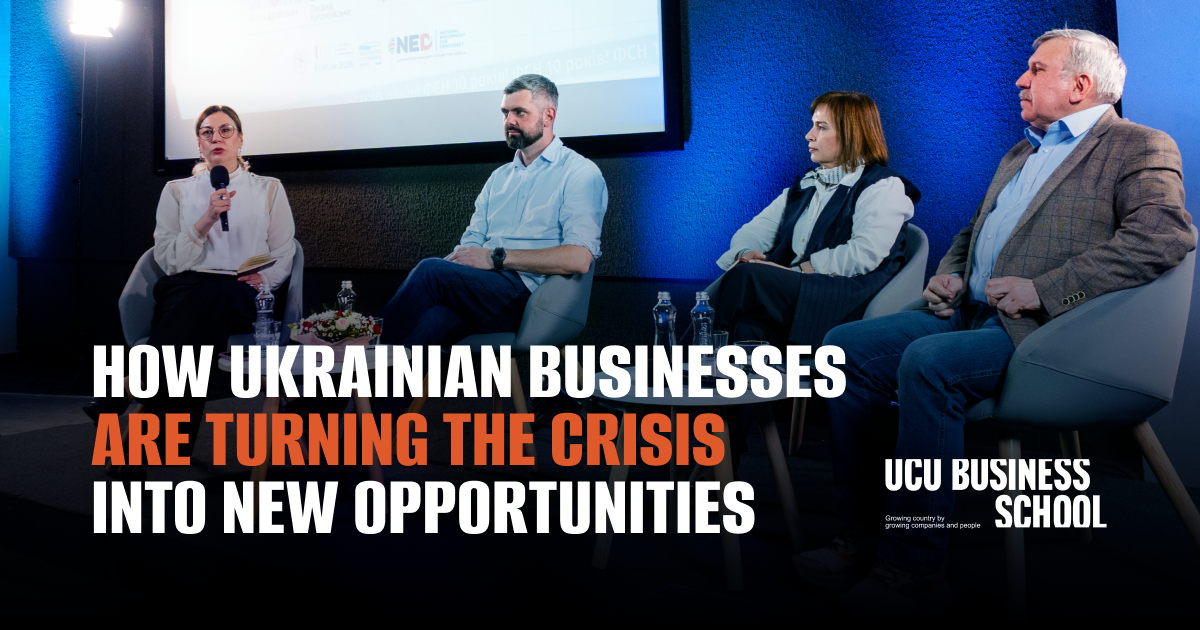 The discussion brought together leaders from the government, defense, and business sectors — Anton Drobovych, founder of the Center for Human Rights and War Memorialization; Yaryna Boichuk, director of the UCU Business School; and Mykhailo Honchar, president of the “Strategy XXI” Center for Global Studies — moderated by Oksana Kulakovska, director of the UCU Analytical Center. The discussion focused on answering the key question: how to transform “existential solidarity” into sustainable institutions that will endure the long haul.
Spirit and Will Against Systemic Failures
Mykhailo Honchar, President of the “Strategy XXI” Center for Global Studies, emphasized that the Ukrainian phenomenon does not fit into conventional military standards. He explained that it is the internal motivation of every Ukrainian that allows society to demonstrate an incredible synergy that is difficult to calculate mathematically.
He introduced the concept of the “seventh domain” of war — spirit and will. According to NATO’s classification, there are six official domains (spheres) of warfare: land, air, sea, space, cyberspace, and the recently added cognitive domain. However, the Ukrainian experience adds to these an irrational yet decisive factor of inner strength.
“The seventh domain is spirit and will. From a rational perspective, we probably needed to set those markers — some strategic priorities — and develop algorithms and protocols, but would it work? I think it comes from within each of us,” the expert reflects.
 At the same time, he expressed concern over the weakening of state institutions. According to Mykhailo, the loss of experience and a systematic approach to governance creates serious obstacles to strategic planning, particularly in critical sectors.
Business as a Partner of Society and a Catalyst for Development
Yaryna Boichuk, Director of the UCU Business School, highlighted the transformation of Ukrainian entrepreneurs. According to her, business has ceased to be a purely economic player and has taken on functions that, in times of crisis, require immediate decisions and the mobilization of resources.
“Business is no longer just an economic actor; it has become a partner of society, a source of support, and an example of self-reliance. Many began addressing security issues directly and had to make do with the resources they had at their disposal here and now.”
 For the business community, resilience has become not just a means of survival but an opportunity to reach a new level of performance. Yaryna Boichuk sees this ability to adapt as Ukraine’s main competitive advantage:
“Resilience isn’t just about holding on and staying put; on the contrary, it’s like a spring — bouncing back and leaping to the next level thanks to the momentum we gain.”
Existential Solidarity and Safeguarding Trust
Anton Drobovych, founder of the Center for Human Rights and War Memorialization, noted that Ukrainians have a unique experience of unity in moments of greatest danger. However, he distinguishes this state from everyday interaction, which requires more effort and discipline.
“I call this existential solidarity. We Ukrainians are fantastic at it, but we’re not so great at everyday solidarity.”
The civic activist emphasized that to preserve this unity over the long term, the state and society must develop transparent rules of the game. Only clear procedures and feedback can prevent the depletion of social capital and disillusionment.
“Procedures protect trust. It happens that a person trusts someone, but the feedback wasn’t formalized — and that’s it, trust is lost, even though everything was done and fulfilled.”
 The Path to Institutional Resilience
In conclusion, the participants emphasized that Ukraine’s resilience in 2026 lies in its ability to live and plan for the future “here and now,” without waiting for ideal conditions. A shared path of development requires not only heroism but also “restraint” in internal conflicts and a caring attitude toward one another in a society scarred by war. Cross-sectoral cooperation becomes the platform where, through dialogue and trust, institutional resilience is built — resilience capable of withstanding the challenges of tomorrow.