







How does UCU Business School educate and support veteran-owned businesses? What is the Resilience School for Veteran Businesses program? And what do veteran entrepreneurs need to learn today to remain competitive and become strong players in the market? Read more in the article below.
The Resilience School for Veteran Businesses educational program has launched at UCU Business School. Veterans, family members of veterans, and families of fallen and missing Ukrainian service members gathered at the university.
The program’s key goal is to strengthen Ukraine’s economic resilience and competitiveness by supporting businesses founded by veterans and their families, as well as by building a strong entrepreneurial community.
It was especially valuable that, at the start of the program, participants had the opportunity to engage with guest speakers and reflect on the development of veteran-owned businesses and their impact on strengthening communities and local economic resilience.
The program began with a panel discussion titled “The Impact of Business on Community Development: Leadership, Responsibility, and Sustainability.”
Participants and speakers included: Ihor Bezkorovainyi, Deputy Minister of Economy, Environment, and Agriculture of Ukraine, veteran, Andrii Moskalenko, First Deputy Mayor of Lviv, Roman Tychkivskyi, Director of Strategic Initiatives, UMAEF Veterans Support Program, veteran, Yaryna Boichuk, CEO of UCU Business School, Andrii Rybak, veteran, owner of the semi-prepared food production company The discussion was moderated by Andrii Zholob, Deputy Mayor for Veteran Affairs.
Shared Responsibility of Veteran Businesses and Communities
Andrii Moskalenko emphasized how crucial business engagement is for city development. He noted that 70% of Lviv’s budget is formed through personal income tax, which directly depends on employment and job creation.
“Without business, a city cannot function. It is the money of people who work, walk the streets, and pay taxes,”he said.
He also shared that in recent years the city has implemented several grant programs for businesses in cooperation with donors, highlighting that veteran-owned businesses now receive special attention. As an example, he mentioned a veteran loyalty program developed jointly by the city and businesses, including sticker labels for establishments that offer discounts to service members.
The key takeaway from his remarks was that partnership between business and communities lays the foundation for sustainable urban development.
What Should Veterans Learn Today?
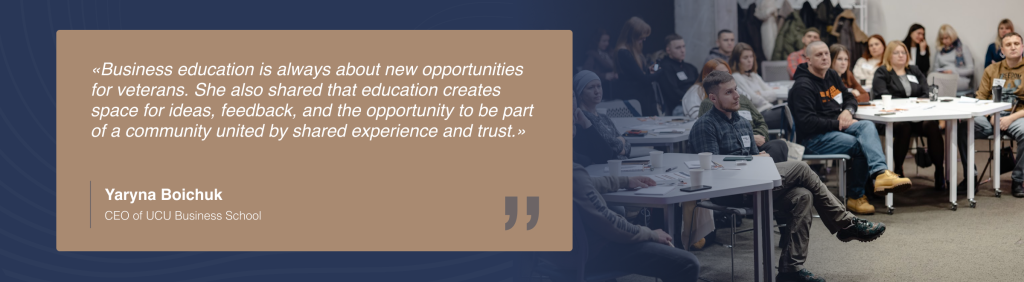
This question was addressed by Yaryna Boichuk, CEO of UCU Business School:
“To stay in the same place today, you have to keep learning constantly.”
She added that business education always opens new opportunities for veterans, creating space for ideas, feedback, and participation in a community united by shared experience and trust.
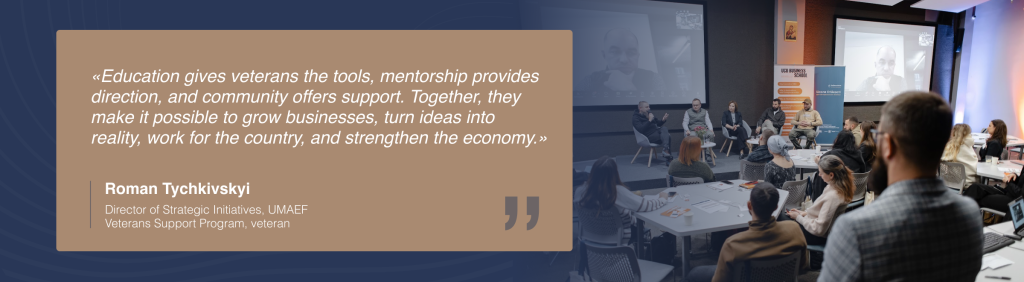
Roman Tychkivskyi summarized the mission of the program:
“The school aims to strengthen each participant’s resilience by increasing added value in business and partnerships.”
He wished all participants a productive start.
Oleh Shymanskyi added:
“Education must be practical, modern, and engaging—not abstract, but something that truly prepares people for real life.”
He stressed the importance of basic financial literacy and legal knowledge for both veterans and civilians.
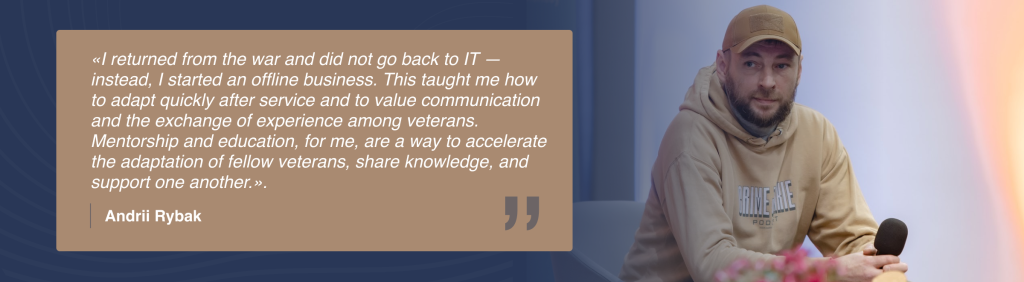
Veteran entrepreneur and mentor Andrii Rybak shared his personal journey:
“I returned from the war and did not return to IT — instead, I started an offline business. This taught me how to adapt quickly after service and to value communication and the exchange of experience among veterans. Mentorship and education, for me, are a way to accelerate the adaptation of fellow veterans, share knowledge, and support one another.”
Can Veteran and Civilian Businesses Compete in the Same Market?
“For veteran-owned businesses to successfully coexist with civilian ones, authorities must support peaceful cooperation and partnership,” said Andrii Moskalenko, emphasizing collaboration as a key factor”.
Ihor Bezkorovainyi noted that the issue is complex. He stressed the importance of proactive dialogue, understanding governmental responsibilities, and properly articulating requests from veterans.
He emphasized that any initiative must be legally grounded and well-structured, and that knowledge of governance principles combined with the search for lawful solutions enables veterans to launch real business cases.
“Conditions differ across regions and cities. But one thing is certain: proactive communication, preparation for dialogue, and understanding how authorities operate are essential. And it’s important to remember—nothing is truly free, even for veterans; someone always pays for it,” he concluded.
Together with participants, speakers discussed cases where veterans may receive premises free of charge and how such mechanisms actually work.
At the end of the discussion, attendees had the opportunity to ask questions about various aspects of business operations: how to communicate effectively with authorities, what the law provides for their businesses, which criteria matter when applying for grants, and what increases the chances of receiving funding.
After the practical and insightful business discussions, Myroslav Marynovych joined to congratulate and inspire participants. Together, they reflected on resilience and the unbreakable human spirit in times of great upheaval.
On the second day of the program, participants visited companies to see real-life examples of resilient business practices, including Rezervist, a tactical clothing manufacturer, and the semi-prepared food production company.
Over the course of 10 months, participants will engage in advisory boards with UCU Business School alumni, mentoring sessions, and classes with the school’s faculty. This comprehensive support enables veterans to grow their businesses, implement new ideas, and strengthen the resilience of the veteran entrepreneur community.
Disclaimer:
The program is implemented by UCU Business School in partnership with the Ukraine-Moldova American Enterprise Fund (UMAEF).