






Today, the Ukrainian experience is moving far beyond news headlines and becoming part of the curricula at leading global academic institutions. Ivey Publishing (Ivey Business School, Canada) and the Ukrainian Catholic University Business School have officially announced the launch of a joint co-branded partnership. The announcement was made during the recent open event, “Four Years of Resilience, Purpose, Community, and Leadership in Ukraine.”
The initiative aims to develop a collection of materials enabling educators and business leaders worldwide to study lessons in leadership and adaptability under conditions of extreme crisis. The central focus of the discussion was a new teaching case about OKKO Group — “A Bombed Gas Station in Korotych: The Spirit of Ukrainians Exemplified” — which describes the restoration of a civilian facility in just two days after an airstrike, symbolizing the resilience of both business and community.
 Voices of Leaders: Why the Ukrainian Experience Matters to the World
Opening the presentation of the initiative, Violetta Gallagher, Product Director at Ivey Publishing, emphasized that for the international academic community, this is not merely documentation of events but an opportunity to hear the authentic voices of those at the epicenter. She noted:
“This partnership helps ensure that the experiences, decisions, and leadership practices emerging in Ukraine are documented accurately and respectfully by those closest to the context. Our goal is to create a collection of materials that will teach educators and leaders around the world how to act in conditions of high uncertainty, where conventional assumptions about business no longer apply.”
Professor of Organizational Behaviour at the Ian O. Ihnatowycz Institute for Leadership, Ivey Business School, and lecturer at UCU Business School, Gerard Seijts — who actively supported and co-authored the OKKO case — observed that while stories from countries at war rarely enter business school classrooms, the Ukrainian example is exceptional due to the depth of personal leadership it demonstrates. Reflecting on Ukrainian resilience, he concluded:
“The story of the bombed gas station is just one of many examples of the spirit of Ukrainians — their courage, strength, and deep-rooted determination in defending freedom. We see how a shared purpose motivates people to act, even when the highest price must be paid.”
 Personal Transformation and the Psychological Impact of Recovery
For OKKO employees, the war became a time of uncovering internal resources that had previously seemed hidden. Mykhailo Fihura, Head of Technical Support at the company, notes that the crisis compelled people to surpass themselves, turning what once seemed “impossible” into a standard operating procedure.
“Human capabilities are far broader and deeper than we imagine. What once seemed unattainable has now become a normal, everyday workflow. When people are professional and strong, difficult times simply give them more opportunities to demonstrate their potential.”
Moreover, the restoration of the destroyed gas station in Korotych within two days had not only economic but also profound psychological significance for the community. Mykhailo explains that such speed created a critically important effect:
“Residents who saw the restored station in less than two days felt a genuine emotional uplift. It brings optimism and strength. If the restoration had taken a week, it would have been perceived as routine repairs. But the immediate result became a sign that we truly are a point of resilience.”
Freedom as a Priority Over Fear
For Ukrainians, this collaboration is also a way of processing lived experience. Sofia Opatska, Founding Dean of UCU Business School and Vice-Rector for Strategic Development at Ukrainian Catholic University, sees the creation of such teaching materials as a tool for transforming traumatic experience into intellectual achievement. She explained the role of the business school through case writing:
“For us, reflection is a way of growing through traumatic experience — an opportunity to understand how we, our society, and our businesses are changing. Companies have become an element of stability for Ukrainians: no matter what happens, we know we can rely on them.”
 Ukrainian Adaptability and Leadership as a Daily Ethical Choice
The portrait of Ukrainian business was also outlined by Larysa Galadza, former Canadian Ambassador to Ukraine. She highlighted how proactive Ukrainian private entrepreneurship is compared to many Western models, where businesses often wait for direction from the state. Her message to international leaders was unequivocal:
“Something we can learn from Ukrainians is how businesses step forward to become part of the response [to a crisis]. And that is something I have not seen or witnessed in Canada… Businesses saw themselves as part of the solution. They did not wait for someone to sign a contract with them. They did not wait for someone to develop a strategy. They asked themselves: ‘What can I do? What is the right thing for me to do with the capabilities and resources I have?’ And then they did it. That is incredibly powerful.”
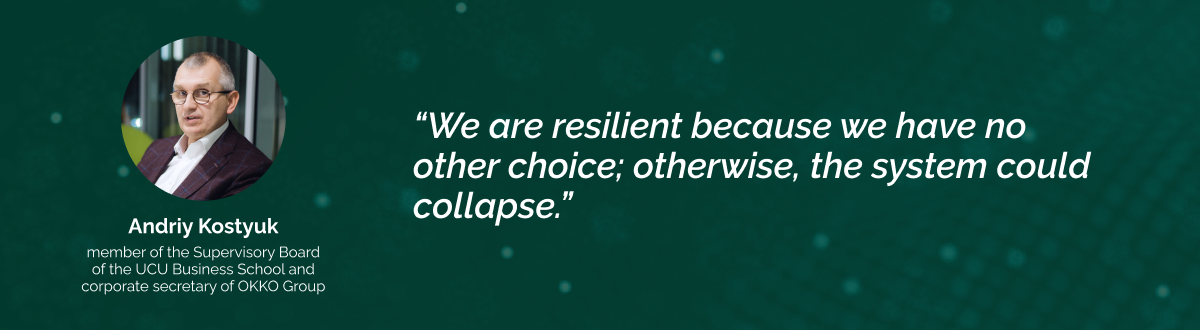
The practical dimension of this resilience was further articulated by Andrii Kostiuk, Member of the Supervisory Board of UCU Business School and Corporate Secretary of OKKO. He stressed that rapid restoration of facilities is not a financial strategy but a duty to society, as the company’s filling stations have evolved into genuine humanitarian hubs. Speaking about the team’s motivation, he stated:
“We are resilient because we have no other choice — otherwise, the system may collapse. Our stations have become ‘points of resilience,’ where people can not only refuel but also receive a signal of optimism, drink a hot coffee, or charge their phones when the city remains without electricity for hours.”
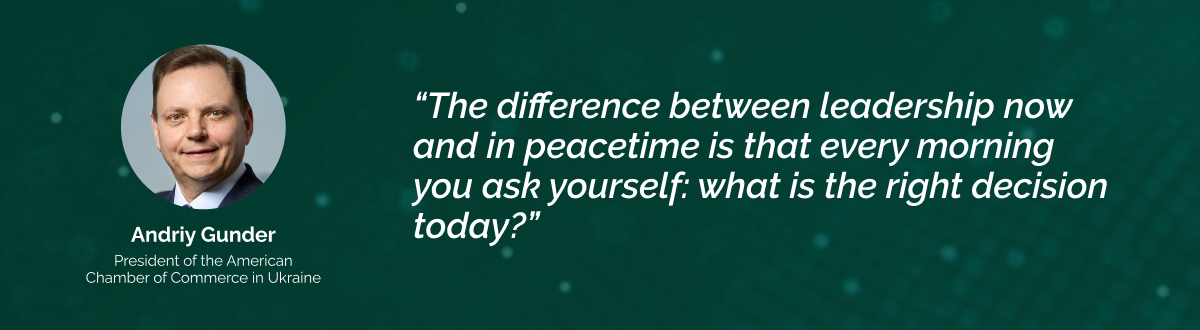
 Andriy Gunder, President of the American Chamber of Commerce in Ukraine, added that contemporary Ukrainian leadership is grounded in empathy and in a daily choice in favor of values. He is convinced that this experience will reshape global management standards:
“The difference between leadership now and in peacetime is that every morning you ask yourself: what will be the right decision today? Business has played an enormous role in supporting the country, and I am confident that future generations will study these cases as examples of phenomenal management during a full-scale war.”
 The partnership between UCU and Ivey confirms that Ukrainian business today is creating intellectual products of global caliber. What once seemed impossible is now becoming part of the global science of leadership — to be studied in the best classrooms around the world.
The case “A Bombed Gas Station in Korotych, Kharkiv Region: The Spirit of Ukrainians Exemplified” about OKKO Group is available on the Ivey Publishing website.