







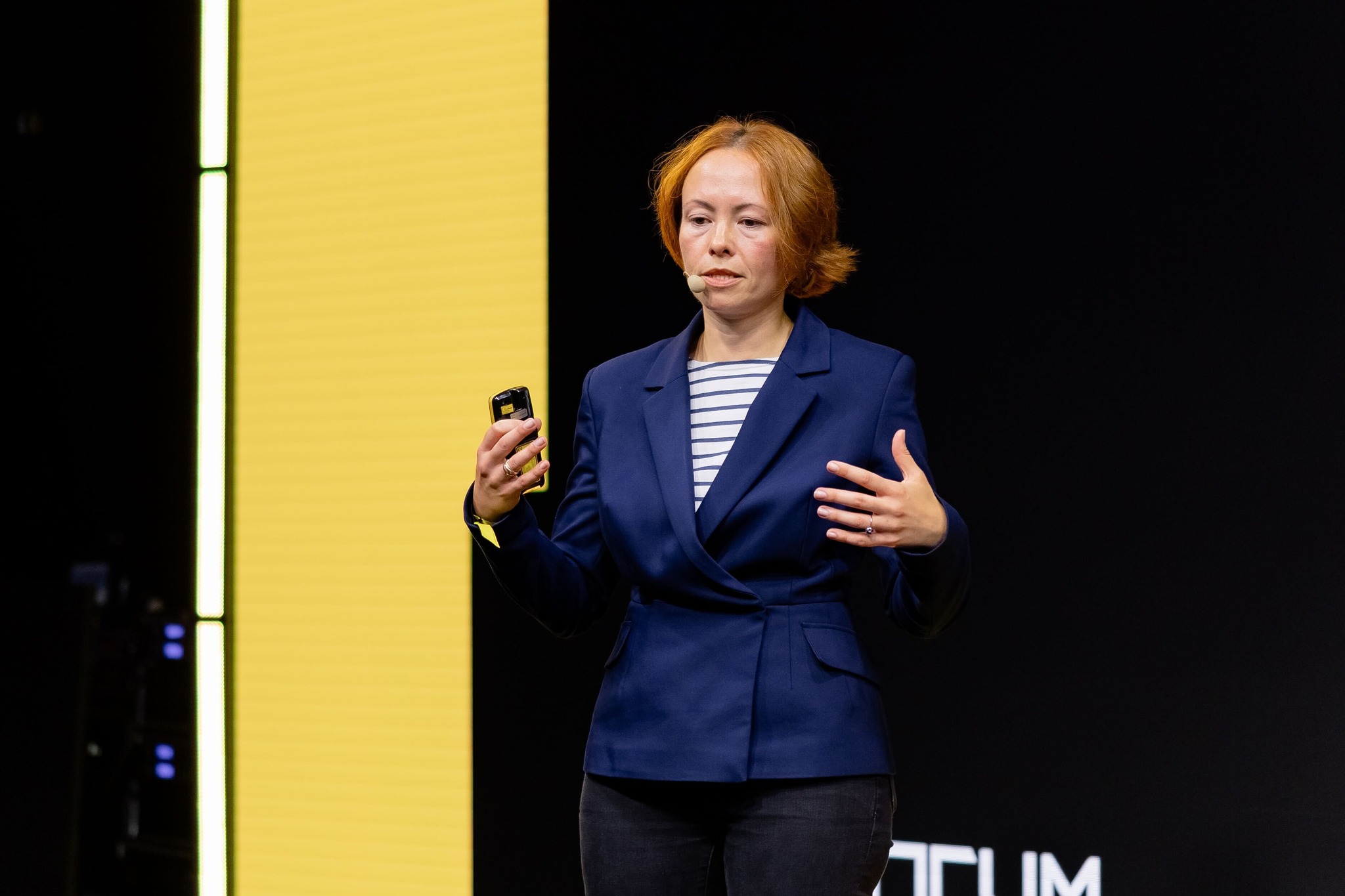
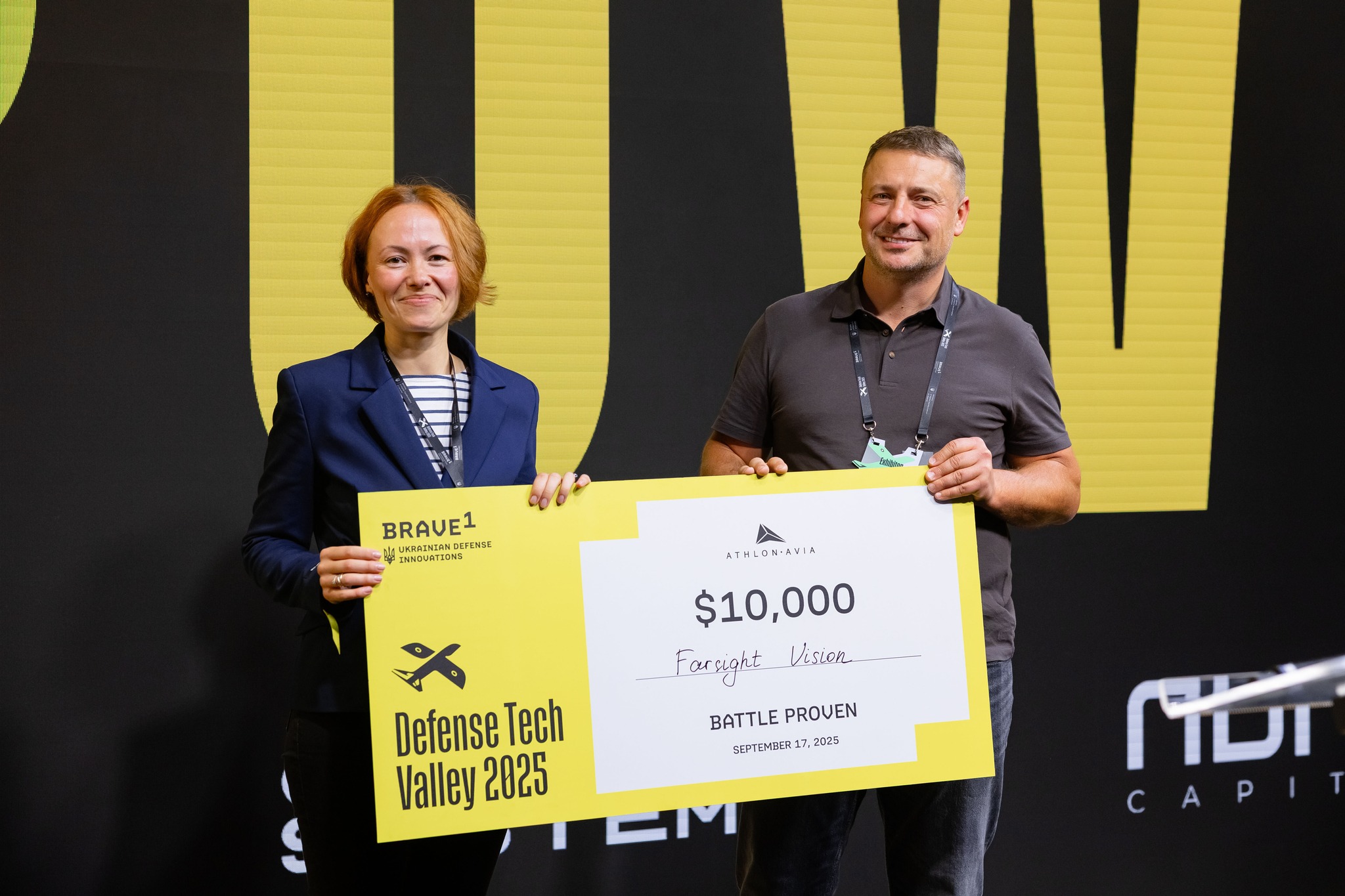
Victoria Yaremchuk is the co-founder and CEO of the technology startup Farsight Vision and a graduate of the UCU Business School’s MSc in Technology Management 2023 program. Victoria’s team creates 3D terrain models and decision-support tools for complex conditions, helping the military plan tasks effectively and ensuring drones have the best possible understanding of the situation on the ground, reducing losses.
How did studying at the UCU Business School help transform a thesis project on medical laboratories into a product for the Armed Forces, and why has “humility” become the main virtue of a modern leader? Read more about Victoria’s personal story and the path of Farsight Vision in the article.
 A beginning in times of uncertainty: why 2020 became a turning point
Victoria’s professional development at the UCU Business School began in 2020, a difficult year for the whole world. It was then, against the backdrop of the COVID-19 pandemic, that she felt the need to go beyond standard management knowledge.
How did you come to the decision to study at the Business School, and why was this period decisive?
When I first tried to enroll, it was 2020. At that time, there was no full-fledged master’s program in technology management due to COVID, so I tried a certification program. My interest was driven by the fact that I had already started managing a rapidly developing large project. And it seemed to me that regular management courses or training for managers would not be enough. I had a lot of responsibility: not just project management, but also financial, marketing, product components, people management, and close cooperation with the HR department. I started as a delivery manager and later became a delivery director. It was a department I was fully responsible for, with a variety of business goals. And it seemed to me that I simply lacked the tools.
How did you feel about your work before you got these systematic tools?
I did a lot of things by touch, trying to guess what I was doing. Probably like many others. One of my acquaintances, who was finishing his studies, spoke very highly of the program. It sounded like a perfect match to me, although I was considering other options, both in Ukraine and abroad. However, I really liked that the UCU Business School was focused on entrepreneurship. It’s not about consulting or managing a large business that someone else created before you. It’s about creating something new, building something from scratch. That’s what I’ve always liked.
Recognizing “ignorance” as the first step toward growth
Enrolling in the UCU Business School often comes with a bit of an intellectual shock when experienced professionals encounter a bunch of new methodologies.
 How exactly did the training change your management perspective, and what were your first impressions of the program?
It changed everything. In fact, at first, I even felt a little disappointed, thinking, “Oh my God, there’s so much I don’t know.” How am I supposed to deal with all these lessons, best practices, and tips that have been thrown at me? We had many practical activities across different areas, but I couldn’t apply everything right away. That was also a little upsetting: you have a wide range of knowledge, but you only use 20-30% of it. However, later, when I became Director of Engineering in an international team, these tools began to “shoot off.” There were challenges there, too — coordinating work across departments in different countries and a large structure. That’s when I needed a lot more of the tools we had practiced during our studies. And when I started my own company, I used a completely different set of tools. Everything was useful — even understanding what we definitely wouldn’t do.
Networking as a way out of the “IT bubble”
For Victoria, business school became a place where knowledge takes second place to people. She emphasizes that the community is the school’s main asset.
You often mention special networking. What was the “wow effect” for you outside of the training modules?
I would say that it’s the other way around: networking, sharing experiences, and understanding how someone else’s experience can be useful to me comes first, and the disciplines and teachers come second. We had many representatives from the IT sector, perhaps because of Lviv’s unique environment, where there are many IT specialists of different levels: product, outsourcing, consulting, but there were also representatives from other businesses. Although we were in a certain “bubble,” with about 50% IT, people had very different levels of experience and company sizes.
 Were there specific moments when interacting with your classmates helped you solve real business problems?
I remember how we analyzed the differences between the positions of CIO, CISO, and CTO in detail, going into deep nuances. We looked at this through the prism of companies from completely different fields. It was interesting when someone from the group brought up a real-life request: “I have this problem, help me.” And we brainstormed using various tools from the modules. When you do exercises like this, you realize: this person thinks completely differently from me, and I want to learn from them. And someone is two steps ahead of you in terms of experience, and you want them to be your mentor. This takes you out of your comfort zone. Each module was completely new knowledge for someone, and this shared challenge brings people very close together. The desire to be part of a community is what I value most.
Partnership forged by competition: the story of a “match” with Volodymyr Nepyuk
One of the most important outcomes of the training for Victoria was meeting first a classmate and then her future partner and the owner of the Farsight Vision service station, Volodymyr Nepyuk. It wasn’t about falling in love with a shared business idea at first sight, but rather a long test of character.
How exactly did your “match” with Volodymyr happen?
That’s my favorite question. Our partnership began with competition. We have an inside joke: Volodymyr recalls that I always had my own point of view in discussions. And he always had his own. He reads a lot, knows a lot, and it was obvious right away. We had a kind of mini-competition—an exchange of ideas in a dynamic environment. We challenged each other and were part of an active group of five to seven classmates who constantly shared case studies, books, and invitations to business events. We are very inquisitive; we needed to know everything.
What exactly in his character made you think, “I can build a business with this person”?
We felt a natural desire to do something together, although at first there were no specifics. I noticed one thing: we were given homework assignments, and Volodya and I always did them. There were colleagues who did it every other time, but he always saw it through to the end. For me, this was an indicator that he could be relied upon. His sense of humor was also important. As Volodya says, “Humor is a sign of high intelligence.” Most importantly, our primary goal was not simply to make money. Financially, we were both doing well. We wanted to build something valuable that would benefit the country here and now.
 Tuck School of Business and FBI methodologies: American experience
An important milestone was an exchange program in the US, which gave Victoria the tools to negotiate at the highest level.
You mentioned studying at the Tuck School of Business. How did this experience influence your strategic thinking skills?
In 2023, I went on an exchange program to the US for one semester. There was an extremely cool course on negotiating in crisis situations. We studied the methods used by American federal agencies, such as the FBI, and military negotiators who rescue hostages or prisoners and have developed approaches over decades. To be honest, when I was taking this course, I didn’t fully understand it. It is only when you start practicing that you remember the theory. Strategic communication, as taught by a good business school, must go hand in hand with practice. At UCU, we had a “safe space” for training, but the real “tough negotiations” began later. Over the past two and a half years, there has been a great need for these skills.
Transforming an idea: from communications to 3D terrain modeling
Farsight Vision did not immediately become what we know it as today. The product evolved along with our understanding of the needs of the front lines.
Did your thesis project become the foundation for creating Farsight Vision?
If my first idea had worked out, it would have been a perfect match, because my thesis was about communication systems. But life made some adjustments. However, the approaches to product implementation, business model, and capitalization — these developments from my thesis became useful for Farsight Vision by about 30%. Feedback from mentors and the community helped shape what we have now.
How did the product concept change in the context of full-scale war?
There were two ideas. The first was to automate communications within the defense forces, drawing on my experience at an American healthcare startup. But I knew about parallel projects in this area and wasn’t sure we could achieve such a scale in three months. The second idea was about processing drone video. At first, it was narrow: modeling trenches and engineering structures for the 2023 counteroffensive. Since I am not a military person, I focused on requests. If I were to get involved in this now, with my current knowledge, I would say, “Friends, don’t bother modeling trenches. You need to model the territory and plan defense operations based on it.“ We didn’t have that understanding back then, but we had time to do research because we didn’t want to make a product ”just for the sake of it.”
 Humility as the highest managerial virtue
One of the most unexpected lessons Victoria learned at business school was the concept of “humility.” She reinterpreted it from a religious term to a powerful leadership tool.
How do UCU values help you make critical decisions under high stress?
We often talked about values in the leadership and human resources management modules. One of the main factors for me is humility. Before studying at UCU, I did not consider humility to be a sign of leadership. But after studying at the school, this leadership virtue now contributes most to the company’s growth and development.
What does humility mean in the context of managing a DefTech company?
We work in an extremely stressful environment. We don’t want to betray the trust of our end users—the defenders—and, at the same time, we don’t want to betray the trust of our internal team. Humility allows us to step back and let someone else “take the wheel.” To give colleagues the opportunity to take responsibility, show leadership, and make decisions. Even if you see that the decision is a little off track, the opportunity to let someone try is very inspiring. It’s about the ability to compromise. Understanding the complexity of leadership is what the Business School subtly “wraps” you in. If it weren’t for Farsight Vision, I wouldn’t have been able to fully experience everything we were taught.
Alumni Community: Feeling at Home
Despite her busy schedule, Victoria finds time to stay connected with the school, including joining the Alumni Council.
How do you keep in touch with the community now that you have so little time?
I really do have very little time. We have group chats, we meet from time to time, and we see news on Facebook. I try to get involved in alumni events as much as possible. I am a member of the Alumni Council, although I don’t have time to be super active there. But when something happens in Lviv and at UCU, I am very happy to be there. It feels like coming home. There are not many places like that in the world, but UCU has become one of them. Everyone there is always family, even new people — they are immediately yours.
 The future: Ukrainian business in NATO markets
Victoria’s vision for Farsight Vision goes far beyond the local market. She sees the company as a global player that brings Ukrainian experience to the world.
How do you see the future of the company in a few years?
We have one path — to become an international company. We have already done a lot to ensure that Ukraine is spoken of positively in NATO countries and the European Union. We are a business and a community where people can learn. We are invited to international platforms and collaborations, and we receive investments from all over the world. Our strategy is to remain a Ukrainian company, represented internationally and operating in various markets. We have many plans because we want to create the community that we were taught about in business school.
Author: Olena Sulikovska