






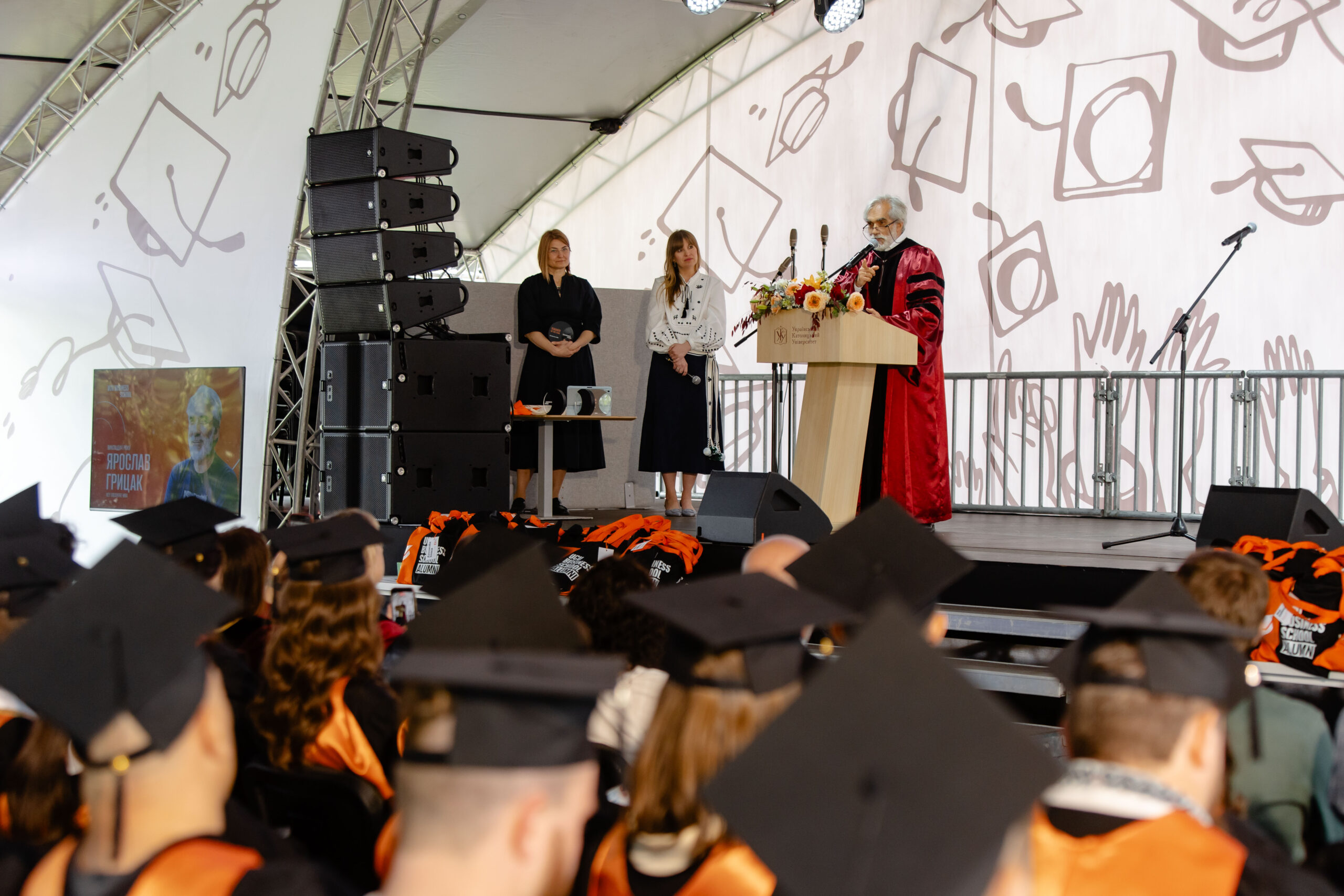
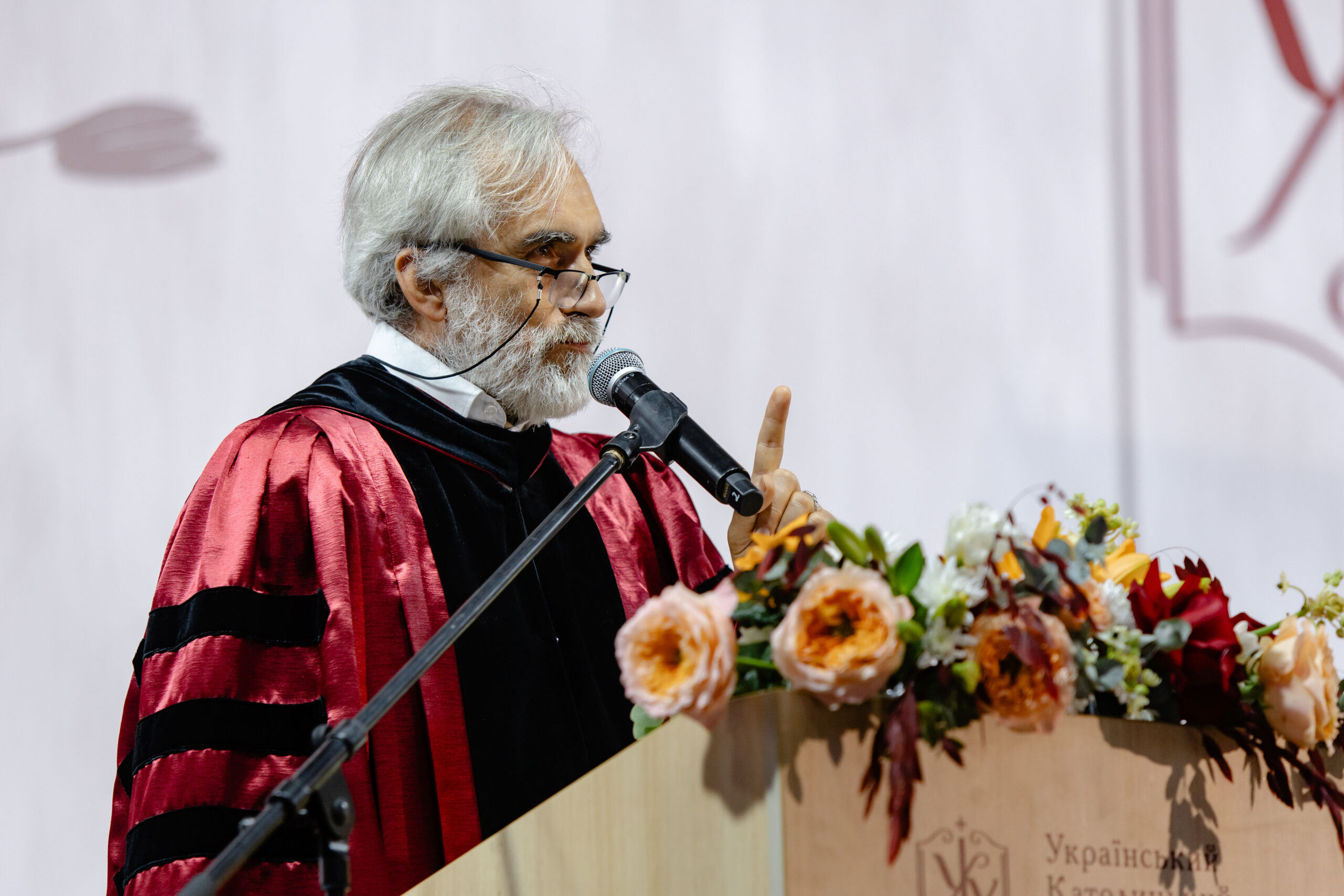
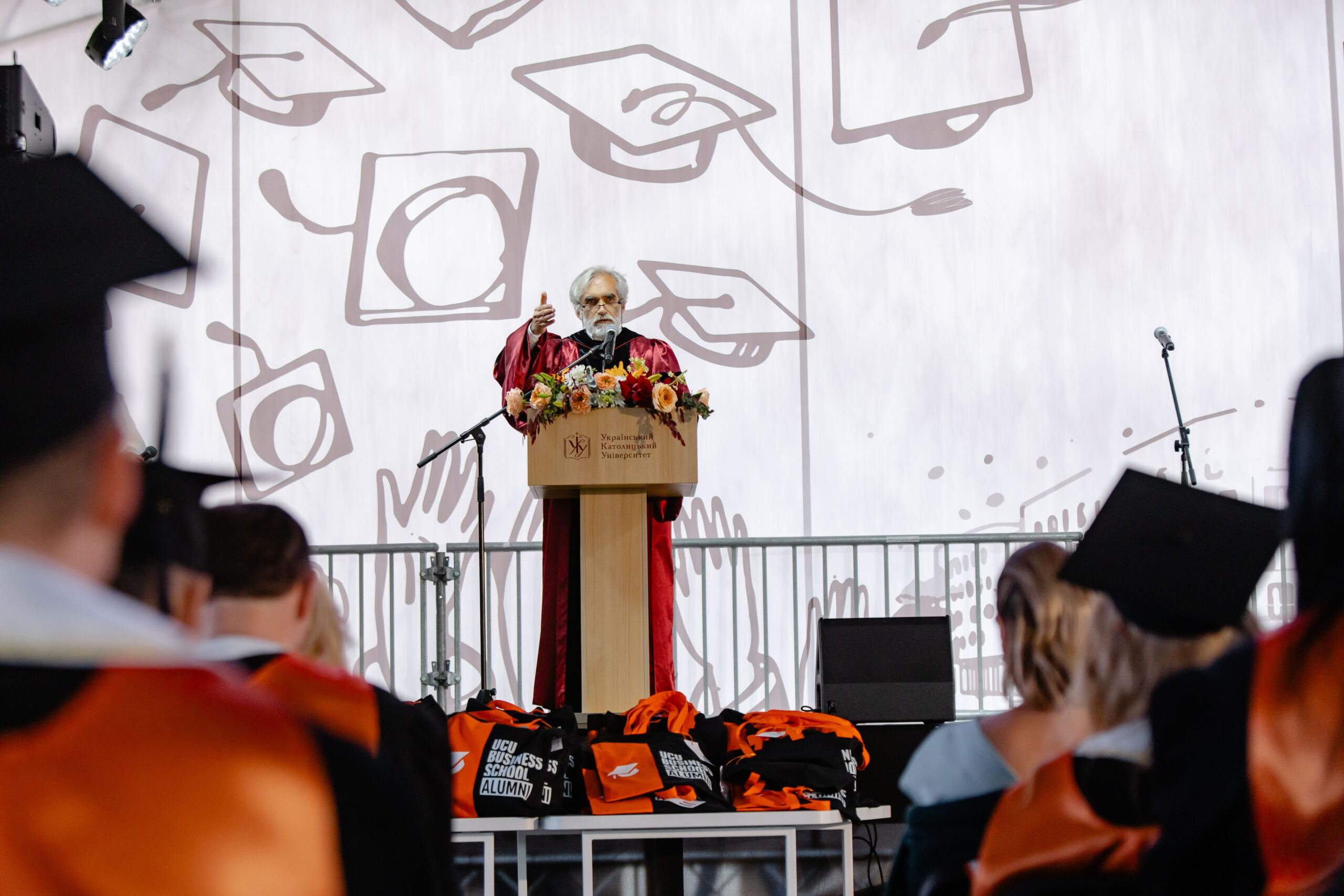
This speech became a defining moment for the UCU Business School community. Renowned in Ukraine and internationally, historian, scholar, public intellectual, member of the Nestor Group, and author of more than 500 academic publications, Yaroslav Hrytsak served as the honorary speaker at the UCU Business School Graduation Ceremony 2026, sharing with a new generation of leaders not only historical parallels but also deeply personal reflections on resilience and the future.
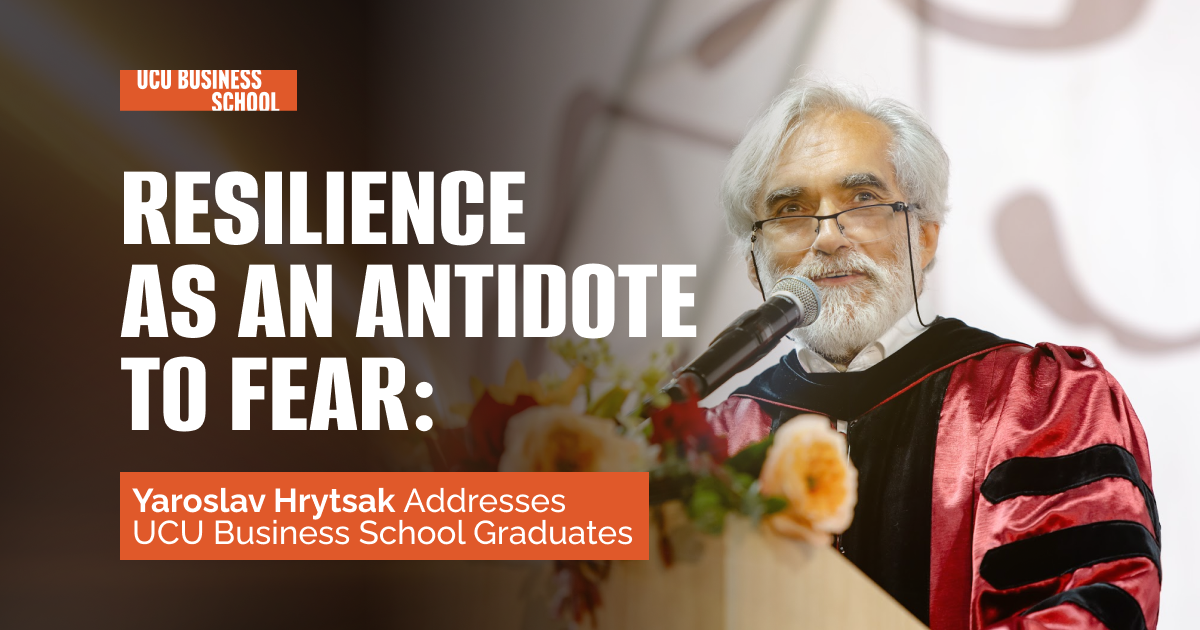 We invite you to explore the key messages and atmosphere of his address:
“Your Reverence, Vice-Rector, Dean of the Business School, dear colleagues, and graduates of the finest business school in Ukraine—and in the world!
Today, on June 13, 2026, I would like to ask you a serious question: should we expect the end of the world? Three days ago, the duration of our war exceeded that of the First World War. In 1918, Europe was exhausted. Yet today, Ukrainian society continues to demonstrate extraordinary resilience.
Historians have calculated that since 1800 BC, humanity has produced exactly 500 predictions of the end of the world. On average, one every ten years. Over the past two centuries, such predictions have appeared every nine months, and since the beginning of this century, every two months. Even the CEO of OpenAI predicts that artificial intelligence could escape human control as early as 2027. But I have good news for you: not one of the previous 500 predictions came true. It is unlikely that the 501st will either.
 Consider the history of our university. Most of you do not remember 1962—the year of the Cuban Missile Crisis. The world stood on the brink of nuclear war when Mykyta Khrushchev ordered missiles to be deployed to Cuba, just 140 kilometers from Florida. For thirteen days, humanity truly hung by a thread.
At that critical moment, one of the key figures was Pope John XXIII. He acted as a mediator between Khrushchev and Kennedy, who, as a Catholic, listened closely to the Pope’s counsel. When the crisis was resolved, Khrushchev asked how he could express his gratitude. The Pope replied: ‘You have a cardinal in Siberia…’
Khrushchev was surprised to learn he was still alive. The cardinal was Josyf Slipyj. By then, he had spent eighteen years in Soviet exile and was already eighty-one years old.
The Soviet leadership allowed him to leave for Rome, assuming that the elderly man would simply spend the rest of his days there. Instead, something remarkable happened. Josyf Slipyj not only survived—he outlived Khrushchev, Brezhnev, and Andropov.
 Upon arriving in Rome, one of his first actions was to establish the Ukrainian Catholic University. His vision was clear: when Ukraine regained its independence, the university should return to Lviv and become a source of ‘Ukrainian light’ for the world.
And so, from the threat of a global catastrophe emerged a university. This is a truth worth remembering whenever fear takes hold.
Fear can be a constructive emotion—if we know how to work with it. We are often afraid, but fear must serve a purpose. As G.K. Chesterton once wrote, we tell children stories about dragons not to frighten them, but to teach them that dragons can be defeated.
Before I conclude, let me offer a few pieces of advice on how to live in a world governed by deadlines:
Read great books. Nothing makes you more significant than engaging in a conversation with the greatest minds of the past.
Learn how to fast properly. True fasting today is not about giving up food. It is about giving up the thing we lack most—time. When you see a desk buried under paperwork, tell yourself: ‘I am not God. I cannot do everything.’ Then go for a coffee or a beer with a friend. Spend time with your children. Embrace those you love. Visit your parents. Give your time to others.
Live well. Live life the way we say in Ukraine — faino. This is a Ukrainian word for living well and fully. As an old Hutsul used to say: “Live in such a way that, when you look back on your life from your deathbed, you can say: ‘Ah, but it was faino!’”
The greatest gift you can give me is your friendship. It is a true honor to call you my friend, and I will treasure that bond for as long as I live.
Congratulations, graduates. Thank you!”
— Yaroslav Hrytsak
This year, Yaroslav Hrytsak was also named “Professor of the Year,” an award determined by a vote of students across the School’s master’s programs. The full list of award recipients is available via the link below.