




The Business School hosted an open meeting organized by the UCU Business School Alumni Book Club. The main event was a discussion of the study “A Bomb as a Legacy: The Collapse of the USSR and Ukraine’s Nuclear Disarmament,” with its author — Mariana Budzheryn, Ph.D. in Political Science and Senior Research Fellow at the Nuclear Energy Management Project of the Belfer Center at Harvard’s Kennedy School.
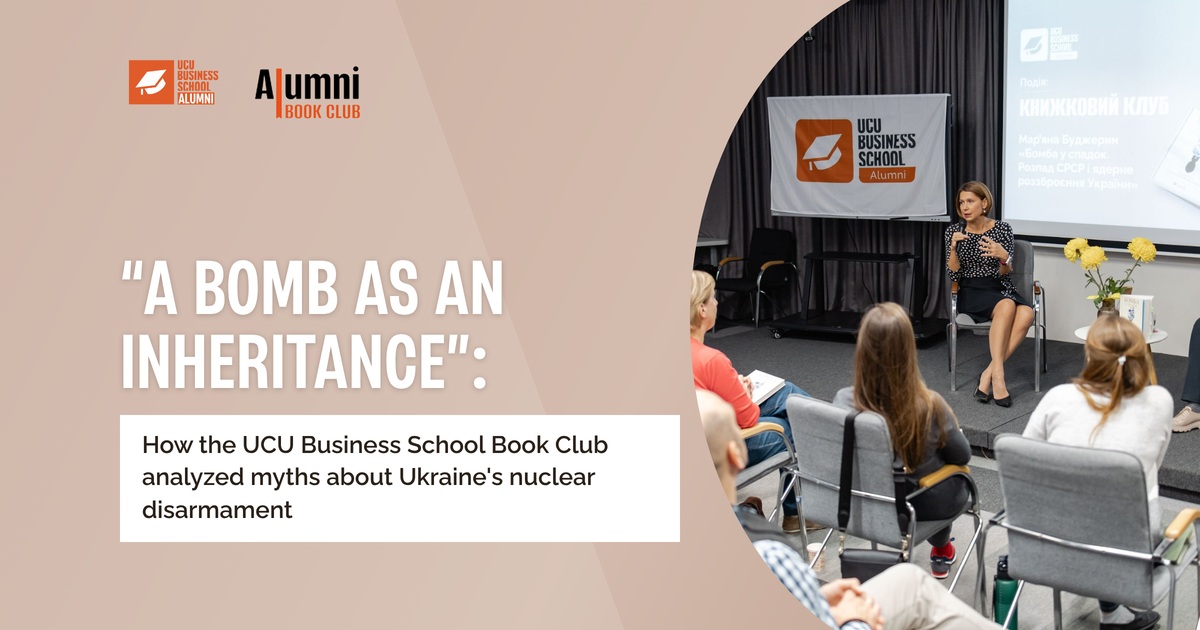
Master’s program students, alumni, and the UCU community gathered to examine in detail one of the most complex geopolitical cases in modern Ukrainian history. The meeting was moderated by Tetiana Novolodska, head of the UCU Business School Alumni Association, who emphasized that for the fifth consecutive year, the Book Club project has served as a platform for in-depth reflection and the search for managerial insights.
Why did Mariana Budzheryn’s book change the perspective on the events of the 1990s?
Mariana Budzheryn is a native of Lviv and a graduate of the Kyiv-Mohyla Academy and Central European University. She began work on her academic book, “A Bomb as an Inheritance”, back in 2010–2012.
“Back then, the topic of nuclear weapons was considered completely out of fashion in European academia,” Mariana Budzheryn said during the meeting. “Everyone was talking about soft power, migration, bureaucracy in Brussels, and human security. Military power seemed like a relic of the Cold War. But I stuck with this topic out of stubbornness and a sense of duty to Ukraine.”
In 2024, “The Bomb as an Inheritance” gained international recognition — winning the prestigious Colby Military Writers’ Award, an American prize for military history. The researcher became the first woman to receive the award in its 25-year history. The book was originally published in English in 2023 and was later translated into Ukrainian by the “Local History” publishing house and into Polish by the Juliusz Mieroszewski Center for Dialogue.

According to the author, her main goal was to debunk two widespread notions, which she proposes to rethink:
– The Western myth: that the nuclear arsenal was purely Russian, and Ukraine merely happened to have it on its territory and negotiated for compensation.
– The Ukrainian myth: that Ukraine allegedly possessed the world’s third-largest nuclear arsenal and recklessly gave it up (under the Budapest Memorandum).
What was the real diplomatic and technical dilemma facing Ukraine?
During a discussion at UCU, the circumstances facing the young Ukrainian leadership, headed by Leonid Kravchuk, in 1991–1994 were examined in detail.
As Mariana Budzheryn explained, following the August coup and the declaration of independence in 1991, a complex command structure for strategic nuclear forces existed, in which the Russian leadership continued to play a central role.

1. The Chornobyl Disaster and the Social Context
In the Declaration on State Sovereignty of July 16, 1990, Ukraine voluntarily affirmed its intention to become a nuclear-free state. The main drivers of this decision were the 1986 Chornobyl disaster and the “Green World” anti-nuclear movement, which included Volodymyr Yavorivsky, Ivan Drach, and Vyacheslav Chornovil. In the public consciousness, everything nuclear was automatically associated with Moscow’s imperial oppression.
2. Critical Technical Dependency
In official documents, Ukraine asserted its ownership of the inherited nuclear weapons. At the same time, the operational use of the arsenal, the command system, and the technical infrastructure were closely tied to Moscow. The warheads of intercontinental ballistic missiles required specialized maintenance at factories in the Russian Federation.
3. Energy and Financial Vulnerability
Had Ukraine refused to disarm, it could have faced external pressure, economic leverage, funding issues, and international isolation.
“The alternative to the 1994 Budapest Memorandum was not a better treaty offering guarantees on the level of NATO’s Article 5, but rather nothing at all — diplomatic isolation, sanctions, and exclusion from the international system,” the researcher emphasized.
Was there a “third way” for Ukraine in the 1990s, and why did the Budapest Memorandum fail?
Responding to a question from graduates of the UCU Business School, Mariana Budzheryn suggested considering an alternative path for Ukraine: transferring its nuclear warheads to Russia while maintaining the opportunity to develop its own nuclear technologies for peaceful purposes. At the same time, Ukraine could retain its conventional missile capabilities and develop its own missile systems. According to the author, such an approach would allow Ukraine to combine a demonstration of goodwill with the preservation of the state’s strategic capabilities.

In her analysis of the Budapest Memorandum, the researcher highlighted the distinction between the English terms “security assurances” and “security guarantees” (the latter being legal guarantees involving a military commitment).
“Even the strongest international treaty doesn’t work on its own unless it’s filled with concrete meaning every day,” explained Mariana Budzheryn. “By signing the memorandum in 1994, Ukraine effectively shelved it for 20 years. Article 5 of the NATO Charter works not because of four lines of text, but because of decades of base deployments, joint exercises, intelligence sharing, and a unified command structure.”
At the same time, the researcher emphasized that when Russia occupied Crimea and invaded the Donbas, Washington opted for the narrowest interpretation of the Budapest Memorandum, thereby blocking the provision of real military aid to Ukraine.
What is the key lesson CEOs should take away from the “Legacy Bomb” case study?
During the concluding part of the meeting, the researcher answered the key management question: if this case study were taught at a business school, what single key lesson should a CEO take away?
Mariana Budzherin noted that the main managerial trap lies in attempting to reduce a complex choice to binary logic—either completely surrender the asset or risk total conflict. Instead, top management must identify alternatives that minimize risks and maximize positive outcomes.

Book club participants and alumni of the UCU Business School aptly expanded on this answer:
“We often become an ‘office of simple solutions’ because it’s psychologically easier for the human brain to choose a linear ‘either/or’ option. But true strategic leadership is the ability to see and keep focused on several parallel, multi-step processes with a long-term horizon for implementation, rather than seeking quick answers.”
How Are Modern Technologies and Asymmetric Weapons Shifting the Balance of Power?
Referring to the events of the full-scale war, Mariana Budzherin shared observations from her current research project—a documentation of the capture of the Zaporizhzhia Nuclear Power Plant by Russian occupiers. The author noted that Russia’s aggression has permanently shattered illusions about “brotherly projects” even among former Russian-speaking nuclear plant workers in Energodar.
The optimistic conclusion for Ukraine is that the development of conventional weapons can strengthen the ability to deter nuclear blackmail, the researcher believes. For example, operations like “Pavutyna” demonstrate how relatively inexpensive drones can strike the enemy’s strategic targets. The development of Ukraine’s own missile technologies and other weapons systems can also strengthen the country’s defense capabilities and create additional deterrents without relying on nuclear weapons.
“The world is witnessing a unique historical precedent: a non-nuclear country, thanks to innovation, resilience, and courage, is holding back a war against the world’s largest nuclear power,” concluded Mariana Budzheryn. “Our task is not to wait for guarantees on paper, but to integrate ourselves institutionally into the European defense system on a daily basis, establishing joint production facilities and intelligence-sharing mechanisms.”

You can view the list of books for 2026 here.
Read also: A New Wave of Opportunities: How the UCU Business School Ecosystem Empowers Its Alumni
Background:
Mariana Budzheryn holds a Ph.D. in political science and is a senior research fellow at the Belfer Center for Science and International Affairs at Harvard’s Kennedy School. Her research focuses on the nuclear (non)proliferation regime, arms control, nuclear deterrence and escalation, as well as the manipulation of nuclear risks in conventional conflicts. Budzheryn graduated from the National University of Kyiv-Mohyla Academy and Central European University. She is originally from Lviv. In 2024, for her book “A Bomb as an Inheritance”, she received the William Colby Prize in Military History, becoming the first female recipient in the award’s 25-year history.