







At the start of the academic year, during the Big Start 2026 event at the UCU Business School, Jean-Christophe Boni, founder and director of the Team4UA Foundation, shared his experience with making emergency decisions at critical moments. At Big Start 2026, Jean-Christophe Boni spoke about his transformation from an investor to the leader of a humanitarian movement, the principles of “irrational leadership,” technological transparency in NGOs, and sources of resilience during wartime.
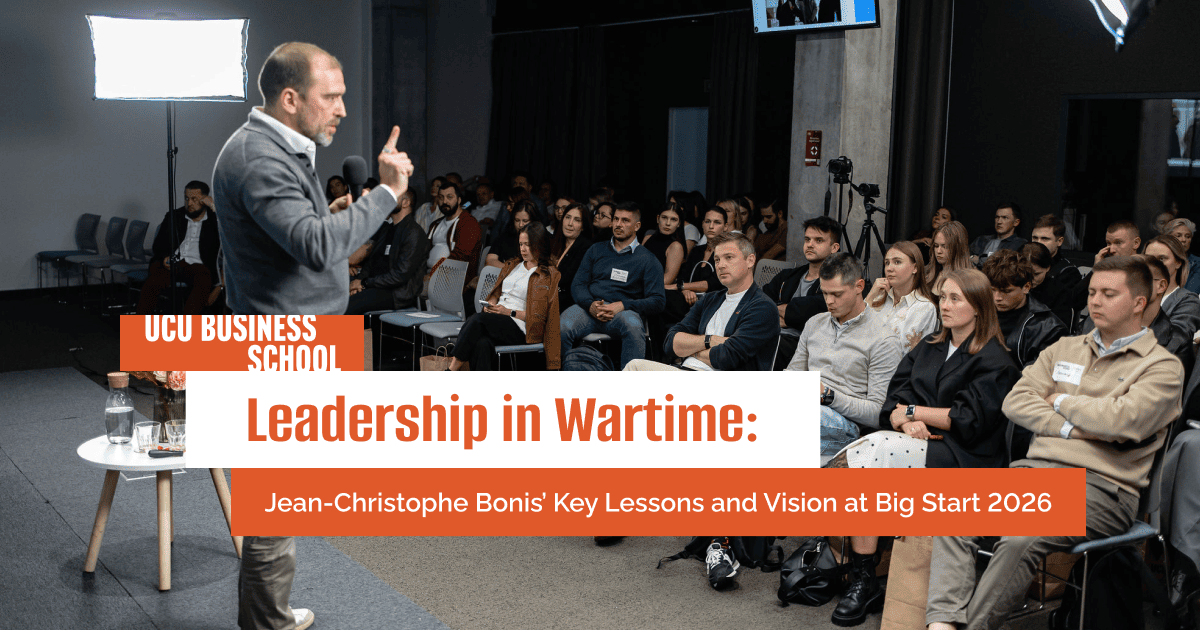
From October 7–10, 2026, the new academic year began at the UCU Business School in Lviv under the theme “Leadership in Change. Unity in Action. Resilience Through Development.” Seventy-six new students in five master’s programs embarked on their journey amid a time of uncertainty. The evening session on the first day featured a presentation by French tech entrepreneur, investor, and futurist Jean-Christophe Boni, whose personal experience exemplifies how speed and ethical choices can overcome bureaucracy.
How did a decision made on February 24, 2022, change the investor’s life and lead to the founding of Team4UA?
On February 24, 2022, Jean-Christophe Boni was in Warsaw. At the time, he was leading an investment fund as managing partner and served as co-chair of French Tech. When the French Embassy convened an emergency meeting of diplomats and civil society representatives, international organizations offered to send several ambulances.
“It was a good idea, but I was convinced that the scale of the response was completely out of proportion to the scale of the disaster,” Jean-Christophe recalls. “When I was diplomatically advised not to intervene, I decided to act on my own. If you see a crisis, you have two options: wait or act.”
Since UN agencies lacked an official mandate from the Polish government for large-scale operations in the early days, chaos ensued at the border. So Jean-Christophe enlisted the help of his friends from the Ukrainian diaspora.
As a result of this initiative, on the very first day the team received 500 calls from volunteers and drivers across Europe, and on the second day, inquiries exceeded 3,000, enabling the launch of a round-the-clock warehouse hub for sorting humanitarian aid. In a month and a half, they managed to evacuate over 100,000 refugees to European capitals.
What is the philosophy behind “irrational leadership”?
Business education teaches students to use logic, rational analysis, risk assessment, and to develop long-term strategies. However, in exceptional situations, the first decision must always be emotional and intuitive—one based on an inner sense.
“My first decision to leave a comfortable life and a position at an investment fund to go to Ukraine with just a backpack was completely illogical from a business perspective,” Jean-Christophe emphasizes. “My parents and loved ones didn’t understand why I would go to a country that everyone was fleeing. But it was the second decision—a cold, rational analysis of how to set up logistics and maintain structure—that transformed that emotional impulse into a sustainable institution.”
According to Jean-Christophe, leadership in times of war requires a manager to be willing to pay the price for his own decisions. He lost his high salary and a good night’s sleep, but gained complete inner harmony between his personal values and his daily activities.

How does the Team4UA Foundation combine technology, AI, and transparency in the nonprofit sector?
Upon arriving in Lviv in the spring of 2022, Jean-Christophe founded the Team4UA Foundation, which later grew into a national charitable foundation. As of 2026, the organization has a team of over 100 professionals and funds approximately 20 partner organizations along the entire front line, leading the TERA Consortium—the first alliance of national and local humanitarian operators.
The foundation became one of the largest recipients of funding from UN humanitarian agencies among national organizations in Ukraine in 2026. Jean-Christophe applied his experience in the technology business and venture capital to the humanitarian sector. Team4UA implements digital tools for data management, monitoring of aid delivery, analysis of results, and report preparation. The organization is also exploring ways to use artificial intelligence to optimize internal processes. This approach helps strengthen oversight of program implementation, ensure accountability, and transparently report to international donors on the use of funds.
Why are hope and faith in Ukraine’s future the main resources for new leaders?
Jean-Christophe Boni urged students not to lose hope and to rely on their own strengths.
“When I worked in finance, one of my mentors used to say, ‘Invest during war, sell during peace,’” the speaker shared. “I don’t care about political statements coming out of European capitals. I see Ukrainian youth; I see this modern UCU campus; and I feel the energy of people who are learning to shape the future during the most difficult times. You have more reasons for hope than most countries in Europe.”

5 Leadership Rules for UCU Business School Students by Jean-Christophe Boni
The entrepreneur has formulated five practical guidelines for participants in UCU Business School programs:
- Trust your intuition: the first critical decision is often an emotional one;
- Start small: to change the system, all you need is a clear structure and to lead by example.
- Know how to say “no”: avoid ineffective meetings, processes, and decisions that contradict your values.
- Learn from mistakes: don’t be afraid of setbacks.
- Be true to yourself: the main marker of success is waking up in the morning knowing that your work has deep meaning.
As a reminder, 76 students recently began the academic year in five master’s programs: Key Executive MBA, Master in Marketing Management, Master in Innovations and Entrepreneurship, Master in Managing Impact-Driven Organizations, and Master in Technology Management.
Learn more about events and master’s programs at the UCU Business School
Learn more about admission requirements, course modules, and research at the UCU Business School on its official resources:
Explore the master’s programs at the UCU Business School
Find out details about the 2026 admissions cycle
Read other analytical articles and news from the UCU Business School