




Since the start of the full-scale invasion, the UCU Business School has advocated for the digital independence of Ukrainian businesses and the security of their operations. Early in the war, together with Olena Kuzmichova, co-founder of the Ukrainian ERP Forum and a professor at the UCU Business School, we prepared an article titled “Russian military software, such as 1C, must go the way of the Russian ship.”
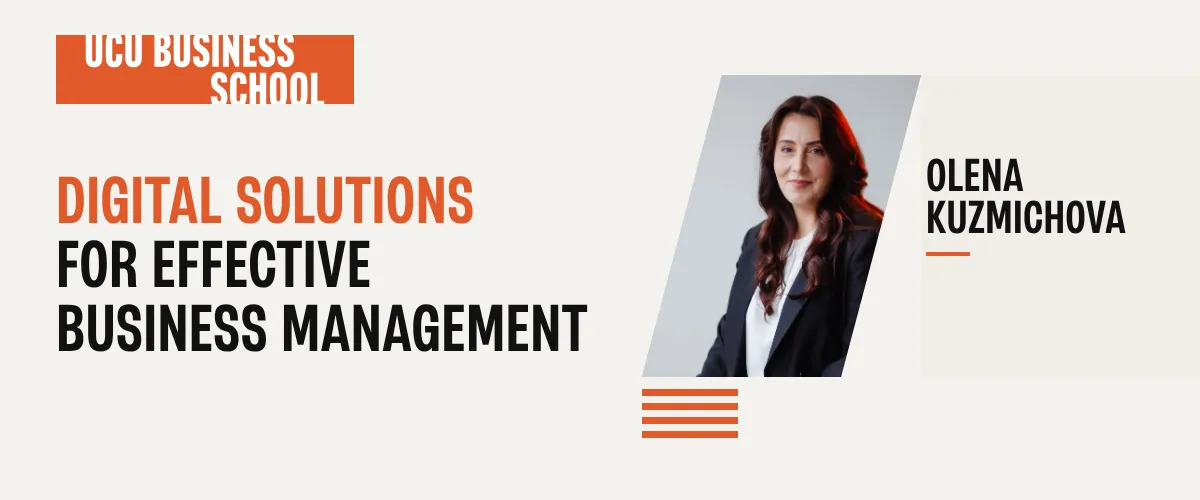
Today, the shift away from Russian software has entered the practical implementation phase. To help business leaders navigate this process in a deliberate and systematic way, the UCU Business School is launching a series of online events:
On November 3 at 5:30 p.m., there will be a webinar titled “Digital Transformation for Micro- and Small Businesses: Where to Start Without Chaos or Unnecessary Costs?”
On November 17 at 5:30 p.m., there will be a webinar titled “Why Do Digital Transformations Fail? A Systematic Approach Instead of Buying Software.”
A full-scale replacement of 1C BAS is critical to the sustainability of Ukrainian businesses, yet most owners postpone this step due to concerns about business disruption and resistance from the accounting department. In reality, phasing out Russian software is a strategic management decision that requires the personal involvement of the business’s top executive. In this article, Olena Kuzmichova, co-founder of the Ukrainian ERP Forum and lecturer at the UCU Business School, outlines a step-by-step process for a secure transition to an ERP system based on the Catalog of Alternatives and Kotter’s change management model.
Why is phasing out 1C and BAS by 2026 a matter of business security, rather than just an IT department issue?
Retaining Russian accounting systems poses threats to businesses that go far beyond technical maintenance. In 2025, CERT-UA of the State Special Communications Service investigated 5,927 cyberattacks and incidents, in which Russian software remains one of the main channels through which adversaries gain access to companies’ infrastructure. Despite this, according to CFO Club Ukraine, approximately 75% of Ukrainian users of accounting systems still work with 1C or its derivatives.
Four risk categories associated with continuing to use 1C/BAS:
- Data security: high risk of losing control over the company’s financial and commercial information.
- Operational resilience: critical dependence on the enemy’s vendor ecosystem, whose updates cannot be controlled.
- Legal and reputational liability: The State Special Communications Service’s list of prohibited software already exceeds 880 items, and legislative restrictions are constantly tightening.
- Growth constraints: Outdated architecture makes scaling, entering foreign markets, and attracting partners impossible.
Why Is There No “Universal Replacement for 1C”?
Business owners often ask, “What can replace 1C?” This question creates a false expectation that there is a single program that will perfectly replicate a company’s processes — without any risk.
There is no universal replacement for 1C/BAS, since businesses vary significantly in scale, industry, and digital maturity. A system suitable for an IT company with 30 employees will not meet the needs of an agricultural holding or a company with its own logistics.
The right question is: Which system supports the logic of my specific business, and how can I transition to it without causing chaos?
As part of the “Hostile Software” project, a Catalog of 1C and BAS Alternatives has been developed, featuring 14 proven systems that are not associated with hostile jurisdictions and are localized for Ukraine.
Among the solutions are the Ukrainian-developed Bookkeeper, Nova Era, A5.ERP, Debit Plus, Vpravno, Dilovod, MASTER, and IT-Enterprise, as well as the international solutions Odoo, Microsoft Dynamics 365 (Business Central and Finance & SCM), SAP Business One, and SAP Cloud ERP, which are localized and implemented by Ukrainian partners.
How to transition to ERP without chaos using Kotter’s model?
Based on the “Change Management” course at the UCU Business School, a practical brochure titled “Safe ERP Replacement” has been developed, which adapts John Kotter’s 8-step model to Ukrainian realities:
- Sense of urgency: The owner answers the question of what will happen to the business if 1C is abandoned and communicates this to the team.
- Forming a leadership team: a sponsor (CEO/owner), heads of finance, logistics, and sales, and an integrator with real authority.
- Vision and strategy (AS-IS → TO-BE): describing the current state and formulating requirements as business outcomes (for example: “management reports are available online”).
- Shortlist and dialogue with integrators: reaching out to several teams with a single request to obtain a cost estimate and gap analysis.
- Transparent communication: honestly explaining the reasons for the transition and the tasks for each department.
- Creating the right conditions: allocating time for training, allowing room for error, and adjusting KPIs.
- Quick Wins: Phased rollout of individual modules with noticeable benefits for the team.
- Consolidating changes: Complete elimination of parallel Excel spreadsheets and establishing the ERP system as the foundation for growth.
- How much does replacing 1C cost: How to calculate the total cost of ownership (TCO)?
The most common mistake managers make is comparing only the cost of software licenses. The budget should be evaluated based on the total cost of ownership (TCO) over a 3–5-year horizon.
Cost Breakdown for Replacing 1C and Implementing an ERP System
| Cost Category | What Is Included in the Calculation | What to Look For |
| Implementation | Integration services, data migration, configuration, and training | The integrator is responsible for adapting the system to business processes |
| Internal Costs | Work hours of managers and key employees | At peak times, the team spends up to 70% of its time on the project |
| Software and Licenses | Subscriptions, licenses, updates, and advanced modules | A low initial cost does not mean a low-cost system over a 5-year period |
| Infrastructure and Support | Cloud/servers, cybersecurity, and annual support | The integrator’s support costs approximately 20% of the implementation cost per year |
About the Author:
Olena Kuzmichova is a co-founder of the Ukrainian ERP Forum, founder of the Agnostic consulting practice, a lecturer at the UCU Business School, and a 2020 graduate of the Key Executive MBA program. She has over 20 years of practical experience in FinTech, banking, and B2B SaaS and is a Prosci®-certified change management practitioner. The brochure “Safe ERP Replacement” was co-authored with Olena Sozanska with the support of the UCU Business School and the IT Ukraine Association.