






In today’s business environment, where the operational workload on executives has reached a 24/7 pace, taking time for training is a strategic investment in survival and growth. For Ukrnafta, which has demonstrated rapid growth over the past three years, this challenge became critical: the company needed to transition its leadership from intuitive to systematic.
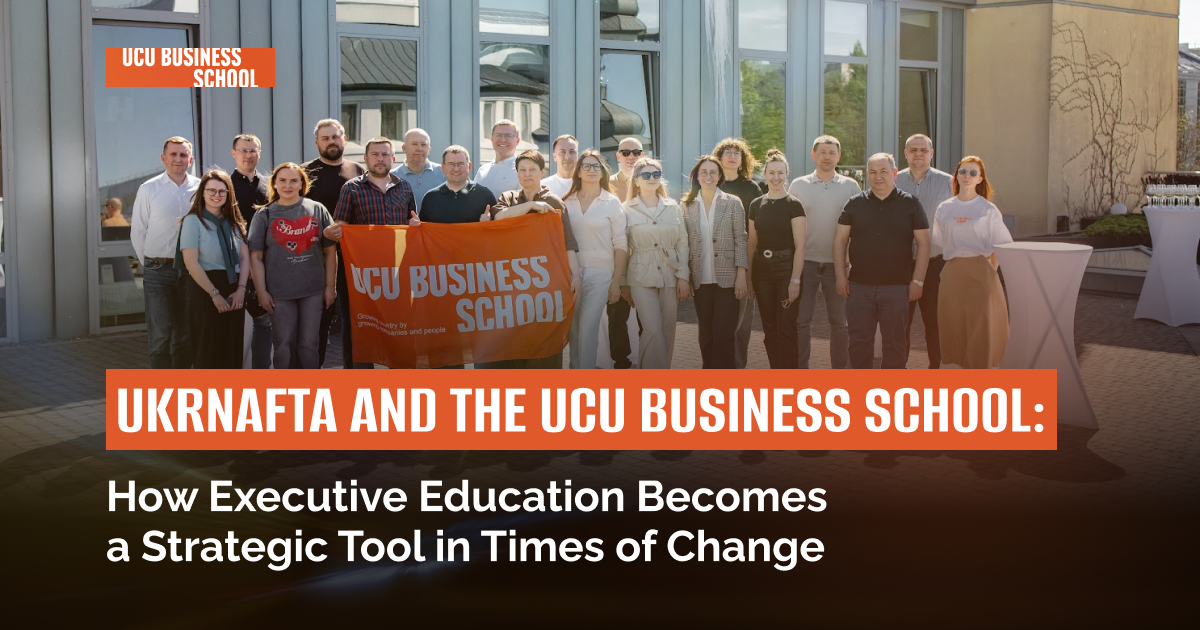 The response to this need was a corporate program offered by the UCU Business School for 25 selected N-2-level managers. Most of them form the “foundation” of the company: department and institute directors, division and branch heads, and operations managers who have dedicated more than 10 years to Ukrnafta and advanced through the ranks internally.
For them, the program served as a bridge from narrow technical expertise to ethical leadership, strategic thinking, and managing teams under high-stress conditions. It was an opportunity to “switch off” from firefighting mode, systematize their experience, master delegation skills, and learn to speak with top management in the common language of numbers and strategy.
Goals and Methodology: 40% Hands-On Practice for Real Change
The training is structured around a 60% theory and 40% practice approach. The program includes interactive discussions, analysis of real-world case studies, and practical exercises that allow participants to immediately apply what they’ve learned to their work processes.
The program began with an exploration of business as a system, led by Valerii Pekar, a professor at the Business School of the Ukrainian Catholic University and the Kyiv-Mohyla Business School, who explained the concept of “multicolored management” and the evolution of thinking within organizations. Kateryna Hirna, a lecturer at the UCU Business School, continued this module with a discussion of strategic management, helping participants map out the path from vision and mission to concrete results through the lens of an organization’s life cycle.
The second stage of the program focused on effective leadership and personal productivity. Andriy Rozhdestvenskyy, Ph.D., and Executive Director of the UCU Leadership Center, focused on the development of leadership character and the specifics of crisis management, which is extremely relevant for civilian leaders during martial law. At the same time, Serhii Potapov, a lecturer at the UCU Business School and a consultant in project and process management, led a module on project management, providing tools for working in conditions of uncertainty—including task decomposition using the PODSC method and algorithms for safeguarding projects prior to implementation.
The operational management and finance module enabled participants to align their efforts with the business’s overarching goals. Lecturer Yuriy Zayarnyy helped managers master the “language of numbers” by explaining the differences between P&L and cash flow, as well as financial modeling techniques.
The final module focused on team building and business communication. In particular, instructor Svitlana Bugay emphasized active listening and motivation through transparent interaction as key tools for delegation
Participant Feedback: From Theory to Practice
For leaders of large companies, the biggest challenge is striking a balance between routine and development. Olga Chukhmanenko, head of a department at PJSC “Ukrnafta,” notes that the training helped her step beyond her daily tasks:
“There’s a lot of practical work, and it’s nice to take a little break, pause, and hear something interesting and new that you can’t always pick up on in your daily routine.”
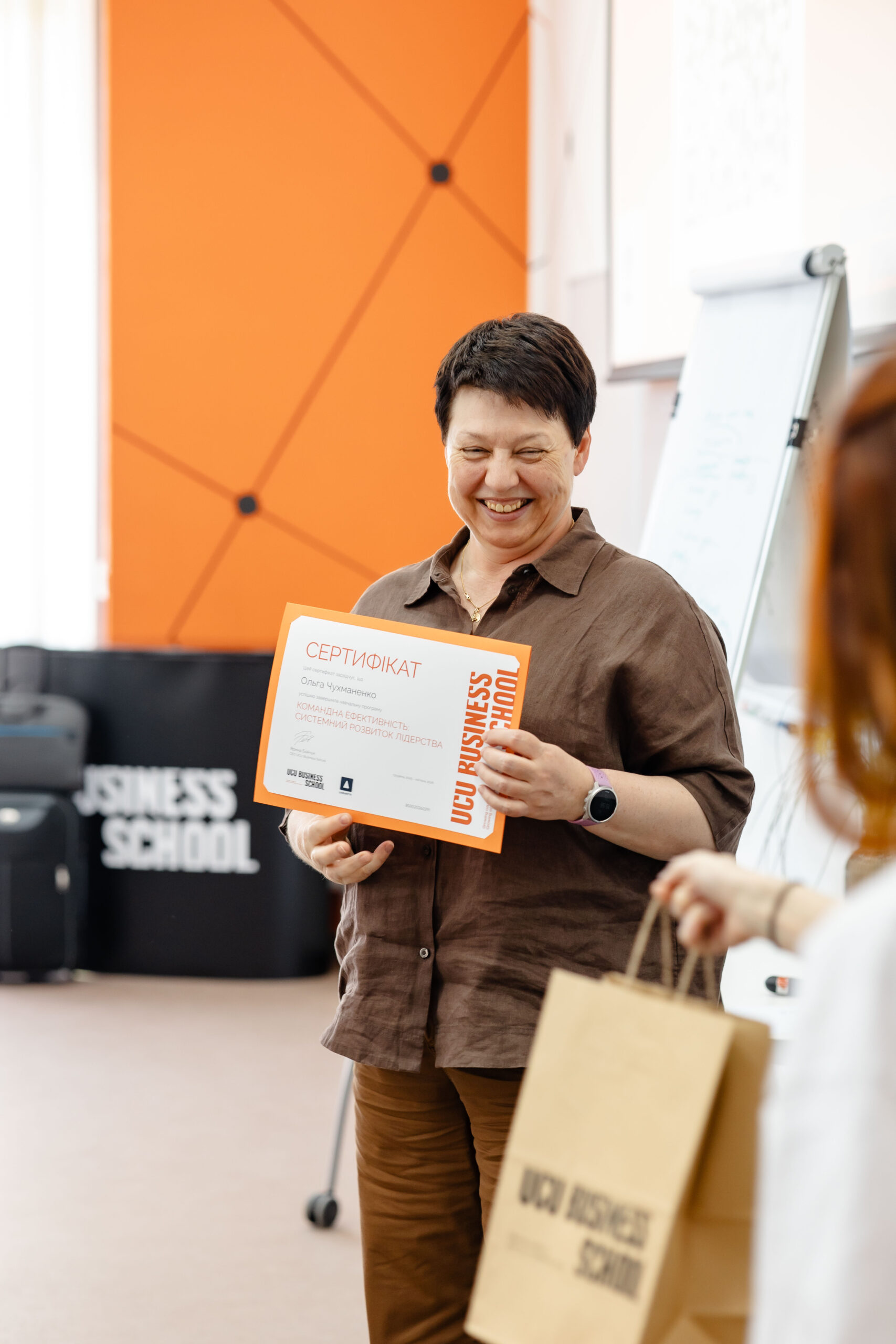 She emphasizes that investing in personal development is a strategic move because, without a new knowledge base, a manager risks making poor decisions due to being “bogged down” in day-to-day issues.
The communications module turned out to be one of the most impactful for managers. Natalia Khomik, Marketing Director at Ukrnafta, shares that the practical tools for negotiation and idea advocacy proved most useful to her.
“My colleagues and I were saying: today’s module (on communications) is probably the strongest. All the managers are gathered here, and the main tool for everyone’s work is communication and reaching agreements—with everyone,” says Natalia.
According to her, the team has already begun implementing Valery Pekar’s “color management” approach, which helps better understand people’s personality types and build effective dialogue.
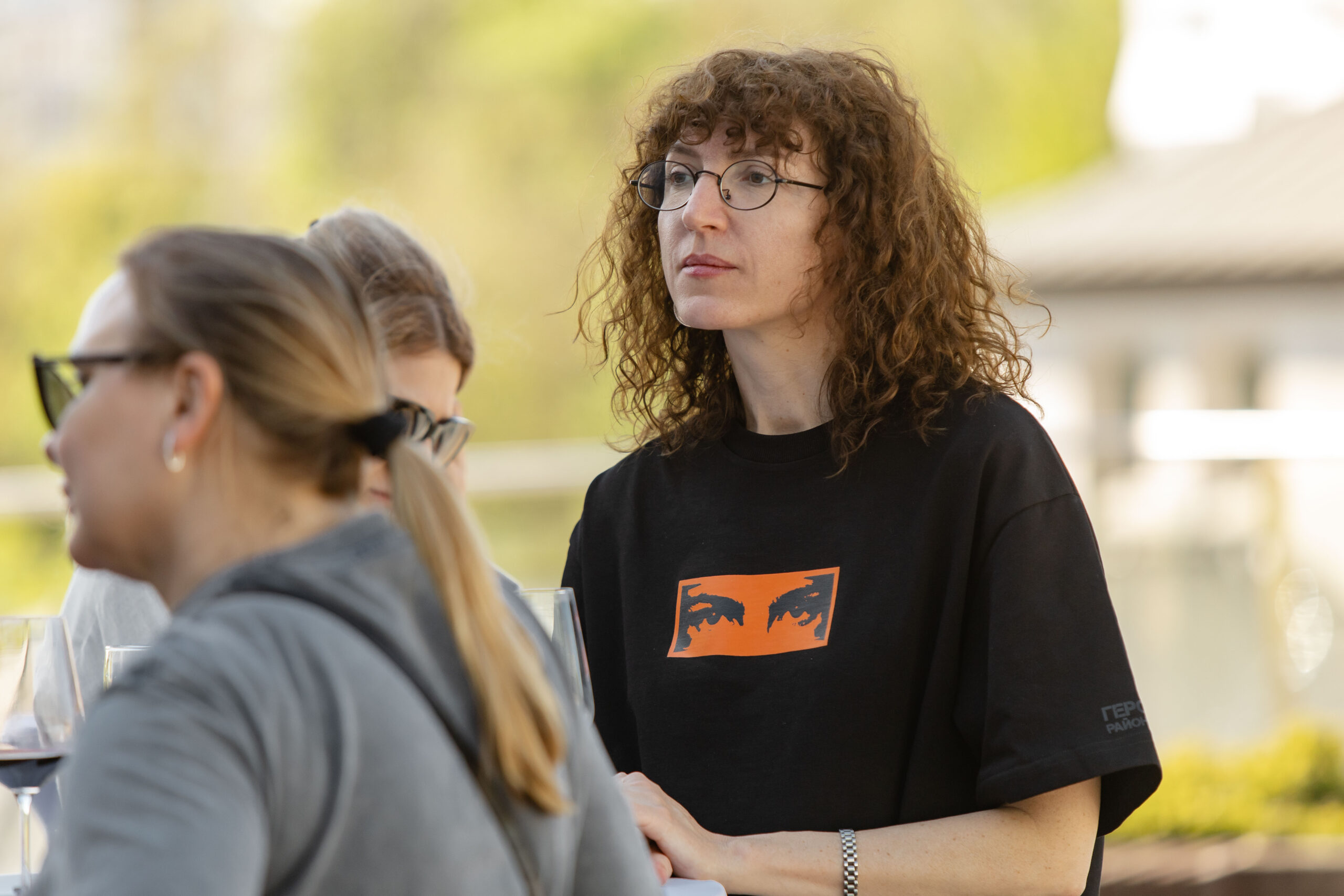 For a large company, it is important that all levels of management speak the same language. One of the company’s technical specialists noted that the training helps the CEO and middle managers better understand one another, which makes meetings and brainstorming sessions significantly more effective.
Special attention was paid to finance. Participants are already actively applying the knowledge they gained to calculate investment cases, taking into account inflation and the risks of martial law.
“We have a smaller gap between planned and actual figures thanks to a more detailed NPV calculation,” notes Roman Kolodyazhny, Director of PJSC “Ukrnafta.”
In addition to new knowledge, corporate training at UCU has become a powerful tool for team building. Given the high operational workload, physical attendance at training sessions is practically the only opportunity for top management to fully immerse themselves in the process.
Olga Chukhmanenko adds that solving case studies together allows one to see colleagues not as abstract managers, but as real people with their own skills and needs:
“You start to feel like part of the team in a different way.”
For Ukrnafta, corporate training became more than just an educational course; it was an opportunity to align the vision, refine management tools, and reach a new level of teamwork.
Would you like to align your team and equip it with modern management tools? Learn more about corporate training opportunities at the UCU Business School. We develop programs tailored to the specific challenges in your industry.