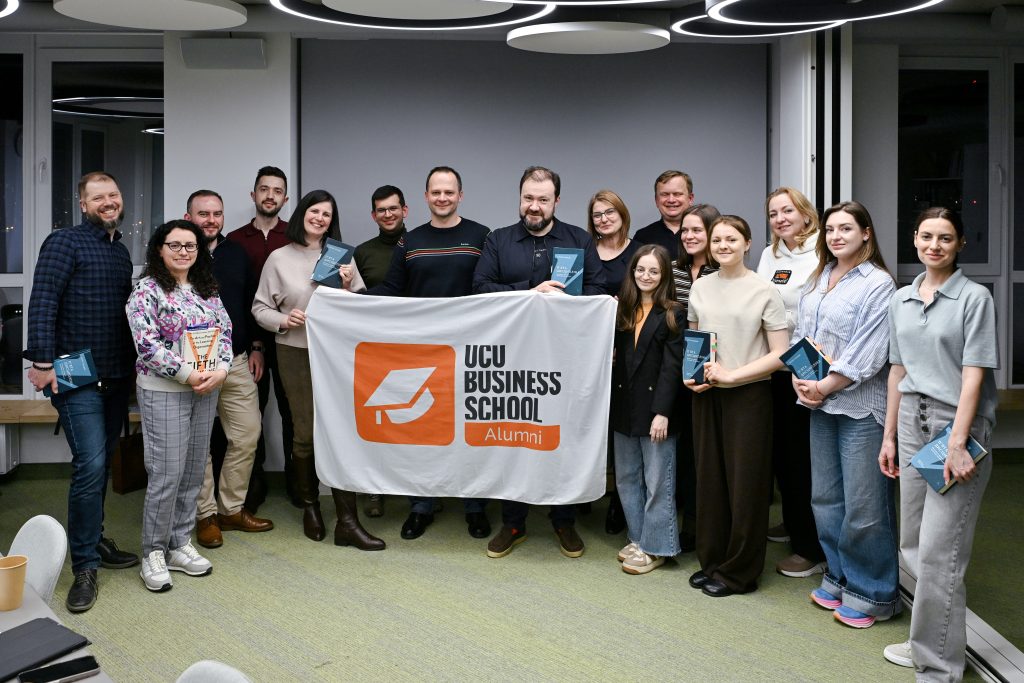







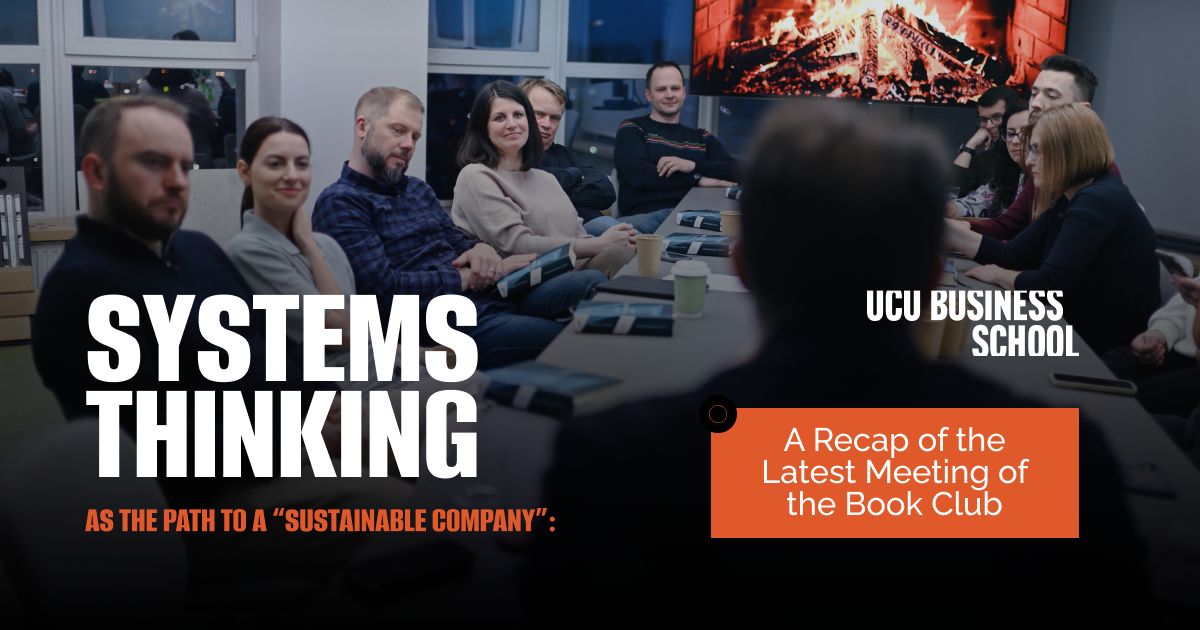
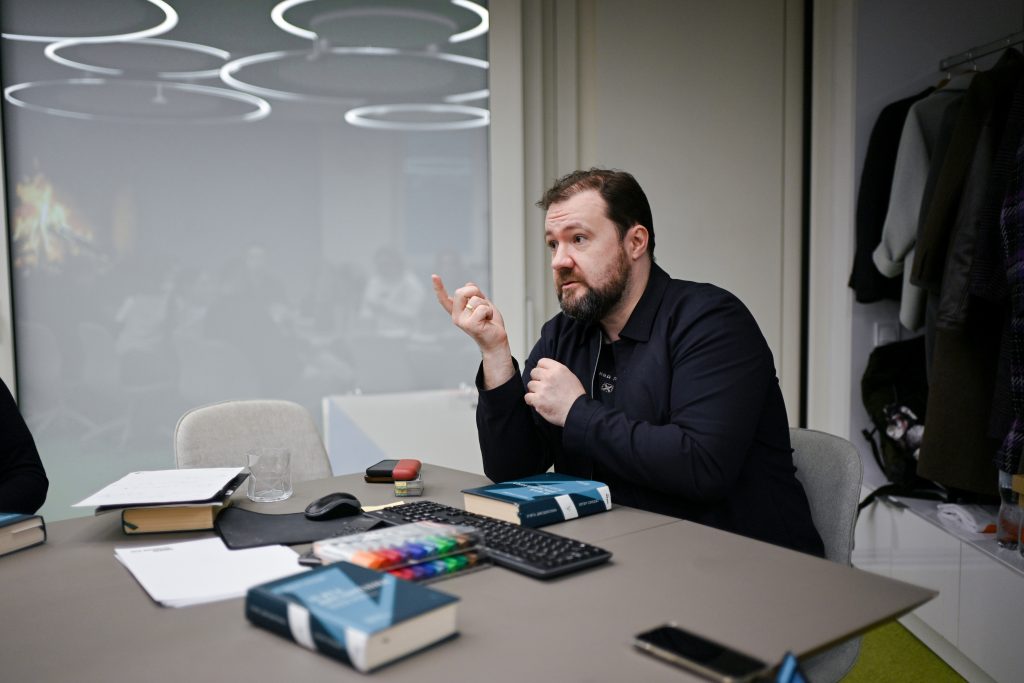
As part of the Book Club — created to bring together UCU Business School alumni through shared reading and the exchange of experiences — a recent session focused on the concepts of systems thinking. The keynote speaker was Yulian Chaplinskyi — renowned architect and urbanist, former Chief Architect of Lviv and Deputy Minister, now CEO of AVR Development, and a graduate of the Key Executive MBA program at UCU Business School.
The meeting took place at AVR Development and centered on the ideas from Peter Senge’s The Fifth Discipline: The Art and Practice of the Learning Organization, as well as their practical application in managing modern organizations. Participants reflected on business transformation, overcoming cynicism, and finding systemic solutions in times of complexity and uncertainty.
The Company as a Living Ecosystem
Yulian Chaplinskyi emphasized that modern businesses should move away from rigid hierarchies toward a model more akin to a natural ecosystem. In his view, systems thinking enables leaders to see not linear cause-and-effect relationships, but complex interdependencies.
“The paradox is that The Fifth Discipline seems to be about business, which demands precision, yet a company can be imagined as a tropical forest. It may look like chaos, but everything functions in harmony, and everyone thrives—the insect, the lion, and the palm tree alike. To me, this is about a constantly moving molecular structure, and that is what we need to understand first.”
This philosophy became the foundation for transforming his own company: in 2015, the brand “Chaplinskyi & Partners” evolved into AVR Development, shifting the focus from the individual leader to team collaboration and shared responsibility.
The idea resonated strongly with participants, sparking discussion about the importance of leaders “letting go” of control and allowing systems to self-regulate.
The Five Disciplines, Overcoming Resistance, and a Culture of Reflection
A significant part of the discussion was devoted to the five core components of a learning-oriented organization: systems thinking, personal mastery, mental models, shared vision, and team-based learning. Valeriia Kozlova, MBA Program Curator, also introduced reflection practices, including the EQ Boost technique, which Chaplinskyi referred to as a “sixth discipline.”
Participants noted that the biggest barrier to innovation is often not the lack of technology, but resistance within the system itself. Rigid instructions and an “efficiency tyranny” imposed by overly rigid KPIs can hinder development, turning into invisible constraints.

Drawing on his own experience, Chaplinskyi highlighted that one of the key obstacles to innovation is internal closedness and “silent consent” within teams. Systems thinking helps identify the factors that slow down progress and transform them into levers for growth. Among the most dangerous “blockers,” he identified cynicism, which erodes organizational culture.
“A cynic is a disappointed idealist, and such a person can become a bottleneck for the entire system. We try to counter cynicism through team games, workshops, and openness, as results are always better when achieved collectively than when you’re working on something on your own. People who are prone to idealization burn out easily, so reflection is essential to bring them back into a productive state.”
Ultimately, participants agreed that overcoming resistance is only possible when there is a commitment to truth within the team and permission for productive conflict of ideas. As alumni noted during the discussion, people do not resist change itself — they resist being changed without their consent. This is why the joint development of a shared vision is essential to the success of any transformation.
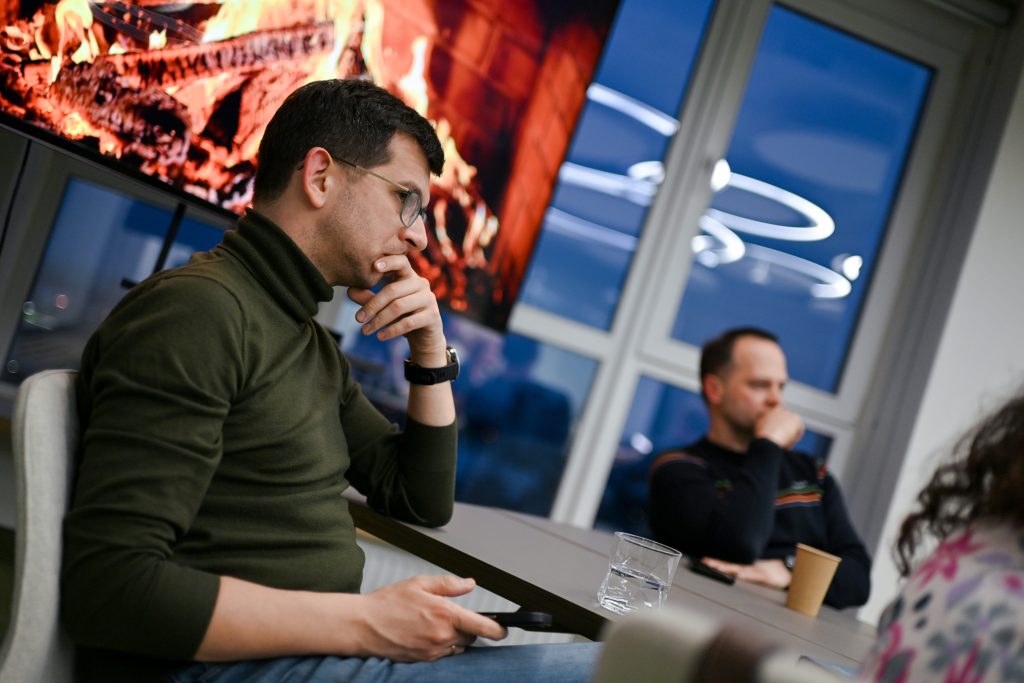
In response to these challenges, the community explored the practice of building a culture of open reflection to reduce fear and foster transparency within teams.
“We start and end our meetings with a short reflection: what we bring in and what we leave with. When people are not afraid to say that they feel overwhelmed by their task list or disappointed by setbacks, it works incredibly well. When we understand each other’s emotional state, we can truly listen and create a shared vision without unnecessary barriers,” Chaplinskyi shared.
Such an approach transforms routine workflows into systems that continuously learn to recognize emotions and remain open to new ideas.

Knowledge Economy and the “Enduring Company”
Chaplinskyi also noted that his MBA experience had a direct impact on the company’s financial performance. He gave an example of how a single idea for changing the approach to a client—developed through learning — brought the company €50,000 in revenue.Moreover, a systemic approach enabled process automation: AVR’s R&D department developed plugins that reduce design time from 120 hours to a single click.
The urbanist concluded by outlining his ambitious goal: to build an “everlasting company” capable of operating effectively regardless of its founders, grounded in a strong foundation of knowledge and values.
“Being a visionary leader is not about giving speeches or inspiring troops. My day looks very much like that of any manager. Being a visionary leader means solving everyday problems while constantly keeping your vision in mind.”

Concluding the Book Club session, the participants highlighted how the UCU Business School environment nurtures the “soil” where world-class theoretical concepts from books become practical tools driving the transformation of Ukrainian business.