








Yulian Chaplinsky is the CEO of the architecture and engineering firm AVR Development and a graduate of the Key Executive MBA 2025 program at UCU Business School. Julian has gone from founding his own company to transforming his business into an innovative ecosystem, having served as Lviv’s chief architect and Deputy Minister of Community and Territorial Development for European Integration.
To learn how to scale an architectural business, transform routine design into a company with scientific expertise, and reach a new level of strategic thinking, read the interview with Yulian Chaplinsky.
 Yulian, in 2015, your company changed its name from “Chaplinsky & Partners” to AVR Development. You stated that you were no longer building a firm named after yourself. What was the main motivation behind this move, and how has your business philosophy changed?
In reality, this wasn’t just a name change, but a complete transformation of the company—both formally and informally. When I founded my business in 2006, I was influenced by the trend of “star architects” such as Norman Foster, Richard Meier, or Zaha Hadid. Back then, it seemed that a firm bearing one’s name was about responsibility: you stand behind the product with your surname, and that obligates you, because your family’s reputation is on the line.
However, things turned out differently in Ukraine. The largest team we ever had under the name “Chaplinsky & Partners” consisted of about 40 people. In 2015, I was offered the position of chief city architect, but under the law, I was not allowed to engage in business activities. It would have been strange to leave a company bearing my name while serving as a public official. During the nearly six years I was away from the business, the company had nurtured leading specialists who decided to rename it AVR Development.
When I returned in 2019, there was no point in renaming the company back to its original name. The team had grown to 80 people, with its own leadership and new cultural patterns. It became clear that it was impossible to organize such a large group under a single name. Moreover, I realized that architects in Ukraine are more likely to unite around an idea than around someone’s surname. My ambition for “stardom” faded after working at the city council and the ministry. When you see the overarching systems and the massive problems facing cities, chasing after your own vanity becomes too petty. There are far bigger problems, and solving them will have a greater impact than searching for your own style.
 The full-scale invasion posed a challenge for every business. How did AVR Development weather the first months of the war?
The challenge was the same as for everyone else—to survive. Many people left, especially young people and women. We downsized our team a bit, but not drastically—we were left with about 80 people. The office was empty for the first few months—people were dealing with their own problems. We started communicating with our main clients. It turned out that people had flocked to them en masse, demanding refunds, but the money had already been invested in materials. So the clients asked, “Finish the construction and hand over the apartments to us.” This required working documentation.
In 2022, we generated 38% of the revenue we had in 2021. I thought 2023 would be the same, but we unexpectedly reached 92% of the pre-war level. The market began to recover, and old projects were revived. However, it was precisely at this time that my partner, Roman, and I began to experience some tension—a “midlife crisis” for our business. We couldn’t form a shared vision amid the uncertainty. I always leaned toward the optimistic scenario, while Roman, as a financier, leaned toward the pessimistic one. At one point during this back-and-forth, Roman said, “Let’s go get an MBA. Maybe we’ll hear at least one phrase there that will sway us one way or the other.” That’s how we ended up at the UCU Business School.
You might be interested in: Education Enlightens, or How a Leader Can Strengthen Their Position in Times of Crisis
You studied alongside your long-time partner. How did that shared experience at the UCU Business School influence your relationship and the company’s operations?
Studying together was extremely beneficial. We had a six-year hiatus in our joint business, and its effects are still felt today. We developed different habits: I got used to delegating authority through my work in senior positions, while Roman was more accustomed to controlling processes manually. These differences in approach were critical.
At business school, it was interesting to observe how differently we reacted to the same information. We were very lucky with our mentor, Valeria Kozlova (former director of the master’s program), and with our group. It was a synergy of intellectually and emotionally powerful people. We rushed through the modules at full speed because we were looking forward to meeting with friends. Reviewing case studies through the eyes of an IT specialist, an athlete, or a fellow architect was incredibly enriching. It’s a kind of informational metabolism that you can’t get anywhere else.
 The training helped us change our communication approaches. Roman used to go to work to “make friends.” For him, relationships were the main criterion. For me, however, results came first, which is why I could be harsh with people. After classes with Valeria Kozlova, we discovered techniques for reflection and reading emotions. I realized that if a person is paralyzed by fear, no amount of pressure will yield results. Roman, on the other hand, realized that he shouldn’t just chase after maximum comfort in communication. We both changed our approaches, specifically at the UCU Business School.
One of the key insights from your training was the concept of “layers” in business scaling. What does this mean for AVR Development?
Before the training, I thought of scaling solely in terms of numbers and people. But it turns out there are invisible “layers” that hinder growth, like a transparent film. These are the layers of HR, communications, financial strategy, emotional intelligence, innovation, and marketing. You can’t just grab three out of ten layers and hope for success. If you haven’t worked on HR, you’ll face people issues when you grow by 50%. Without a financial strategy, you don’t know where you’re headed.
Learning isn’t just a direction; it’s about forming an “ozone layer” around your business. Only when you create this atmosphere can you understand how to move into “space” and which solar system you’re in. We’ve identified our “roadblocks.” We used to think we were just designers. Now we understand that we can provide services in completely different fields.
Clarifying partners’ choices and intent has become very important. I even came up with a parable about a yacht: friends decided to buy one, but one wanted to take girls out, another—children, a third—to fish in silence, and a fourth—to make money as a taxi. They all chose the yacht, but their intentions varied. It’s the same in business: if one person just wants to buy a mansion and another wants to conquer the universe, the first will become an anchor for the second. This needs to be discussed at the outset, and the UCU Business School gave us the space for such conversations.
 People call you an “emergentor”—someone who creates and nurtures living systems. How has this vision transformed your role as CEO and the company’s structure?
This description from my classmates really resonates with me. Emergence is a system’s ability to create new systems where 1+1 equals more than two. When I became CEO, I came to the team with a message: people say we’re a “slave ship” or a “project farm.” But I want to transform AVR into a research and development company that doesn’t just design, but draws conclusions.
Today, we have R&D and Delivery departments. We analyze case studies and reflect on our mistakes. Now, when I meet with a client, I don’t just show them a picture. I say: “We’ve completed 30 shopping centers. Here’s a list of what didn’t work and what we’ll never repeat, and here are our unique strengths.” This strengthens our expertise incredibly. We no longer have problems recruiting people; on the contrary, we’ve built such internal momentum for self-education that it’s hard for us to find staff at the right level.
I’ve filled the company with multidisciplinary specialists: now we have not only architects, but also financial experts, BIM specialists, and programmers who create our own IT products for design. My strength lies in “setting” new initiatives in motion so that they run on their own and deliver results. That is what building systems is all about.
 The topic of your thesis project for the Key Executive MBA program at the UCU Business School was building a business ecosystem based on BIM technologies. How are you putting these ideas into practice?
My thesis isn’t just a piece of paper; it’s a research project we continue to invest in. I’ve worked in various roles and understand the “pain points” of every position in construction—from estimator to developer. These pain points are constant changes and the inability to stay within budget. My idea is to solve this problem through digitalization and an ecosystem.
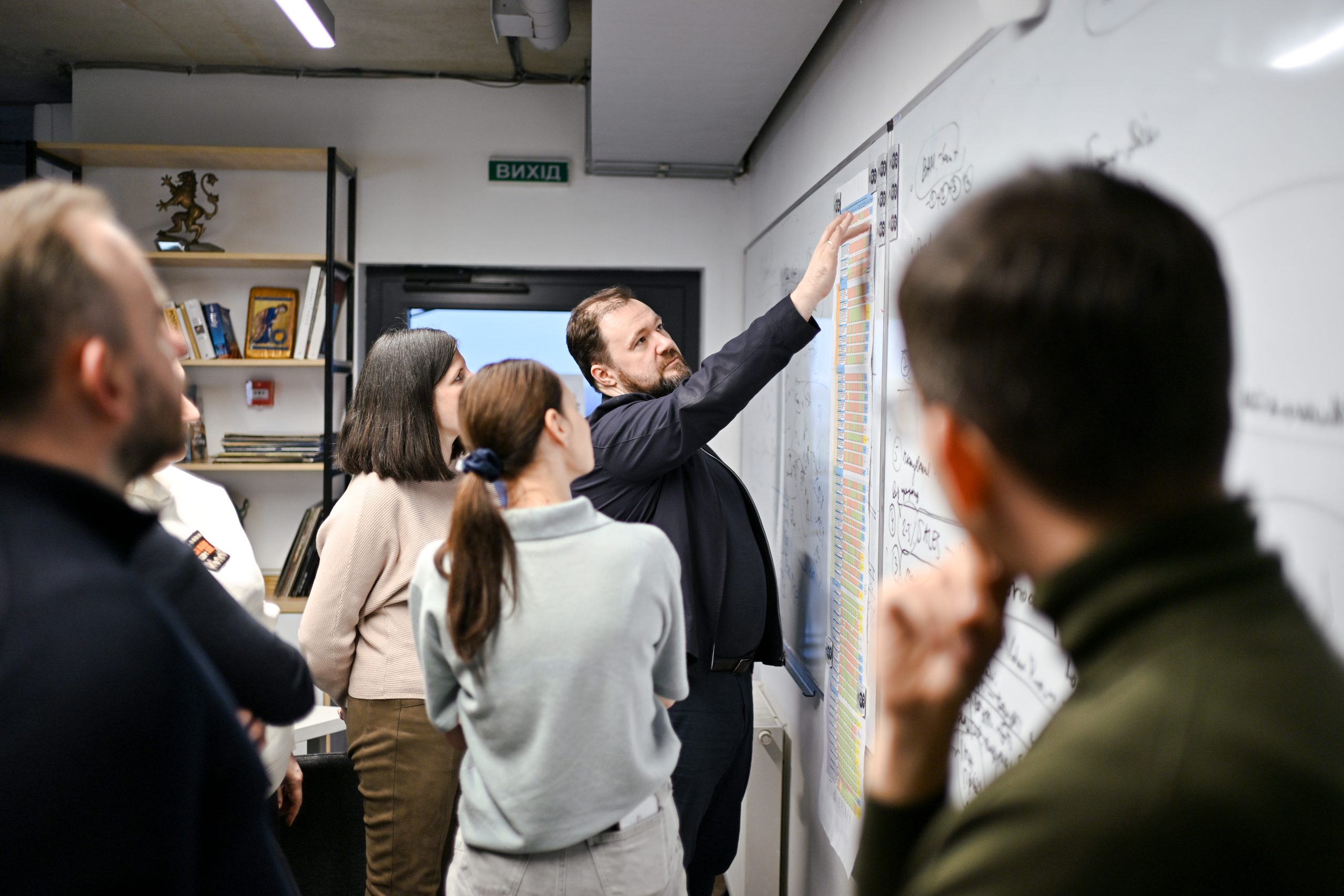
We’re currently testing this product on real-world projects. For example, we calculate the construction cost in real time: we can select just the windows or facades and see the price. Recently, I gathered my group from the UCU Business School at our office and showed them where we are now. They witnessed the birth of this idea in the modules and were moved by the result.
The professors had a huge impact on this project. Olena Maltseva’s module on Value Propositions helped us find the right answer to the client’s “pain.” Valeria Kozlova’s systems theory provided the structure. Yaroslav Hrytsak, with his “exit from Plato’s cave,” inspired a world of ideas. Without the ethics and energy they talk about at UCU, it’s impossible to get anything done. You can know all the formulas, but without that fire, you’ll just be scribbling graphs on the wall of your cave.
You mentioned “Plato’s Allegory of the Cave.” To what extent has the UCU Business School changed your worldview and personal life?
It’s the best thing that’s happened to me in the last 10 years. It wasn’t just a journey into the world of knowledge, but a journey to my true self—to understand who I am, what my purpose is, and what tools I need. I’ve gained so much joy and love for the world that my wife even joked, “Are you going to some kind of theological school?”
 The cultural studies course had an unexpectedly strong impact on me. I went into it with skepticism, but now I believe it’s the primary subject from which any education should begin. Cultural studies are a safeguard against judgment. When you realize that a person simply exists within a different cultural framework, your aggression disappears.
We often talk about transformation, but at the UCU Business School, I discovered the concept of “transfiguration” in a new way. At the Transfiguration Cathedral in Chernihiv, it dawned on me: the Lord did not transform—he was always that way. It was the apostles who were transfigured, because they were able to see him as he truly is. This is the goal of the Business School—the transfiguration of our consciousness, so that we may become free from limitations and “anchors.”
What advice would you give to leaders who are currently hesitating about whether to invest time in learning during wartime?
For a leader, it’s important not only to have the will and knowledge, but also to be ready to conquer the whole world and, in an instant, let it all go. That is true freedom. Every day, I program myself to accept that all of this might not last, which helps me avoid desperately clinging to the outcome.
A stable world obscures leadership opportunities. In Ukraine, now is a wonderful time for self-improvement, because we are in a state of total instability. It is precisely here that you can tap into potential you never even knew you had. I am certain that in no other country in the world would I have achieved what I have here.
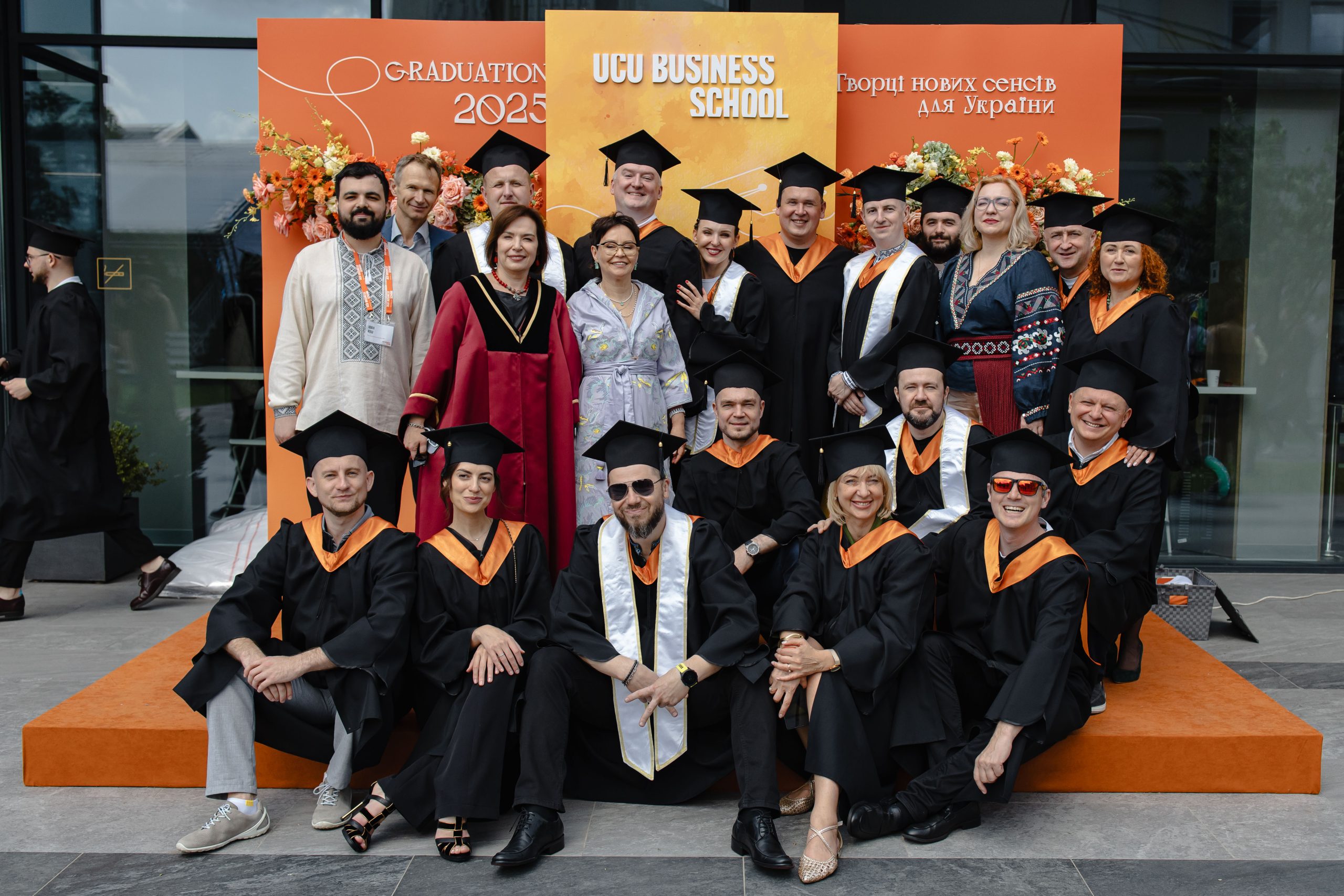 If you’re considering applying to the UCU Business School, ask yourself if you’re ready for a painful transformation. Our group sometimes cried during modules due to emotional stress. But if you feel limited in yourself or in business, the school will definitely provide direction, hope, and techniques. Whether you use them or not is entirely up to you. Business school is like a NASA space telescope: yesterday you were peering through a telescope at a single star, and today an entire galaxy has opened up before you. And going back to your little garden plot is just plain boring.
Are you ready to shift your approach from a “project farm” to an intellectual ecosystem, just as Yulian Chaplinsky did? The UCU Business School provides direction, hope, and concrete techniques for transforming your company through the Key Executive MBA program. Learn more about the master’s programs for management.