








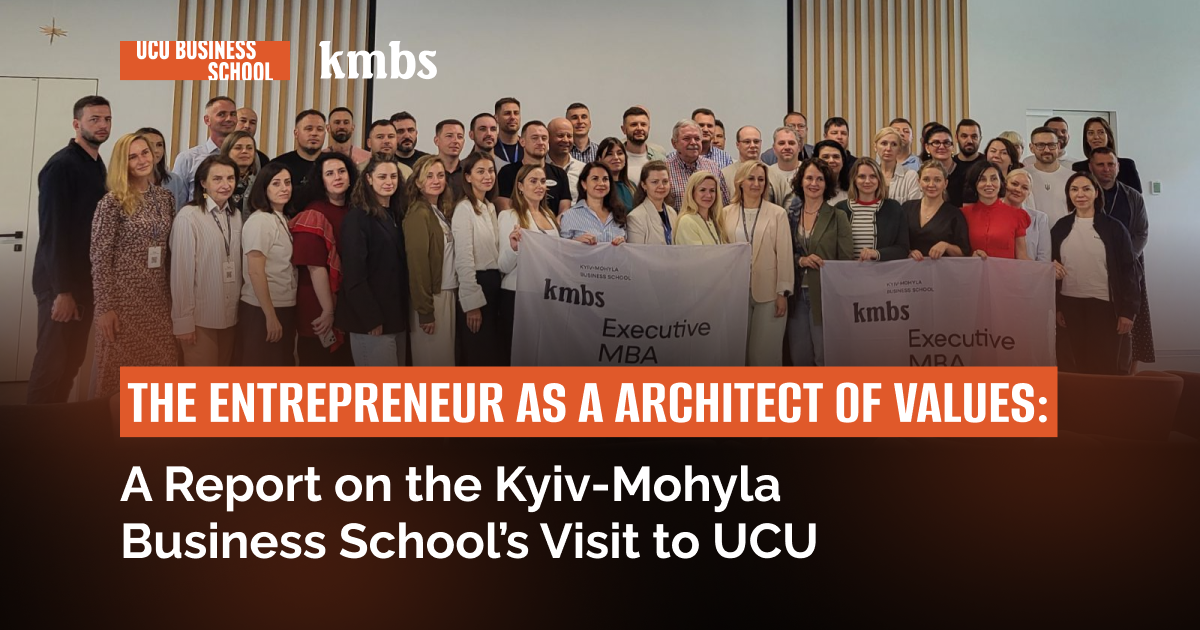
Recently, participants of programs at Kyiv-Mohyla Business School visited Ukrainian Catholic University (UCU). During the visit, Sofia Opatska, Founding Dean of UCU Business School and Vice Rector for Strategic Development at UCU, Myroslav Marynovych, Advisor to the UCU Rector and former dissident, Yaryna Boychuk, CEO of UCU Business School, and Olena Maltseva, Marketing Lecturer and MBA Program Director at Kyiv-Mohyla Business School, discussed management experience, the philosophy of service, and the ethics of responsibility.
 A University That Serves: Bearing Witness in Action
Opening the meeting, Sofia Opatska, Founding Dean of UCU Business School and Vice Rector for Strategic Development at UCU, introduced UCU’s model as a university that serves — a place where education is about more than acquiring knowledge; it is about building a living, learning community.
The UCU community is grounded in three core principles — witnessing, serving, and communicating — as well as the “2Ms” — martyrs and marginalized people. Together, these principles shape the university’s commitment to openness, inclusion, and service.
“We see our task and our mission as being about more than simply transmitting knowledge. We describe it as a living learning community — a community that learns together. You can talk a lot about how something should be done, but what really matters is whether you can demonstrate it yourself, 24/7,” Sofia Opatska explained.
Lessons from Metropolitan Andrey: Leadership as a Form of Service
A central part of the visit was a lecture by Myroslav Marynovych, Advisor to the UCU Rector and former dissident, devoted to the legacy of Metropolitan Andrey Sheptytsky. Marynovych urged leaders not to replace values with short-term interests and emphasized the ethical responsibility that business has toward society.
“Remember that you will never achieve anything truly beneficial for your people by acting against God’s law. Interests very often tempt us to set values aside and pursue what seems beneficial in the moment. And that always ends badly,” Myroslav Marynovych cautioned.
Speaking about national unity, he used the metaphor of a choir, in which different voices need to sound in the same key:
“Ukraine will remain a mosaic — we will never make it homogeneous. The only way to preserve its integrity is through unity in diversity. The problem is not that we speak with different voices, but that in the past we sang in different keys.”
On Maturity and Changing the Way We Think
A conversation between Yaryna Boychuk, CEO of UCU Business School, and Olena Maltseva, a marketing lecturer and MBA Program Director at Kyiv-Mohyla Business School, focused on the partnership between a business school and its students.
Olena Maltseva emphasized that business education is, above all, about participants taking responsibility for their own development.
“We say that we can give you a lot, but you will take as much from it as you are able to take. We genuinely expect participants to engage as partners. It is not about ‘you owe me something’; it is about interaction in which the participant has to be ready and willing to learn,” she noted.
Continuing the discussion about the mission of business education, Yaryna Boychuk emphasized the importance of human capital in modern management. The business community, she argued, should become an intellectual and ethical foundation for society:
“After the war, Ukrainian society should embrace a genuine culture of entrepreneurship. But it should be a culture of the entrepreneur as a builder — someone who does not simply make money, but creates value and takes responsibility for the development of their community and the country as a whole.”
Despite operating in different contexts, the two schools are united by the idea of developing an empowered leader who understands their role in building the country.
The meeting became an opportunity for reflection, bringing the two schools together around a shared vision of the holistic development of both the individual and the country.